
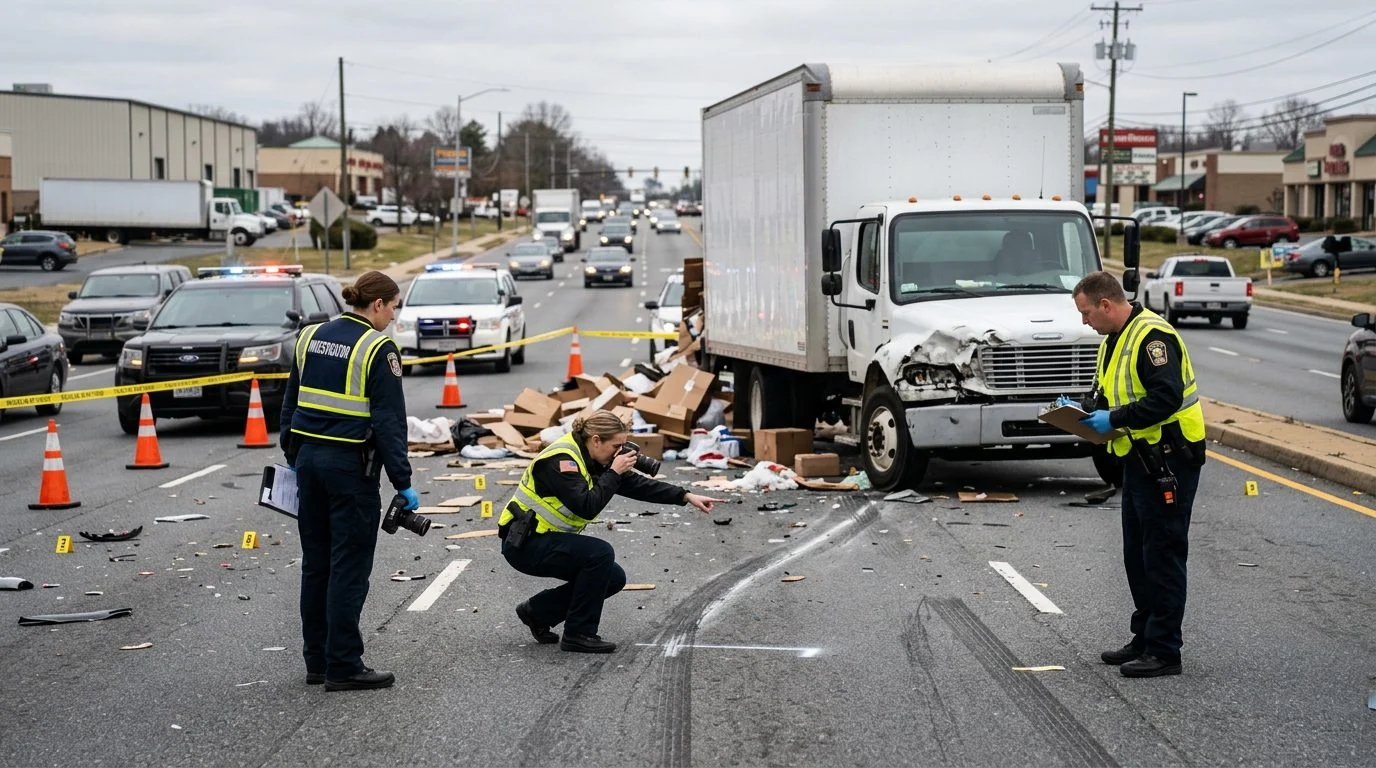
Commercial Vehicle Crashes | Virginia
When a Commercial Vehicle Crash Involves Conduct Beyond Ordinary Carelessness
How punitive damages work in Virginia after a truck or commercial vehicle crash, explained in plain language by Correll Law Firm, with offices in Winchester and Harrisonburg.
Published November 2, 2026
Punitive damages can apply in a commercial vehicle crash case in Virginia, but only when the defendant’s conduct meets a specific legal standard. They are meant to punish that conduct, not to cover medical bills or other losses. This guide explains the standard, how it applies in wrongful death and catastrophic injury cases, and which deadlines to keep in view.
What Punitive Damages Are
Punitive damages are money awarded beyond compensation. Their purpose is to punish a defendant’s conduct and discourage similar conduct.
Compensatory damages (money for losses) cover the harm tied to the injury, such as medical bills, lost income and the cost of ongoing care. They aim to make the injured person whole, as far as money can.
Punitive damages answer a different question. The issue is how the defendant acted, not only how much the injured person lost. A case can involve large losses and still lack a punitive claim, because the conduct did not meet the legal standard.
Commercial vehicle cases raise this question often. A company and its driver make choices over time about scheduling, maintenance and record keeping. Those choices can be examined as evidence of how the defendant acted. Keep the two ideas separate: one measures the harm, the other measures the conduct.
Not sure what your next step is?
Talk it through with Correll Law Firm — we can walk you through how a situation like yours is usually handled and what your options are.
The Virginia Standard for Punitive Damages
The standard looks at the defendant’s state of mind and conduct. The seriousness of the injury alone does not decide it.
Virginia allows punitive damages for actual malice, or for willful or wanton conduct or recklessness showing a conscious disregard for the safety of others, capped at $350,000 (Va. Code § 8.01-38.1).
The jury must find that the conduct met this standard before punitive damages can be awarded. The statute sets a maximum. It does not promise any award.
What Willful and Wanton Conduct Can Look Like in a Commercial Vehicle Crash
The examples below are hypothetical illustrations. They are not descriptions of any real crash or client.
- Illustration one: A commercial driver drinks before driving and then causes a crash. In a personal injury or death case arising from the operation of a motor vehicle, Virginia law allows the finder of fact, in its discretion, to award punitive damages if the evidence proves that the defendant acted with malice toward the plaintiff or that the defendant’s conduct was so willful or wanton as to show a conscious disregard for the rights of others. The statute also sets out specific alcohol-related circumstances in which a driver’s conduct is deemed to meet that standard (Va. Code § 8.01-44.5). Federal rules also bar drivers from using alcohol within 4 hours before going on duty or operating a commercial motor vehicle (49 C.F.R. § 392.5).
- Illustration two: A driver keeps driving past federal limits on driving time and rest, then causes a crash while fatigued. A driver may not operate a commercial motor vehicle when fatigue, illness, or any other cause has impaired, or is so likely to become impaired, the driver’s ability or alertness as to make it unsafe, except that in a grave emergency where compliance would increase the hazard to occupants of the commercial motor vehicle or other highway users, the driver may continue to the nearest place where that hazard is removed (49 C.F.R. § 392.3).
- Illustration three: A motor carrier makes intentionally false entries in driver logs or maintenance records, and a crash follows. Federal rules bar a motor carrier from making fraudulent or intentionally false entries in required records (49 C.F.R. § 390.35).
A rule violation is a starting point, not the whole test. Whether any of these examples meets the Virginia standard depends on the facts. The same type of conduct does not automatically meet it.
Punitive Damages in Wrongful Death Cases
A wrongful death case follows its own filing rules and its own list of damages. Virginia wrongful death actions are filed as follows. A Virginia wrongful death action is filed by the decedent’s personal representative within two years of the death (Va. Code §§ 8.01-50(C), 8.01-244(B)), on behalf of the family members the statute protects.
Virginia wrongful death damages cover the family’s sorrow, mental anguish and loss of the decedent’s companionship, guidance and care; lost income and services; medical expenses from the injury; funeral expenses; and, for willful or wanton conduct, punitive damages (Va. Code § 8.01-52).
Family members do not file the case themselves. They share in the recovery. The standard for punitive damages in a wrongful death action is willful or wanton conduct, or such recklessness as evinces a conscious disregard for the safety of others, and that standard controls whether punitive damages are part of the recovery.
Catastrophic Brain and Spinal Cord Injuries in Commercial Vehicle Cases
Catastrophic injuries affect the size of a case, but they do not decide whether punitive damages apply.
Traumatic brain injury and spinal cord injury often involve extended medical care. The medical records of that care become evidence. They show what happened to the person’s body over time.
That record answers a different question than the defendant’s conduct. A detailed injury record does not prove willful or wanton conduct. Proof of conduct does not prove the full extent of an injury. Each must be shown on its own.
The firm handles catastrophic injuries, including traumatic brain injury and spinal cord injury, from crashes across its service area. The firm’s page on punitive damages in catastrophic injury cases in Virginia covers this topic in more detail: punitive damages in catastrophic injury cases.
Deadlines to Keep in View
A lawsuit clock is one of the first dates to check after a crash.
Virginia generally allows two years from the date of injury to file a personal injury lawsuit (Va. Code § 8.01-243(A)); the clock runs from the date of injury, not the date of discovery, with narrow exceptions.
Some claims carry notice requirements that run out sooner. Those rules are separate from the lawsuit deadline.
Crash reporting is a separate duty with its own timing. Virginia requires a driver involved in a crash with injury or death to stop and report it to police immediately (Va. Code §§ 46.2-371, 46.2-894).
The two-year period is the deadline to file a lawsuit, not the deadline to report a crash (Va. Code § 8.01-243).
Not sure what your next step is?
Talk it through with Correll Law Firm — we can walk you through how a situation like yours is usually handled and what your options are.
How Commercial Vehicle Crash Cases Are Handled in Richmond and Henrico County
The firm is based in Winchester and has an office in Harrisonburg. It represents people from the Shenandoah Valley to Richmond and Henrico County who were hurt in commercial vehicle crashes or who lost a family member in one.
Readers in Richmond and Henrico County face the same core questions: what the driver and company did, how the injury affected the person, and which deadlines apply. The firm’s local page for Richmond and Henrico County covers commercial vehicle crash claims in that area.
Evidence such as driver logs, maintenance files and crash reports is often central in these cases.

Key Points to Understand Before Reading Further
In a personal injury or death action arising from the operation of a motor vehicle, engine or train, the finder of fact may, in its discretion, award punitive damages only if the evidence proves malice toward the plaintiff or willful or wanton conduct showing a conscious disregard for the rights of others (Va. Code § 8.01-44.5). No award can exceed the statutory maximum.
Wrongful death and injury claims each have their own filing timelines. Check both, and do not assume one clock covers the other. For the broader picture of how these claims work, read the firm’s guide on commercial vehicle accidents in Virginia.
Can punitive damages apply after a Virginia truck crash?
They can, but only when the conduct meets the Virginia standard described above.
Does drunk driving make punitive damages more likely?
Drunk driving can be part of the proof under Virginia law. Even then, the finder of fact decides in its discretion whether to award punitive damages.
Does a jury know about the cap on punitive damages?
No. The jury is not told about the cap, and a judge reduces any larger award to the maximum (Va. Code § 8.01-38.1).