
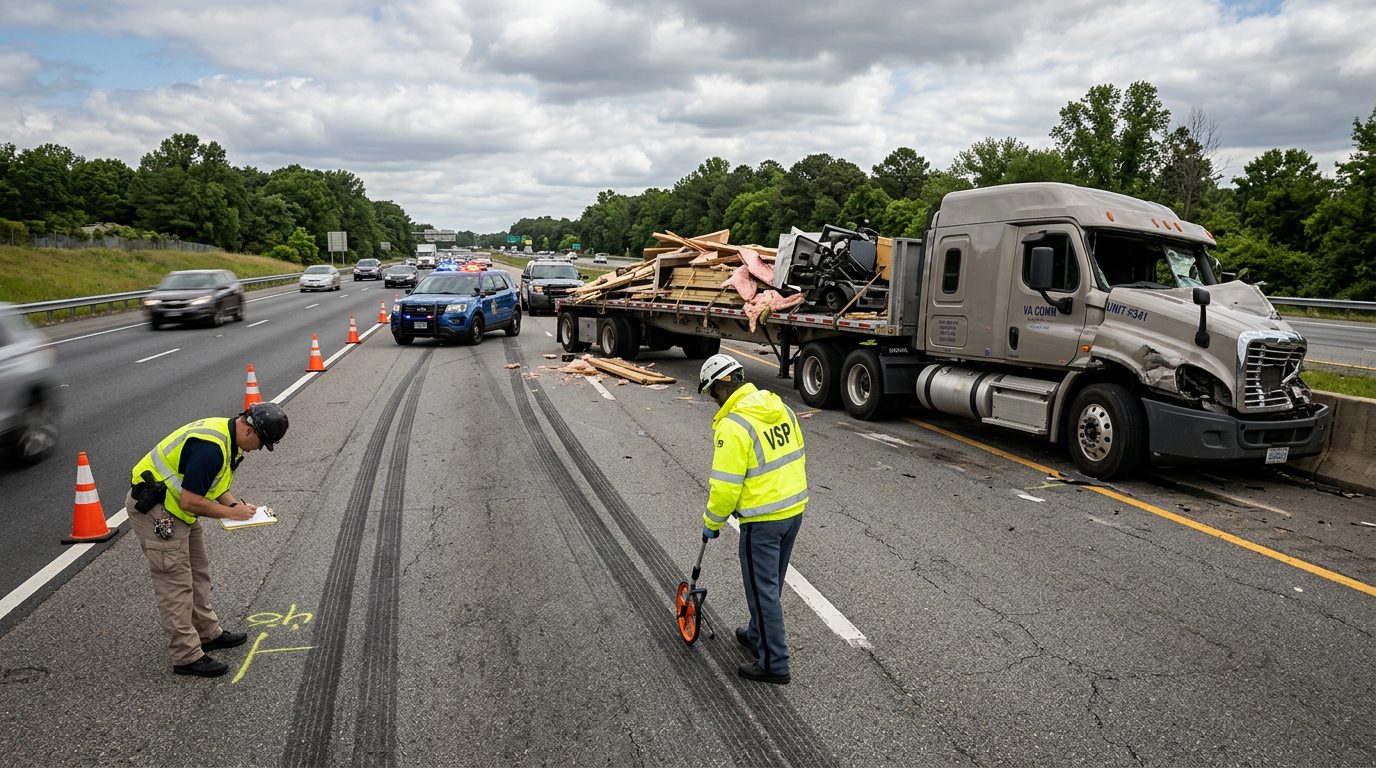
Truck & Commercial Vehicle Accidents | Virginia
What Makes a Vehicle a Commercial Motor Vehicle Under Federal Rules?
A plain-language guide to how federal law defines a commercial motor vehicle, why that label matters after a crash, and how it can affect the questions that follow.
Published November 2, 2026
What is a commercial motor vehicle? It is a vehicle that federal motor carrier safety rules can cover, based on its weight rating and how it is used. The term comes from federal regulation, so a vehicle can fall under it even when it looks like an ordinary car or van.
This page explains the federal definition in plain words. It is written for Virginia readers who are trying to understand a vehicle involved in a crash, or a vehicle they drive or ride in for work. Knowing the category can help you understand which records and rules might apply.
What the federal definition says
The definition is in 49 CFR § 390.5T, the federal section that defines terms used in the motor carrier safety rules. In plain terms, it describes the vehicles those rules can reach.
Those rules apply to commercial motor vehicles that move property or passengers in interstate commerce, which includes trade that crosses state lines and a trip between two places in one state when it is part of a shipment that begins or ends outside that state. The reach is set out in 49 CFR § 390.3T. This makes the definition a federal classification. It does not replace Virginia’s own vehicle rules.
The definition looks at more than one feature. Weight ratings matter, and so does how a vehicle is used. Knowing what is a commercial motor vehicle starts with the wording, not with a general idea of what a truck looks like. Some vehicles that look ordinary can still meet part of the definition.
If a commercial vehicle was part of your crash, you may have a claim, and the firm is glad to talk through your facts with you. Talk it through with Correll Law Firm — we can walk you through how a situation like yours is usually handled and what your options are.

The weight test: GVWR and GCWR
The weight test relies on ratings. The gross vehicle weight rating (GVWR) is the maximum weight a manufacturer rates a single vehicle to carry. The gross combined weight rating (GCWR) covers a vehicle and anything it tows.
Under 49 CFR § 390.5T, the combined figure (GCWR) is the greater of a value specified by the manufacturer of the power unit, if such value is displayed on the Federal Motor Vehicle Safety Standard (FMVSS) certification label required by the National Highway Traffic Safety Administration, or the sum of the ratings of the power unit and the towed unit or units, using whichever combination gives the highest value. The same section says the GCWR of a power unit is not used to define a commercial motor vehicle when that unit is not towing another vehicle.
Here is a hypothetical setup. A pickup driving alone is judged on its own rating. The same pickup hitched to a loaded trailer is judged on the combined figure. That is why a towing setup can be treated differently from the same truck driving alone.
Vehicles used like buses
49 CFR § 390.33 says that when a commercial motor vehicle of one type performs the functions normally performed by a commercial motor vehicle of another type, the rules apply as though it were that other type.
The regulation’s own example is a non-bus vehicle used to perform a bus’s functions. That vehicle is subject to the bus and passenger-transport rules.
Consider a hypothetical work van that a business uses to carry crews to job sites each day. Under this section, whenever a commercial motor vehicle of one type is used to perform the functions normally performed by a commercial motor vehicle of another type, the rules for that other type apply, so if a van that is already a commercial motor vehicle performs the functions a bus normally performs, the bus rules apply to it. Appearance alone does not decide the question.
Interstate and intrastate trips
The federal safety rules reach interstate trips directly, but some rules also reach trips that stay inside one state. The rules define intrastate commerce as trade, traffic or transportation in a state that is not described as interstate commerce, as shown in 49 CFR § 390.5T.
The commercial driver’s license rules in 49 CFR § 390.3T apply to every person who operates a commercial motor vehicle, as defined in § 383.5, in interstate or intrastate commerce, and to all employers of such persons. A trip that stays within Virginia can still raise federal questions, so the facts of the trip matter.
Carriers have duties too. The same section says every employer must know and comply with the regulations that apply to its operations. Every driver must be instructed on those regulations and must comply with them.
Work vans, buses and other borderline vehicles
Many work vehicles look ordinary, so the rating and the use are the facts to check. A vehicle may meet the definition for one job and not for another, depending on how it is used and rated.
A work van, a pickup pulling a trailer and a passenger car can look alike from the road. Their federal status can differ, because the rated weights, any towing setup and the actual use are different.
Classification depends on the facts of each vehicle. Gather the rated weights, note whether the vehicle tows anything, and describe how it is actually used. Then compare those facts with the wording of the definition.
Borderline cases are where confusion tends to start. A single detail, such as whether a trailer is attached, can change the analysis.

Why classification can matter in a Virginia crash claim
Knowing whether a vehicle is covered can matter, because some federal records and rules apply only to vehicles that meet the definition. For a motor carrier, 49 CFR § 391.51 requires a driver qualification file for each driver it employs. That file includes items such as the driver’s application for employment and motor vehicle records from licensing authorities.
The carrier keeps that file for as long as the driver works for it, and for three years after, except for records that paragraph (d) allows to be removed three years after their date of execution. Under 49 CFR § 396.21, periodic inspection reports must be kept for fourteen months from the report date.
Records like these can help show what the rules required of a carrier and its driver at the time of a crash. That is one reason to look at a vehicle’s classification early.
Virginia generally allows two years from the date of injury to file a personal injury lawsuit (Va. Code § 8.01-243(A)); the clock runs from the date of injury, not the date of discovery, with narrow exceptions. Some claims carry notice requirements that run out sooner. Under Va. Code § 8.01-243, subsection A, unless otherwise provided in this section or by other statute, every action for personal injuries, whatever the theory of recovery, shall be brought within two years after the cause of action accrues.
The firm represents people from the Shenandoah Valley to Richmond and Henrico County. For a broader view, see the firm’s Virginia commercial vehicle guide.
Quick answers
Is a work van a commercial motor vehicle?
It can be, depending on its weight rating and how it is used.
How long does a trucking company keep a driver’s file?
It keeps the file while the driver works there, and for three years after.
What is a commercial motor vehicle under federal rules?
It is a vehicle federal safety rules can cover, based on its weight rating and how it is used.