
Car and Truck Accidents | Virginia
Reporting a Virginia Crash: What to Know and Why Timing Matters
Clear answers for drivers and families who are unsure what happens after a crash, from the Shenandoah Valley to Richmond and Henrico County.
Published November 23, 2026
After a crash, the paperwork is easy to misread. Many people mix up three different clocks: the duty to report to police, the deadline to file a lawsuit, and the notice rules in an insurance policy.
This page explains how much time you have in Virginia for each one, based on the state’s statutes.
The short answer: report a crash with injury or death immediately
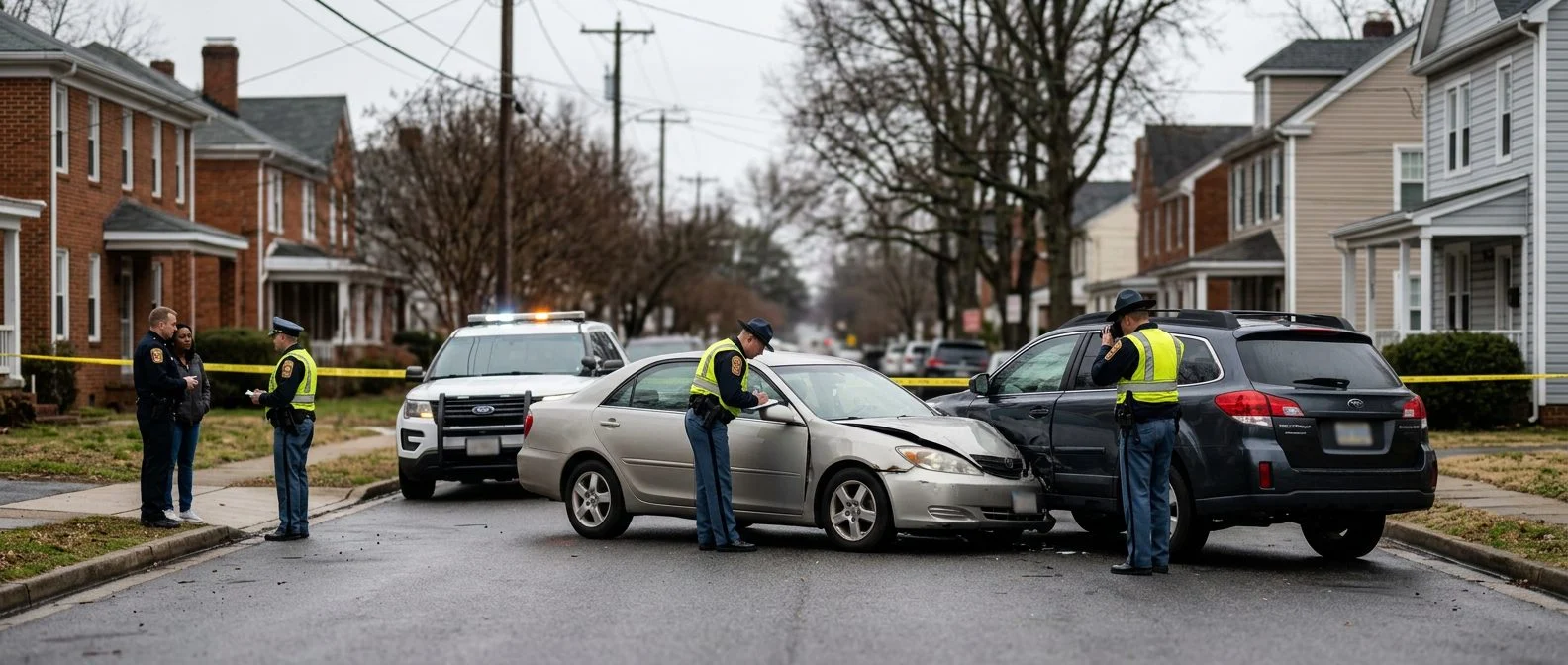
Virginia requires a driver involved in a crash with injury or death to stop and report it to police immediately (Va. Code §§ 46.2-371, 46.2-894). Immediately is the standard the statute uses. Under § 46.2-894, the driver reports his name, address, driver’s license number and vehicle registration number to the State Police or local law enforcement, to the injured person if able to understand it, or to the other driver, an occupant, or the custodian of damaged property.
If injuries keep the driver from reporting right away, the driver must report as soon as reasonably possible, under Va. Code § 46.2-894. A willful failure to report is a Class 4 misdemeanor under Va. Code § 46.2-371. A conviction under § 46.2-894 for a crash that causes injury or death is a Class 5 felony.
For a wider view of crashes involving big trucks and company vehicles, read the commercial vehicle crash guide.
If a crash left you or a family member hurt, you may have a claim, and the firm offers a free case evaluation to talk through your timeline. Talk it through with Correll Law Firm — we can walk you through how a situation like yours is usually handled and what your options are.

What the immediate reporting duty covers
The duty applies to any crash that injures or kills someone. It applies to the driver involved in that crash.
Injuries are not always obvious at the scene. People often feel fine right after a crash and notice pain later. A driver who thinks the crash was minor should still report it if anyone may have been hurt.
The statute also asks the driver to stop as close to the scene as possible without blocking traffic. The driver must share a name, address, driver’s license number and vehicle registration number (Va. Code § 46.2-894).
Some people skip the report when there is little visible damage, or they leave before exchanging information. Both mistakes can cause trouble later, because the police report creates a record of the crash.
A police report is not a lawsuit and not a claim with an insurer. It records what happened, and it is separate from the steps covered below.
Crashes involving commercial vehicles can raise different questions than crashes involving passenger cars.
The two-year clock is for filing a lawsuit, not for reporting the crash
Virginia generally allows two years from the date of injury to file a personal injury lawsuit (Va. Code § 8.01-243(A)); the clock runs from the date of injury, not the date of discovery, with narrow exceptions.
The accrual rule sits in Va. Code § 8.01-230. It starts the period when the injury is sustained.
That matters because people often wait for test results or a full diagnosis.
Waiting toward the end of two years leaves less time to collect records, witness names and repair estimates. Starting early gives more room to gather what the case needs.
Deadlines when someone has died in a crash
A wrongful death claim has its own two-year deadline, and it runs from the date of death (Va. Code § 8.01-244).
A Virginia wrongful death action is filed by the decedent’s personal representative within two years of the death (Va. Code §§ 8.01-50(C), 8.01-244(B)), on behalf of the family members the statute protects.
The group that shares in a recovery is set by statute. Under Va. Code § 8.01-53, that group can include a surviving spouse and children of the deceased. In some cases it includes parents. The group is fixed when the verdict is entered if the jury makes the specification, or when the judgment is rendered if the court specifies the distribution.
Family members often have questions about which records to keep. A copy of the police report, the crash date and the names of any witnesses are useful starting points. The police reporting duty still applies when a crash causes death, under the same statutes covered above.
Reporting to your insurance company: a separate timeline
Insurance notice timing comes from the policy and the type of claim. It does not come from the police reporting statute.
Some claims carry notice requirements that run out sooner than the two-year lawsuit period, so timing depends on the facts and the policy wording.
When you report a crash to an insurer, you will usually give the date, time and place. You will also give the names of the drivers and passengers, the other vehicles involved and any police report number. Gather these details while they are fresh.
A report to an insurer does not replace the report to police.
If the crash involved a commercial truck, the trucking company may have its own reporting steps. The firm’s guide on trucking company lawsuits in Virginia covers that side of the case.
The firm is based in Winchester and has an office in Harrisonburg, and it represents people from the Shenandoah Valley to Richmond and Henrico County. It handles crash claims for people in the Shenandoah Valley and the Richmond area.

Frequently asked questions
Does reporting a crash to police start the two-year lawsuit clock?
The police report is a separate duty.
Do commercial truck drivers have to report crashes to police in Virginia?
Yes. The reporting statutes apply to any driver in a crash with injury or death, including commercial vehicle drivers.
What happens if a driver does not stop and report a crash?
A willful failure to report is a Class 4 misdemeanor under Va. Code § 46.2-371. A conviction for a crash with injury or death under § 46.2-894 is a Class 5 felony.
Who files a wrongful death lawsuit after a fatal crash?
The decedent’s personal representative files it, as explained above. Readers asking about a death in a truck crash can read the family wrongful death guide.