
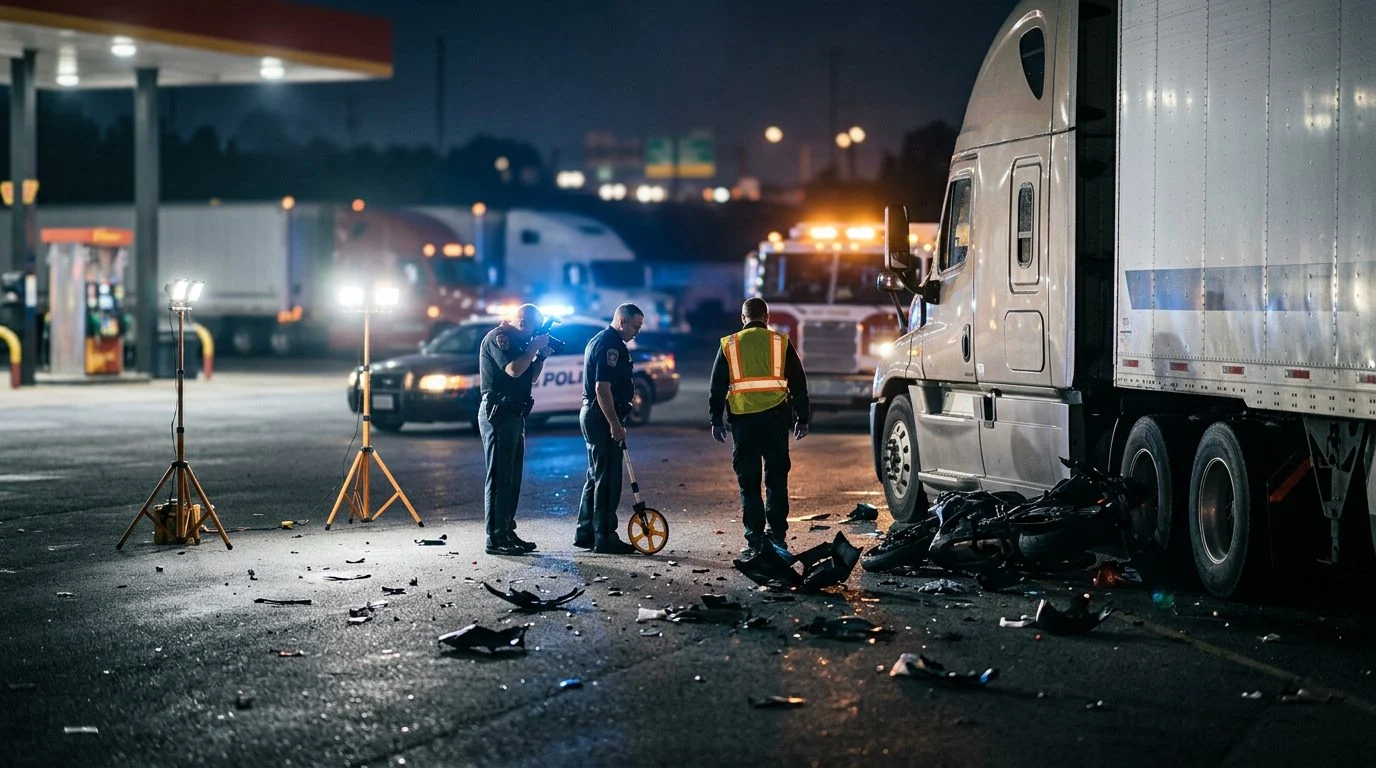
Motorcycle crashes in Virginia
When a Commercial Truck Takes a Motorcyclist's Life
Grief, unanswered questions and paperwork arrive at the same time. Here is a clear, plain-language guide for Virginia families.
Published November 14, 2026
When a motorcyclist is killed by a commercial truck in Virginia, the family faces grief and hard legal questions at the same time. This page explains the main Virginia rules in the order families often need them.
Virginia law allows a wrongful death claim when a death is caused by the wrongful act, neglect, or default of another, and that act, neglect, or default is one that would have entitled the injured person to bring a lawsuit and recover damages if he or she had not died (Va. Code § 8.01-50(A), (C)). The sections below cover reporting, who files, timing, damages, fault and evidence.
Why a Motorcycle and Commercial Truck Crash Is Different
A motorcyclist has little physical protection, and a commercial truck’s size can make a crash far more severe. A motorcycle has no steel frame or airbags around the rider. A loaded truck is much heavier and needs more distance to stop. The Insurance Institute for Highway Safety publishes large-truck crash data.
Commercial trucks also run under federal safety rules. Every motor carrier must systematically inspect, repair, and maintain all motor vehicles subject to its control (49 C.F.R. § 396.3). A trucking company and its driver may have duties that an ordinary driver does not.
The firm represents families from the Shenandoah Valley to Richmond and Henrico County. Each crash has its own facts. This page explains the Virginia framework, not the details of any one crash.
Not sure what your next step is?
Talk it through with Correll Law Firm — we can walk you through how a situation like yours is usually handled and what your options are.

Reporting the Crash in Virginia
Virginia requires a driver involved in a crash with injury or death to stop and report it to police immediately (Va. Code §§ 46.2-371, 46.2-894).
The police report is a starting point. It records the officers’ view of the scene, the vehicles and the people involved. Families can ask the investigating agency how to get a copy. A report alone does not decide who was at fault.
The two-year period described above is the deadline to file a lawsuit, not the deadline to report a crash to police (Va. Code § 8.01-243).
Who May Bring a Wrongful Death Claim in Virginia
A Virginia wrongful death action is filed by the decedent’s personal representative within two years of the death (Va. Code §§ 8.01-50(C), 8.01-244(B)), on behalf of the family members the statute protects.
The personal representative is the person legally authorized to act for the deceased person’s estate. The action is brought in the name of the personal representative. Family members do not file the action themselves. They share in any recovery.
Virginia law also sets who shares in the money.
Two-Year Timing for Injury Claims and Notice Issues
Virginia generally allows two years from the date of injury to file a personal injury lawsuit (Va. Code § 8.01-243(A)); the clock runs from the date of injury, not the date of discovery, with narrow exceptions.
Some claims carry notice requirements that run out sooner than the filing period. Families should ask early about any notice step that may apply to their claim.
The injury clock and the wrongful death clock can start on different dates. Keep the dates of the crash and the death together in one place.
What Wrongful Death Damages Cover
Virginia wrongful death damages cover the family’s sorrow, mental anguish and loss of the decedent’s companionship, guidance and care; lost income and services; medical expenses from the injury; funeral expenses; and, for willful or wanton conduct, punitive damages (Va. Code § 8.01-52).
In plain terms, the sorrow and loss category covers the family’s grief and the loss of the person’s support and presence. The lost income and services category covers the reasonably expected loss of the person’s income and of the services, protection, care and assistance the person provided to the household. The medical category covers treatment that followed the crash and led to the death. Reasonable funeral costs are also part of the claim.
Punitive Damages in Trucking Crashes
Punitive damages are not available for ordinary carelessness. Virginia allows punitive damages for actual malice, or for willful or wanton conduct or recklessness showing a conscious disregard for the safety of others, capped at $350,000 (Va. Code § 8.01-38.1).
In a trucking case, the evidence may focus on what the company or driver knew about known problems and what they did about them.
Not sure what your next step is?
Talk it through with Correll Law Firm — we can walk you through how a situation like yours is usually handled and what your options are.
How Fault Is Argued After a Motorcycle and Truck Collision
The parties often disagree about how the crash happened and who caused it. Disputes may center on the motorcyclist’s speed and lane position, the truck’s path and turns, and what each driver could see.
Virginia follows contributory negligence: if you are found even partly at fault, you may be barred from recovering, with limited exceptions. Talk to a lawyer about your facts.
How fault will be decided depends on the facts of each crash.

Evidence in a Commercial Truck Crash Case
The evidence that often matters most includes the police report, photos of the scene and vehicles, witness information and medical records.
Records a trucking company keeps can also matter. Federal rules require vehicle inspection, repair and maintenance records to be kept where the vehicle is housed for one year, and for six months after the vehicle leaves the carrier’s control (49 C.F.R. § 396.3). Periodic inspection reports must be kept for fourteen months (49 C.F.R. § 396.21). Driver qualification files must be kept while the driver works for the carrier and three years after (49 C.F.R. § 391.51).
Because these periods are limited, records can be discarded on a set schedule. For more detail, read the firm’s guide on truck maintenance records in a crash claim.
Frequently asked questions
Does the police report decide who was at fault?
No. It is one piece of evidence. Fault is decided on all the facts of the crash.
Do the injury and wrongful death clocks run together?
They can start on different dates. The injury clock runs from the date of injury, and the wrongful death clock runs from the death.