
Virginia personal injury | Winchester and Harrisonburg
From the First Meeting to Trial: What Happens Next
A plain-language guide for injured people and families in Virginia, from the first conversation through possible trial.
Published November 16, 2026
After a serious crash, many injured people and their families want to know what happens next. The steps can feel hard to follow, especially while injuries are still being treated.
This guide explains the personal injury case process in Virginia in plain words, from the first meeting through possible trial.
What steps does a personal injury case typically go through in Virginia, from the first meeting and investigation through demand letters, filing suit, and possible trial?
Most Virginia injury claims move through a first meeting, an investigation, a demand letter to the insurer, and a lawsuit if the claim is not resolved. Discovery and negotiation can follow, and only some cases reach a trial.
The stages overlap. A case can move back and forth between them, and the order can shift with the facts. Some claims settle before any lawsuit is filed. Others need a court because the sides disagree about fault, injuries or losses.
Each stage builds on the one before. Early facts, such as the crash scene and the first medical records, shape later steps. Gaps early on can make later steps harder.
This page follows the usual order. It starts with the first meeting, then covers crash reporting, evidence, demand letters, the filing deadline, partial fault, and what happens once a suit is on file.
If you were hurt in a crash, you may have a claim, and the firm is glad to talk with you about the facts of your situation. Talk it through with Correll Law Firm — we can walk you through how a situation like yours is usually handled and what your options are.
What happens at the first meeting with the firm?
The first meeting is a conversation. The injured person, or the family, explains what happened, what injuries they have, and what treatment has followed. The firm listens first, then asks questions about the crash.
It helps to bring what you already have. Useful items include:
- The date and location of the crash
- The police report number, if there is one
- Photos of the vehicles, the scene and your injuries
- Insurance information for everyone involved
- Medical records and bills so far
- A list of missed work and other losses
You don’t need every item at the first meeting. Missing pieces can be gathered later. You can also ask questions about the process before you decide anything. Correll Law Firm has an office in Winchester and an office in Harrisonburg, Virginia, and represents people from the Shenandoah Valley to Richmond and Henrico County.
Why do Virginia drivers need to report a crash right away?
Virginia requires a driver involved in a crash with injury or death to stop and report it to police immediately (Va. Code §§ 46.2-371, 46.2-894).
Reporting a crash is a separate duty from filing a lawsuit.
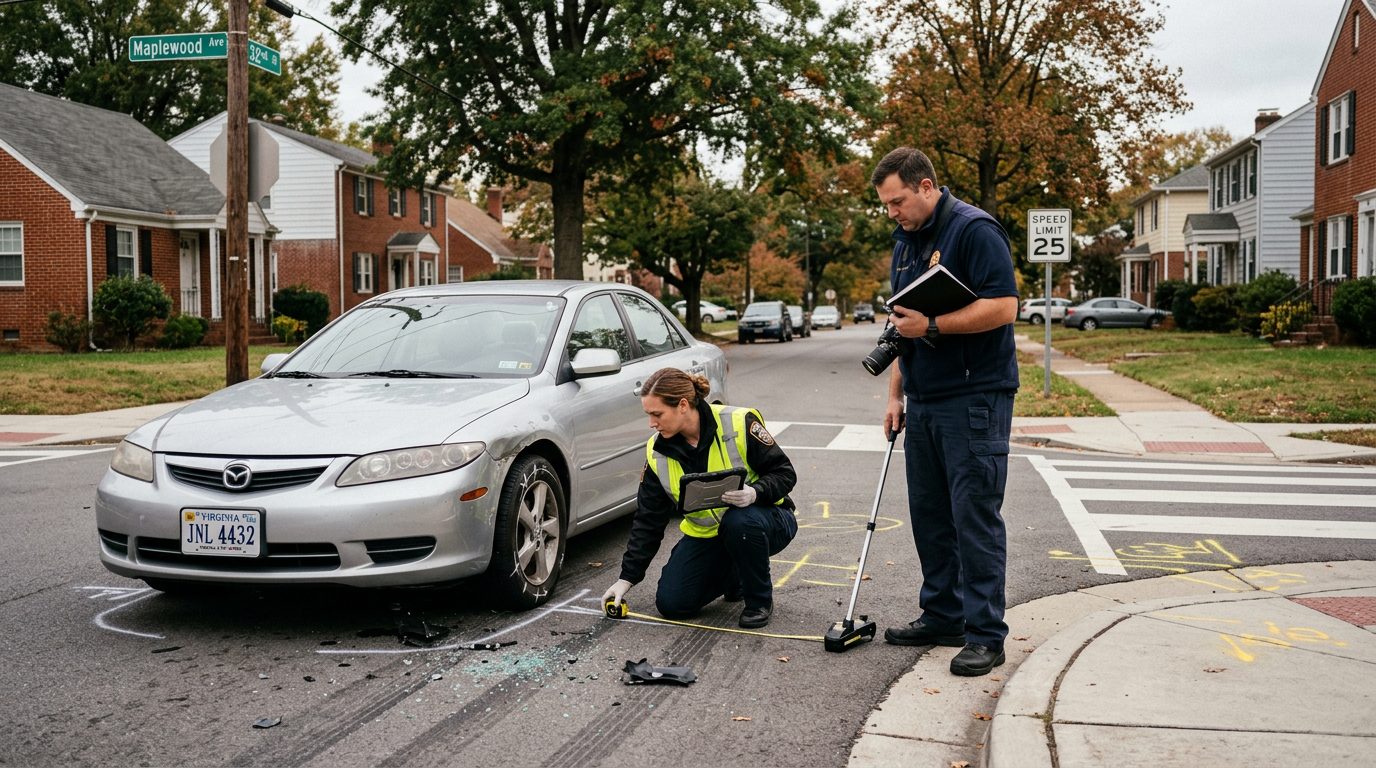
Keep a copy of the police report and any citations. Write down what the other driver said, and where and when, while your memory is fresh. A report made at the scene often matters later, when insurers compare accounts.
How is the evidence investigated in a Virginia injury case?
The investigation gathers records that show how the crash happened and how it affected the injured person. Common sources include police reports, witness contact information, photos and video, vehicle damage records, and medical records that tie the injuries to the crash.
Truck and commercial vehicle crashes often need more records. Federal rules require a motor carrier to keep driver records of duty status and supporting documents for at least six months from the date of receipt (49 C.F.R. § 395.8). Periodic vehicle inspection reports must be kept for fourteen months from the date of the report (49 C.F.R. § 396.21).
That is why early requests matter. Records kept for a limited time can be harder to obtain once that window closes.
Some cases also use medical providers to explain injuries, or accident reconstruction professionals to study how the crash happened. Those outside professionals give their own opinions.
What is a demand letter in a Virginia personal injury claim?
A demand letter is a written statement sent to the insurer for the at-fault party. It summarizes the facts, the injuries, the treatment and the losses, and asks for compensation.
The insurer then reviews the letter. It may respond, ask for more records, or make a counteroffer. Negotiation can go on for a while. The letter does not itself start a lawsuit.
A letter is only as strong as the records behind it. A demand that lacks medical records or bills is easier for an insurer to question.
When does the firm file a lawsuit in Virginia?
A lawsuit is usually filed when the claim cannot be resolved through negotiation and a legal deadline is getting close. The deadline matters more than many people expect.
Virginia generally allows two years from the date of injury to file a personal injury lawsuit (Va. Code § 8.01-243(A)); the clock runs from the date of injury, not the date of discovery, with narrow exceptions.
Some claims carry notice requirements that run out sooner. Va. Code § 15.2-209 reads: “Every claim cognizable against any county, city, or town for negligence shall be forever barred unless the claimant or his agent, attorney, or representative has filed a written statement of the nature of the claim, which includes the time and place at which the injury is alleged to have occurred, within six months after such cause of action accrued.” Va. Code § 15.2-209 reads: “Failure to provide such statement shall not bar a claim against any county, city, or town, provided that the attorney, chief executive, or mayor of such locality, or any insurer or entity providing coverage or indemnification of the claim, had actual knowledge of the claim, which includes the nature of the claim and the time and place at which the injury is alleged to have occurred, within six months after such cause of action accrued.”
When a crash causes a death, the rules differ. A Virginia wrongful death action is filed by the decedent’s personal representative within two years of the death (Va. Code §§ 8.01-50(C), 8.01-244(B)), on behalf of the family members the statute protects.
Not sure what your next step is?
Talk it through with Correll Law Firm — we can walk you through how a situation like yours is usually handled and what your options are.
What happens if the injured person is partly at fault?
Virginia follows contributory negligence: if you are found even partly at fault, you may be barred from recovering, with limited exceptions. Talk to a lawyer about your facts.
Whether this applies depends on the facts of the crash and the evidence. The investigation step above is where those facts get pinned down.
What happens after a lawsuit is filed, and how long does the process take?
After a lawsuit is filed, the case enters discovery. Each side asks for documents and written answers. Witnesses may also give depositions, which are questions answered under oath.
Pretrial motions ask the judge to decide a point before trial. Settlement talks often continue while the case is pending.
How long the process takes depends on the facts. The injuries, when medical treatment ends, the court’s schedule and whether the sides can agree all affect timing. No single timeline fits every case.
Trial is one possible end point, not the only one. After a trial, a party may be able to ask a higher court to review the result.
How long does a personal injury case take in Virginia?
The length depends on the facts, the injuries and the court’s schedule. No single timeline fits every case.