
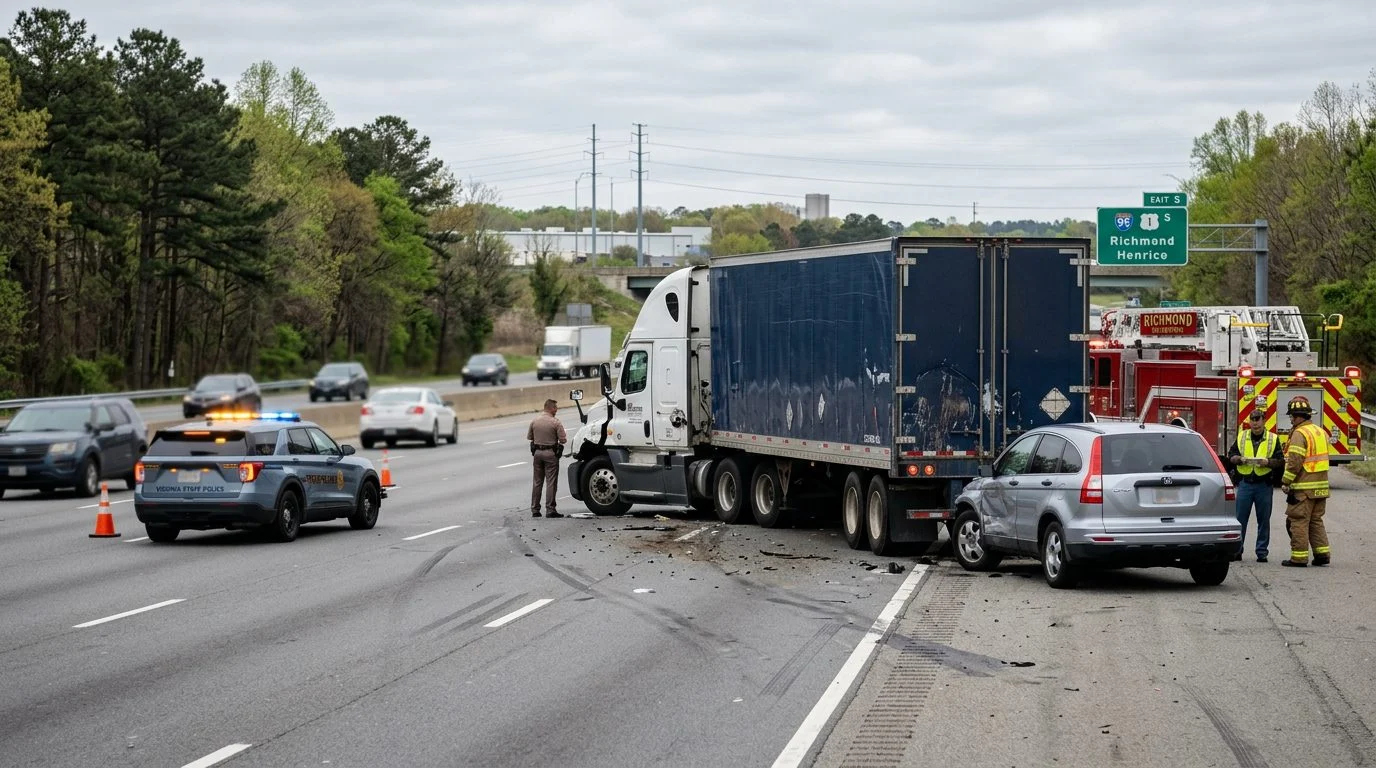
Truck Accidents | Richmond and Henrico County
Serious Tractor-Trailer Crashes in Richmond and Henrico County
Published November 13, 2026
A crash with a tractor-trailer can leave you injured, unable to work, and facing questions you never expected. Many people in Richmond and Henrico County who are hurt in these crashes want a clear picture before they decide what to do next.
In short, a tractor-trailer crash claim seeks money for the harm a crash caused, and it can reach more than the driver. Which parties may be responsible depends on the facts. This guide explains the evidence, deadlines and damages that shape these claims in Virginia.
What a Tractor-Trailer Crash Case Involves
A tractor-trailer crash case is a personal injury claim that arises from a crash involving a large commercial truck. Tractor-trailers, also called semi-trucks, are heavy vehicles that are often owned or leased by a company rather than the person driving them.
These claims differ from ordinary car accident claims in three ways:
- The truck is often run by a motor carrier, so the claim may involve a business as well as a driver.
- Many trucks fall under federal safety rules, which create records such as driver logs and maintenance files.
- Injuries can be severe because of the size and weight of the vehicle.
This page is written for injured drivers and passengers, pedestrians, and families of people killed in these crashes. It is especially relevant to Richmond and Henrico County residents hurt on local roads and interstates.
Not sure what your next step is?
Talk it through with Correll Law Firm — we can walk you through how a situation like yours is usually handled and what your options are.
Crash Types and Injuries the Firm Handles
The firm handles tractor-trailer crash claims involving several common crash patterns and serious injuries. Common patterns include:
- Rear-end collisions into slowed or stopped traffic
- Lane-change collisions, where a truck moves into a car’s space
- Jackknifing, when the trailer swings out of line with the cab
- Underride crashes, where a car slides beneath a trailer
- Crashes involving shifted or lost loads
Serious injuries in these crashes can include catastrophic injuries, traumatic brain injury and spinal cord injury. A catastrophic injury causes lasting harm that changes how a person lives and works.
The firm handles these matters for families.
Who May Be Responsible After a Truck Crash
Responsibility after a truck crash may extend beyond the driver. The company that operates the truck may be part of a claim. Other parties may include the company that loaded or secured the cargo, a maintenance or repair provider, and a maker of a defective part.
Commercial insurance policies, company safety programs and driver records can become part of the claim. Federal rules require a motor carrier to keep a driver qualification file for each driver it employs. That file includes the driver’s application and motor vehicle record, and it must be kept while the driver works there and for three years after, except that certain records, such as the motor vehicle record from the annual driver record inquiry, may be removed three years after the date of execution (49 C.F.R. § 391.51). A motor carrier must also require its drivers to follow the federal driver rules that apply to them (49 C.F.R. § 390.11).
Evidence That Matters After a Tractor-Trailer Crash
Evidence from a truck crash can be lost or overwritten, so early steps matter. Virginia requires a driver involved in a crash with injury or death to stop and report it to police immediately (Va. Code §§ 46.2-371, 46.2-894). The duty to report appears in Va. Code § 46.2-371. The two-year period is the deadline to file a lawsuit, not the deadline to report a crash.
Records to ask about include:
- Electronic logging device data. Federal rules require most motor carriers to use these devices to record driver duty status, except a private motor carrier of passengers (nonbusiness), and allow manual recording in some cases (49 C.F.R. § 395.8).
- Dispatch and communication records
- Maintenance and inspection files
- Driver qualification files
- Vehicle event data
Federal rules let carriers keep records by many technologies, as long as the records stay accurate and can be reproduced later (49 C.F.R. § 379.7). Because the company holds most of these records, early requests can matter. If you can, take photos of the scene and vehicles, write down witness names and keep every medical record.
Deadlines and Early Steps in Virginia
The main filing deadline in a Virginia injury case is set by statute, and the clock starts at the injury. Virginia generally allows two years from the date of injury to file a personal injury lawsuit (Va. Code § 8.01-243(A)); the clock runs from the date of injury, not the date of discovery, with narrow exceptions. Under Va. Code § 8.01-243, every action for personal injuries, whatever the theory of recovery, must be brought within two years after the cause of action accrues, unless otherwise provided in that section or by other statute. Some claims carry notice requirements that run out sooner.
A Virginia wrongful death action is filed by the decedent’s personal representative within two years of the death (Va. Code §§ 8.01-50(C), 8.01-244(B)), on behalf of the family members the statute protects. The statutes are Va. Code § 8.01-244 and Va. Code § 8.01-50.
Virginia follows contributory negligence: if you are found even partly at fault, you may be barred from recovering, with limited exceptions. Talk to a lawyer about your facts. Keep every medical appointment and follow your treatment plan, since gaps in care can make it harder to tie injuries to the crash.
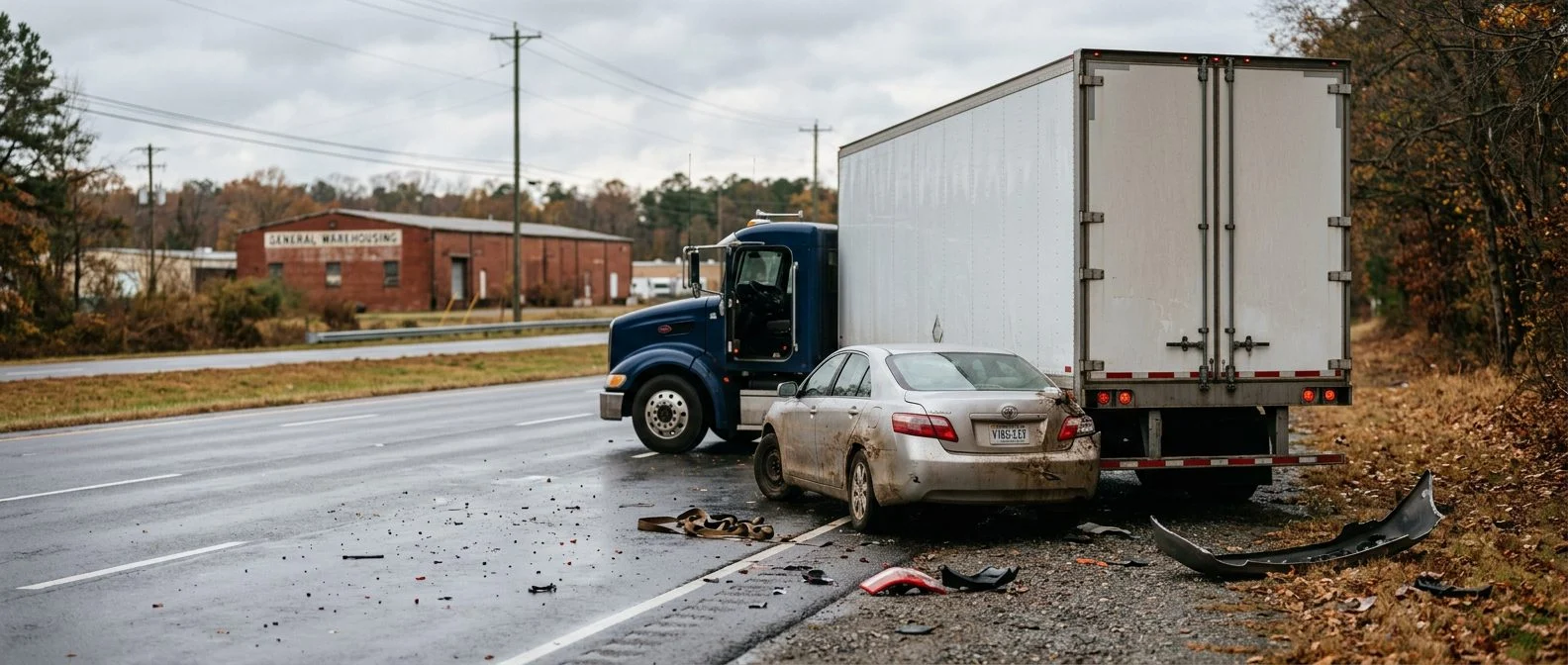
What Compensation May Cover in Virginia
Each claim is different, and general information cannot predict the outcome of any claim.
Virginia allows punitive damages for actual malice, or for willful or wanton conduct or recklessness showing a conscious disregard for the safety of others, capped at $350,000 (Va. Code § 8.01-38.1). The cap is in Va. Code § 8.01-38.1.
Virginia wrongful death damages cover the family’s sorrow, mental anguish and loss of the decedent’s companionship, guidance and care; lost income and services; medical expenses from the injury; funeral expenses; and, for willful or wanton conduct, punitive damages (Va. Code § 8.01-52). The statute is Va. Code § 8.01-52.
Not sure what your next step is?
Talk it through with Correll Law Firm — we can walk you through how a situation like yours is usually handled and what your options are.
How the Process Typically Works
A tractor-trailer claim usually moves through five general stages, though timing varies from case to case.
- Initial review. The firm looks at the crash facts, injuries and records the injured person already has.
- Evidence gathering. The firm requests crash, company and maintenance records. Where needed, it may bring in outside accident reconstruction professionals.
- Medical documentation. The firm reviews how the injuries affect work, daily life and future needs.
- Communication with insurers. The firm communicates and negotiates with insurers and other parties.
- Filing, if needed. If a fair resolution is not reached, a lawsuit is filed within the applicable deadlines.
The firm cannot promise how long any stage will take.
Why the Firm Handles These Claims
The firm focuses on car and commercial vehicle accidents, catastrophic injuries, traumatic brain injury, spinal cord injury and wrongful death, and it handles truck accident claims. The firm serves clients from its Winchester and Harrisonburg locations. From those offices, it serves Richmond and Henrico County residents, along with people across the Shenandoah Valley and Virginia.
The firm’s support staff, including assistants and office staff, help with the paperwork these claims require.
Common Questions About Tractor-Trailer Crash Claims
The answers below cover common questions about these claims.
Can a truck from another state be part of a Virginia claim?
A carrier from another state may be involved in a Virginia crash claim, and federal rules can apply to interstate carriers. Federal law requires minimum levels of financial responsibility for many interstate truck carriers (49 U.S.C. § 31139).
How long does a truck claim take?
Timing depends on injuries, records and whether the claim settles or goes to court. The firm cannot promise a timeline.
Should I speak with the trucking company’s insurer?
You may wish to talk with the firm before giving a recorded statement or signing any document.
Does the firm take cases from outside Richmond and Henrico County?
Yes. The firm serves residents across the Shenandoah Valley and Virginia, as well as Richmond and Henrico County.