
Truck Accidents | Virginia
Tractor Trailer Rollover Cases Demand Careful Legal Work
When a loaded rig tips over on a Virginia highway, the first days shape what comes next. The firm helps injured people and families sort out the crash, the injuries and the insurance demands.
Published November 15, 2026
If a tractor-trailer tipped onto its side or roof and hurt you or someone you love, you may be facing medical bills, lost work and hard questions. In Virginia, a rollover claim can seek compensation from the people responsible for the crash, which may include the driver, the trucking company and others. Virginia also sets strict time limits, so early steps matter.
What a Tractor-Trailer Rollover Crash Is and Who It Affects
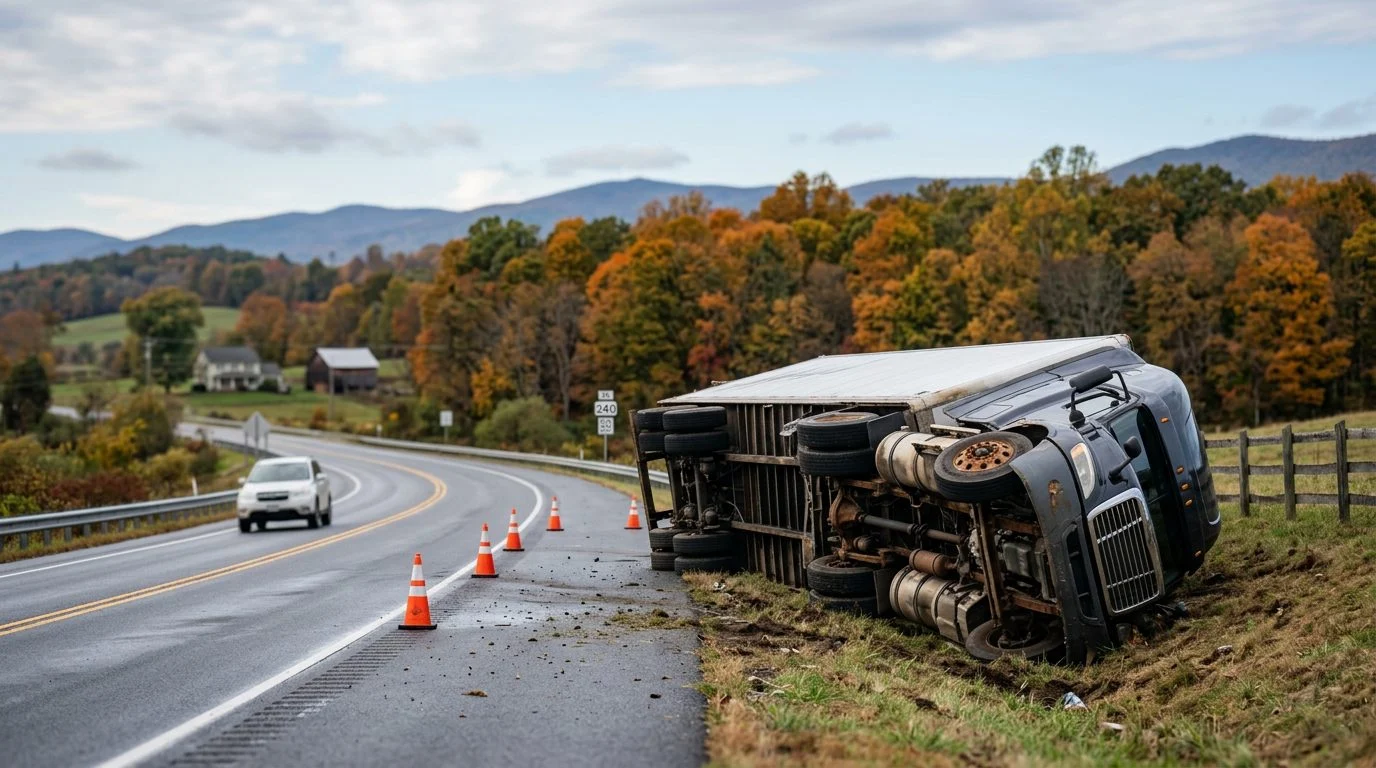
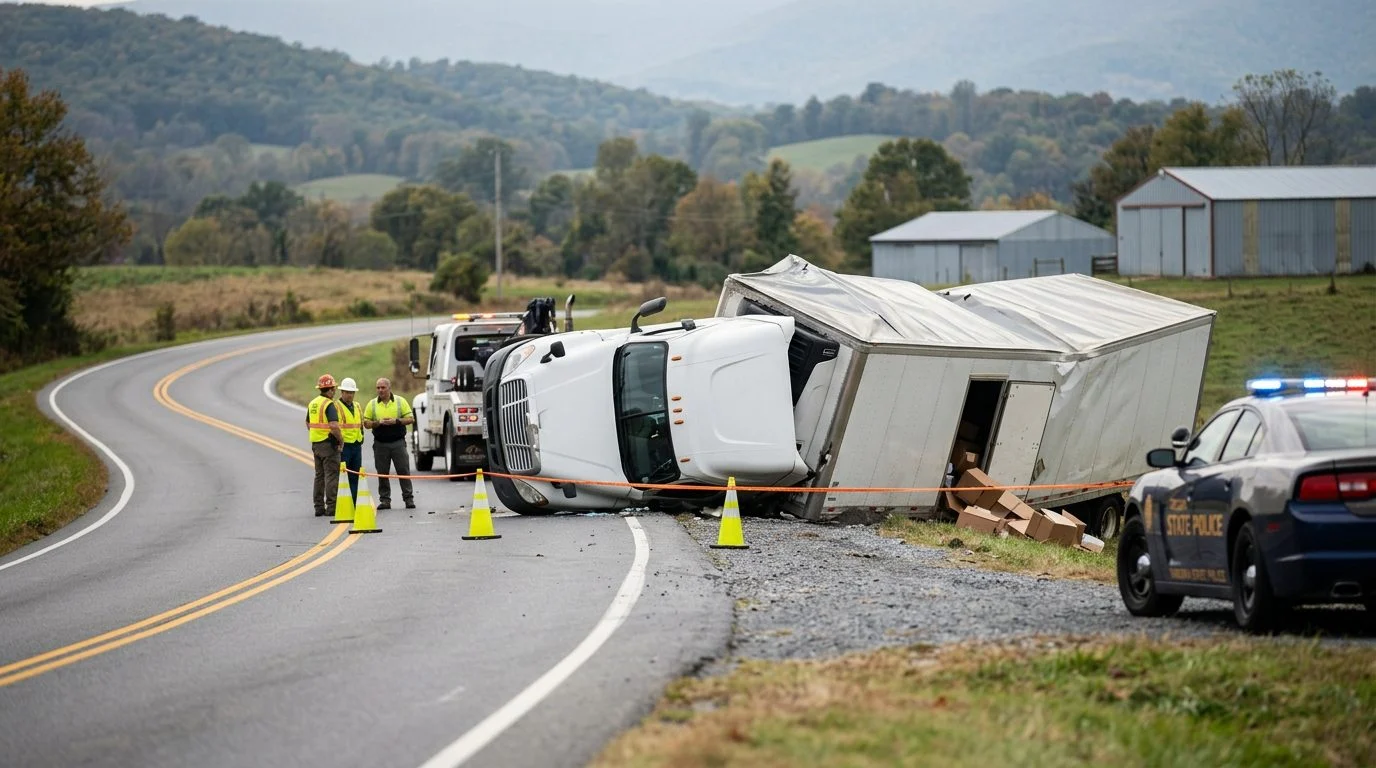
A tractor-trailer rollover happens when a loaded truck tips onto its side or roof. These crashes often start on ramps, on curves or during sudden lane changes. A rolling trailer can block several lanes and spill debris across traffic.
People in passenger cars, pickups and motorcycles can be seriously hurt when a big truck rolls into their path. The driver and passengers in the truck can be hurt too. When a crash causes a death, the family can also have a claim.
Correll Law Firm is a Virginia personal injury firm. Its work focuses on car accidents, truck and commercial vehicle accidents, catastrophic injuries, traumatic brain injury, spinal cord injury and wrongful death. The firm handles these matters for people across Virginia, including the Shenandoah Valley, Richmond and Henrico County.
If a loaded truck rolled over and hurt you or someone you love, you may have a claim, and the firm is glad to talk through what happened with you. Talk it through with Correll Law Firm — we can walk you through how a situation like yours is usually handled and what your options are.
What a Rollover Claim Covers
A rollover claim can seek payment for medical treatment, rehabilitation and future care. It can also cover lost income and the loss of the ability to work. Damage to the vehicle and personal property can be part of the claim too.
Catastrophic injuries change daily life. Brain injuries, spinal cord injuries and multiple fractures often need long-term planning. These claims usually need detailed medical records and input from qualified outside professionals who can explain what care the person may need in the years ahead.
A crash that causes a death can raise difficult questions for surviving family members about their options. Who files that action, and who shares in any recovery, is explained in the Virginia time limits section below.
Why Rollovers Happen and Who May Be Responsible
Rollovers often start with speed on a curve or ramp, a load that shifts, or cargo that was not secured. Federal cargo securement rules require cargo to be firmly secured. Cargo that is likely to roll must be restrained by chocks, wedges, a cradle or an equivalent means.
Other causes include driver fatigue, impaired driving, and brake or tire failure. Federal driver duty records rules require motor carriers to keep these records for at least six months from the date of receipt. Those records can show how long a driver was on duty before the crash.
Possible responsible parties include the driver, the motor carrier, a company that loaded or shipped the cargo, a maintenance contractor, or a maker of a defective part. Which of them may share responsibility depends on the facts.
Each company may hold different records, so a single crash can require requests to more than one business.
Evidence That Matters Early in a Rollover Case
Virginia requires a driver involved in a crash with injury or death to stop and report it to police immediately (Va. Code §§ 46.2-371, 46.2-894). Reporting the crash is a separate step from filing a lawsuit.
Federal rules call for drug and alcohol testing after some truck crashes. Under 49 C.F.R. § 382.303, when a crash involves a commercial motor vehicle operating on a public road in commerce, the employer is required to have alcohol and controlled-substance testing done as soon as practicable for a surviving driver who was performing safety-sensitive functions with respect to the vehicle if someone died. If the crash instead involved bodily injury to a person who immediately received medical treatment away from the scene, or disabling damage requiring a vehicle to be towed or otherwise transported away from the scene, the testing applies only to a surviving driver who receives a citation for a moving traffic violation arising from the accident within 8 hours for alcohol or within 32 hours for controlled substances (49 C.F.R. § 382.303). Alcohol tests should happen as soon as practicable after the crash. If a test is not given within two hours, the employer must keep a record of the reasons, and attempts to give an alcohol test stop after eight hours. If a test is not given in time, the employer must keep a record of why.
Timing matters for other evidence too. Driver records have a set keep time, so early requests matter. Scene evidence can include skid marks, the position of the trailer, cargo on the roadway, photos, witness names, dashcam footage and electronic data the truck stores. Medical records from the first days after the crash should note why each treatment step was needed.
How the Process Works, Step by Step
A rollover claim usually moves through clear stages. Each stage can take time, and the facts of each crash shape the path.
- Intake: The firm gathers the crash report, medical records and the injured person’s or family’s account of what happened.
- Investigation: The firm requests carrier records and sends letters asking companies to preserve evidence. The scene and vehicles may be reviewed.
- Medical and technical documentation: The firm works with medical providers and, where needed, accident reconstruction professionals who may testify if the case reaches that stage.
- Demand and negotiation: A demand is sent to the responsible parties and their insurers, followed by discussions about a resolution.
- Lawsuit, if needed: If a fair resolution is not reached, the case may be filed within Virginia time limits. Discovery, mediation and trial preparation can follow.
Serious rollover cases often take many months. Some take longer, depending on the injuries and the facts.
Virginia Time Limits and Fault Rules
Virginia generally allows two years from the date of injury to file a personal injury lawsuit (Va. Code § 8.01-243(A)); the clock runs from the date of injury, not the date of discovery, with narrow exceptions. Some claims carry notice requirements that run out sooner.
Virginia follows contributory negligence: if you are found even partly at fault, you may be barred from recovering, with limited exceptions. Talk to a lawyer about your facts.
Virginia allows punitive damages for actual malice, or for willful or wanton conduct or recklessness showing a conscious disregard for the safety of others, capped at $350,000 (Va. Code § 8.01-38.1). A jury must find that the conduct met this standard before punitive damages can be awarded.
A Virginia wrongful death action is filed by the decedent’s personal representative within two years of the death (Va. Code §§ 8.01-50(C), 8.01-244(B)), on behalf of the family members the statute protects. Family members do not file; they share in the recovery.
Under Va. Code § 8.01-243, a personal injury action must be brought within two years after the cause of action accrues, unless otherwise provided in that section or by other statute.
Not sure what your next step is?
Talk it through with Correll Law Firm — we can walk you through how a situation like yours is usually handled and what your options are.
Handling a Serious Truck Crash Claim
The firm serves people from the Shenandoah Valley, Richmond and Henrico County.
The firm’s work centers on serious and catastrophic injuries. Traumatic brain injury, spinal cord injury and wrongful death cases often involve long recovery periods, detailed medical records and careful proof of future needs. The firm also handles car and commercial vehicle claims.
Support staff help track records, deadlines and correspondence, so the details of a file stay organized. Rollover cases can involve several companies, so a claim may need records from each one.
The firm keeps injured people and families informed and explains options at each stage. Decisions about a claim stay with the people it affects, and the firm works to make each step clear.
Frequently Asked Questions
What should I say to an insurance adjuster after a rollover crash?
Stay factual, and avoid guessing about fault or how badly you are hurt. Once the firm is involved, the firm can handle contact with insurers.
Does a rollover case always involve the trucking company?
No. The driver, the carrier, the cargo loader, a maintenance contractor or a parts maker may each be possible, depending on the facts.
What kind of lawyer handles a truck rollover case?
Correll Law Firm handles commercial vehicle and catastrophic injury claims, including rollover crashes.