
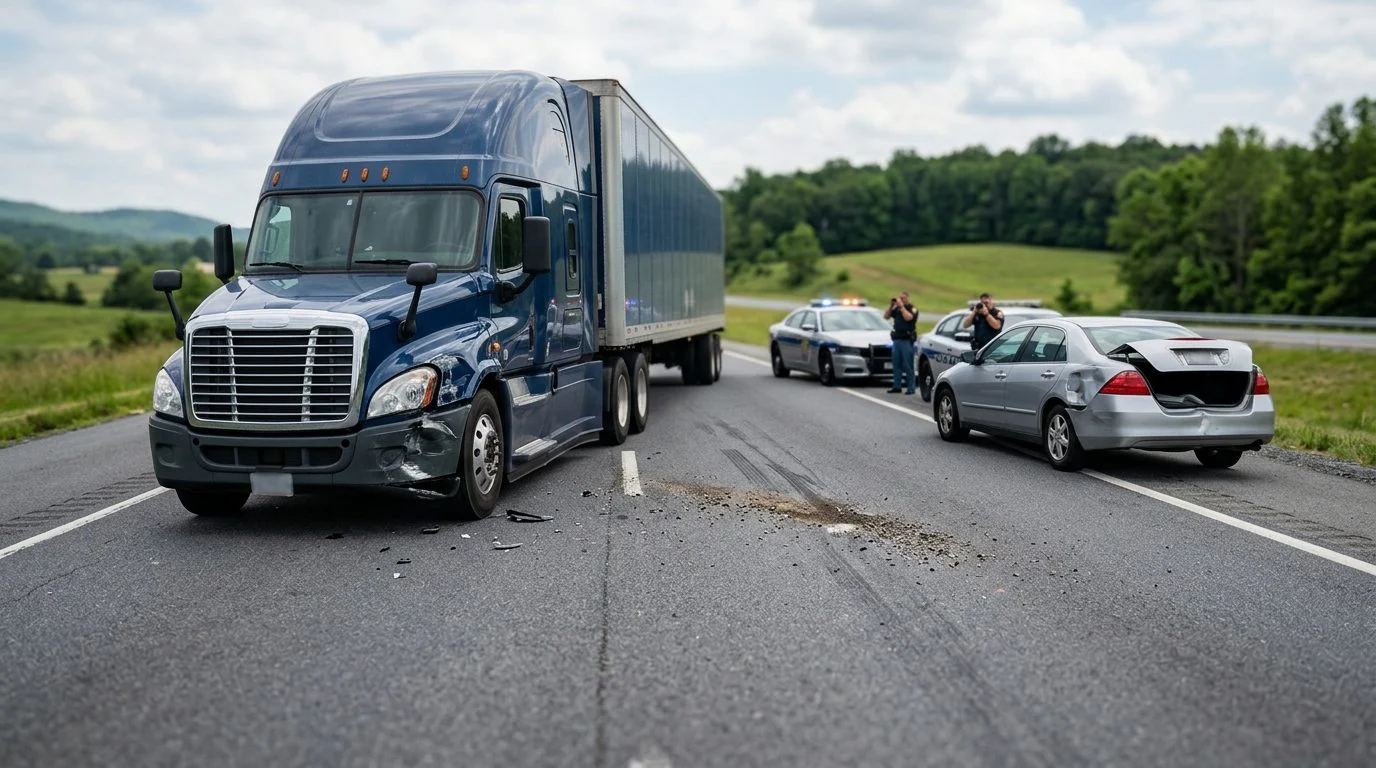
Truck Accidents | Virginia
Trucking Company Dashcam Footage After a Crash in Virginia
Dashcam video can show what happened on the road in the moments before a collision. Here is how footage is recorded, why it can disappear, and how the firm helps families in Virginia ask for it.
Published October 30, 2026
If you were hurt in a truck crash, the fastest way to protect trucking company dashcam footage after crash evidence is a written request sent right away. Video and electronic records can be overwritten, changed, or lost. A clear request names the crash, identifies the truck, and lists what to keep. This guide explains what the footage may show, who may hold it, and what to put in the request.
Why Dashcam Footage Matters After a Truck Crash
Dashcam footage can show what the truck did in the moments before impact. That is often hard to rebuild from memory alone.
A forward-facing camera may show lane position, following distance, speed, and whether the turn signal was on. A camera that faces the driver may show what the driver was doing. Footage from either can line up with GPS data and logs, which helps build a timeline.
Crash scenes change fast. Trucks are towed and repaired, skid marks fade, and witnesses drive away. Video can record what those changes erase.
Many camera systems save footage for a limited time before older files are recorded over. That is why a prompt written request matters. The safest approach is to ask for all footage from the crash period, not only the clips that seem helpful.
If a commercial truck was involved in your crash or a loved one's, you may have a claim, and the firm can talk through your situation with you. Talk it through with Correll Law Firm — we can walk you through how a situation like yours is usually handled and what your options are.

Who May Hold the Video and Related Data
Several parties may hold crash data, so the request should reach more than one place.
The trucking company, the driver, the camera maker, and any fleet-tracking vendor may each keep part of it. Many trucks record location and speed through GPS, telematics, or an electronic logging device. A vendor may store that data on a cloud account the carrier controls.
Police collect their own evidence and write a crash report. That report is separate from the company’s files and does not replace them. A truck’s door placard often shows the carrier name and a USDOT number. The Virginia DMV motor carrier guidance explains USDOT number requirements. Use those details to find the right company.
More than one party can share responsibility. So keep the request broad enough to reach the driver’s records too.
Report the Crash First
Virginia requires a driver involved in a crash with injury or death to stop and report it to police immediately (Va. Code §§ 46.2-371, 46.2-894).
Reporting is the first step, and it creates the record your request depends on. Write down the officer’s name, the agency, and the report number as soon as you have them. If the report isn’t ready yet, note the crash date, time, and location now.
Keep these notes with your copy of the request. They help the company match its files to the right crash.
What to Put in a Written Request to Preserve Footage
A written request should identify the crash and the truck, and ask the company to keep specific records.
Send it to the carrier’s safety or claims department. If the driver works for a different company, send a copy there too. Use email with a read receipt or certified mail with a return receipt, so you have a dated record.
Include these details:
- The date, time, and location of the crash.
- The truck’s unit number or license plate.
- The driver’s name, if you know it.
- The police report number, if you have it.
Ask the company to keep:
- Dashcam video from the crash period, from every camera on the truck.
- GPS, telematics, and electronic logging device data.
- Dispatch messages, photos, and maintenance records for the truck.
Federal rules allow records to be kept by any technology that accurately reflects the information and stays accessible for later reference (49 C.F.R. § 379.7). Ask for written confirmation that the material is being kept. Keep a copy of the request and every reply, with dates.
Other Records to Ask the Company to Keep
Logs, trip records, and inspection reports can show when the driver was working and what condition the truck was in.
Federal rules require carriers to keep supporting documents, such as dispatch and trip records, for each driver for every 24-hour period to verify on-duty not driving time (49 C.F.R. § 395.11). A motor carrier generally need not retain more than eight supporting documents for an individual driver’s 24-hour period, but if it has more than eight it must keep the ones with the earliest and latest time indications, and a carrier that requires a driver to keep paper records of duty status must also keep toll receipts for those periods regardless of the eight-document limit (49 C.F.R. § 395.11). That makes it wise to name the records you need. Federal rules also bar altering electronic logging data so it no longer records accurately (49 C.F.R. § 395.8).
Driver vehicle inspection reports must be kept for three months from the date the written report was prepared under 49 C.F.R. § 396.11, though these rules do not apply to a private motor carrier of passengers (nonbusiness), a driveaway-towaway operation, or any motor carrier operating only one commercial motor vehicle. That short period is one reason to ask early.
After certain crashes, carriers must test surviving drivers for alcohol and controlled substances as soon as practicable (49 C.F.R. § 382.303). If an alcohol test is not given within two hours, the company must keep a record of why. Under this section, if a test is not given within the required time, the employer must prepare and keep on file a record stating the reasons the test was not promptly administered, and submit those records to the FMCSA upon request (49 C.F.R. § 382.303).
Deadlines That Affect Your Request
Virginia generally allows two years from the date of injury to file a personal injury lawsuit (Va. Code § 8.01-243(A)); the clock runs from the date of injury, not the date of discovery, with narrow exceptions.
Some claims carry notice requirements that run out sooner than the filing period. Sending a records request does not file a lawsuit, so keep the filing deadline in view while the footage is being sorted out.
A Virginia wrongful death action is filed by the decedent’s personal representative within two years of the death (Va. Code §§ 8.01-50(C), 8.01-244(B)), on behalf of the family members the statute protects. Family members generally do not file; the personal representative brings the action, but fetal death actions are brought by and in the name of the natural mother, or, if she dies or is under a disability, by the administrator of her estate, her guardian, or her personal representative qualified to bring such action (Va. Code § 8.01-50).
Not sure what your next step is?
Talk it through with Correll Law Firm — we can walk you through how a situation like yours is usually handled and what your options are.

Related Virginia Truck Crash Guidance
The firm’s guide to commercial vehicle accidents in Virginia is a good starting point for the wider topic. Other pages cover what to do when a truck driver says he caused the crash, and commercial truck drivers who leave the scene, which connects to the reporting duty above.
On Interstate 81 through the Shenandoah Valley, video of speed can be compared with the posted limit.
Common questions
Is a preservation request the same as filing a lawsuit?
No. A written request asks the company to keep evidence. It does not file a case, so the two-year deadline still applies.
Can I send the request without a police report number?
Yes. Include the crash date, time, location, and the truck’s unit number or plate, and add the report number once you have it.
Related practice areas
- Commercial Vehicle Accidents in Virginia: What Injured People and Families Should Know First
- Box Truck Accident Lawyer in the Shenandoah Valley