
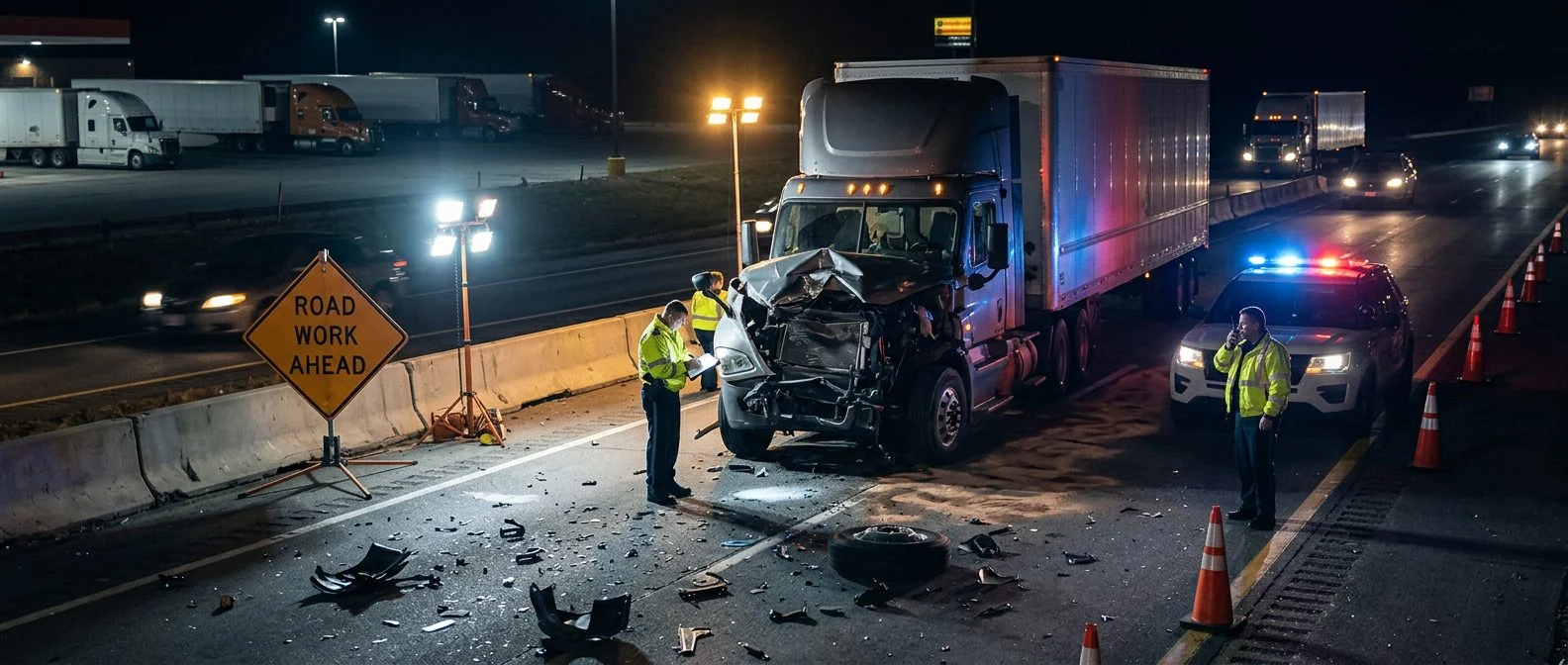
Truck Accidents | Work Zones | Virginia
Hurt in a Work Zone Truck Crash? Start With the Facts
Plain-language guidance for drivers and families on I-81 and I-64, from the Shenandoah Valley to Richmond.
Published November 17, 2026
A crash with a commercial truck in a highway work zone can leave you hurt, shaken and unsure what comes next. Work zones on I-81 and I-64 shrink the space a truck needs to stop and steer, and the facts at the scene shape everything that follows.
This guide explains why these crashes happen, what to document, and which Virginia reporting and filing rules may apply.
Why Work Zones on I-81 and I-64 Raise the Risk of a Truck Crash
Work zones raise the risk because they reduce the room a large truck has to stop, steer and merge. Lane closures, lane shifts and narrowed shoulders squeeze traffic into tighter paths. A loaded truck needs more distance to stop than a passenger car, so a sudden slowdown leaves less margin for error.
When traffic backs up and stops without warning, drivers have less time to react. A truck behind a line of slowed cars may not be able to stop in time.
I-81 runs through the Shenandoah Valley, including the Winchester and Harrisonburg areas. I-64 runs through the Richmond area and Henrico County. Work zones on both highways often combine construction equipment, temporary barriers and changing speed limits in a short stretch of road. Each change asks more of the driver. For a broader look at truck and commercial vehicle claims, see the firm’s commercial vehicle accidents page.
If a work zone crash left you or someone you love hurt, you may have a claim, and the firm is ready to talk through what happened. Talk it through with Correll Law Firm — we can walk you through how a situation like yours is usually handled and what your options are.
What Makes a Work Zone Crash Different from Other Truck Crashes
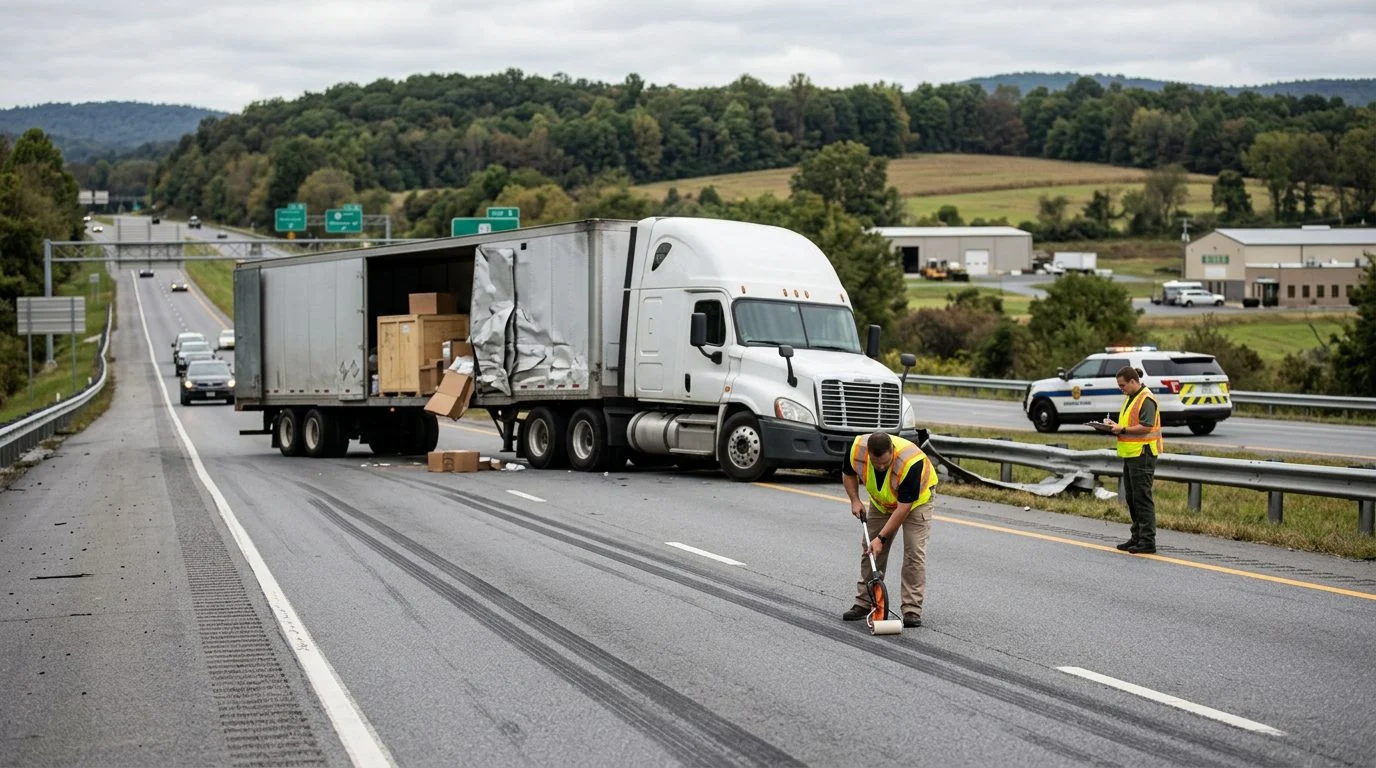
A work zone crash often follows a sequence an open-highway crash does not: slowing, a lane shift, merging, then impact. Each step is a point where the crash could have been avoided or made worse.
A driver may slow for a closure, then find a car merging ahead. The impact may come from behind, into a stopped line of cars, or into the work zone itself.
Many interstate work zones use a crash truck. This is a truck-mounted attenuator, a device at the front of the work zone designed to absorb the force of an impact. Whether it was in place, where it sat and whether it was working can be part of the facts.
Signs, cones, barrier placement and lane markings are road conditions that a crash investigation may examine. Which of these questions matter most turns on the location, the time, the traffic and the vehicles involved.
Accident Reporting Requirements in Virginia
Virginia requires a driver involved in a crash with injury or death to stop and report it to police immediately (Va. Code §§ 46.2-371, 46.2-894).
The stop-and-report duty appears in Va. Code § 46.2-894. After an accident in which a person is killed or injured, or in which an attended vehicle or other attended property is damaged, the driver must stop as close to the scene as possible without obstructing traffic. The driver must also immediately report a name, address, driver’s license number and vehicle registration number to the State Police or local law-enforcement agency, to the person struck if that person appears capable of understanding and retaining the information, to the driver or occupant of the other vehicle, or to the custodian of damaged property.
The driver must give reasonable help to anyone hurt, including taking that person to a doctor or hospital when treatment appears necessary or is requested. If injuries prevent the driver from reporting right away, the report must be made as soon as reasonably possible.
A willful failure to give notice to a law-enforcement officer of an accident resulting in injury to or death of any person, under Va. Code § 46.2-371, is a Class 4 misdemeanor. A conviction under § 46.2-894 is a Class 5 felony if the crash causes injury or death, or more than $1,000 in property damage; if property damage is $1,000 or less, it is a Class 1 misdemeanor.
Evidence to Document After a Work Zone Truck Crash
The most useful evidence shows how the work zone was set up, where the vehicles ended up, and when the crash happened.
Photograph the lane closures, signs, cones, barriers and lane markings, along with the position of each vehicle. Take these pictures before vehicles are moved if it is safe to do so, since a work zone can be changed soon after a crash. If you cannot take photos, ask someone at the scene to help.
Write down the truck’s company name, its unit or trailer number, and the driver’s name if it is shared at the scene. Note the police report number too.
Record the time, weather, lighting, traffic speed and any changes to the set-up while memory is fresh. Keep witnesses’ names and how to reach them. Dashcam or phone video, if it exists, can show how the lane shift and slowing happened.
A common mistake is waiting days to put these details on paper. Keep medical records and bills together, since they document the injury that followed the crash.
Carrier and Driver Records That May Matter in a Truck Claim
Trucking companies keep driver records that can show how long a driver had been on duty before a crash.
Under 49 C.F.R. § 395.8, a motor carrier subject to the requirements of this part must require each driver used by it to record duty status for each 24-hour period, except for a private motor carrier of passengers (nonbusiness). The carrier must keep those records and supporting documents for at least 6 months from the date of receipt.
Because that window is short, timing matters. Other records a truck claim may involve include dispatch and trip records, inspection and maintenance records, and load information.
Which of these exist, and what they show, depends on the facts of the crash and the carrier involved. These records are often requested during a claim or lawsuit rather than gathered at the scene.
Driver logs and trip records can help rebuild the timeline, from the start of the shift to the moment of impact.
Deadlines and Fault Questions in a Virginia Work Zone Crash
Virginia generally allows two years from the date of injury to file a personal injury lawsuit (Va. Code § 8.01-243(A)); the clock runs from the date of injury, not the date of discovery, with narrow exceptions. The statute is at Va. Code § 8.01-243.
Some claims carry shorter notice rules. A missing notice does not bar the claim if the Division of Risk Management, an insurer or entity covering the claim, or the Attorney General had actual knowledge of those same details within that year. If the claimant was under a disability when the claim arose, the tolling rules of § 8.01-229 apply.
Fault in a work zone crash can be contested. Virginia follows contributory negligence: if you are found even partly at fault, you may be barred from recovering, with limited exceptions. Talk to a lawyer about your facts.
Va. Code § 8.01-195.6(C) provides that a notice of claim is deemed filed when it is received in the office of the official to whom the notice is directed.
Not sure what your next step is?
Talk it through with Correll Law Firm — we can walk you through how a situation like yours is usually handled and what your options are.
When a Work Zone Truck Crash Causes a Death or Catastrophic Injury
A Virginia wrongful death action is filed by the decedent’s personal representative within two years of the death (Va. Code §§ 8.01-50(C), 8.01-244(B)), on behalf of the family members the statute protects.
Virginia wrongful death damages cover the family’s sorrow, mental anguish and loss of the decedent’s companionship, guidance and care; lost income and services; medical expenses from the injury; funeral expenses; and, for willful or wanton conduct, punitive damages (Va. Code § 8.01-52). Va. Code § 8.01-52 provides that the verdict or judgment of the court trying the case without a jury shall include, but may not be limited to, the following damages, and that a jury may award damages it deems fair and just; the list is set out in Va. Code § 8.01-52.
Virginia allows punitive damages for actual malice, or for willful or wanton conduct or recklessness showing a conscious disregard for the safety of others, capped at $350,000 (Va. Code § 8.01-38.1). Whether a particular case meets this standard depends on its specific facts. The cap is set in Va. Code § 8.01-38.1.
Traumatic brain injury and spinal cord injury can require long-term medical care and long periods away from work. The firm handles catastrophic injury claims from the Shenandoah Valley to Richmond and Henrico County.
How the Firm Handles Work Zone Truck Claims
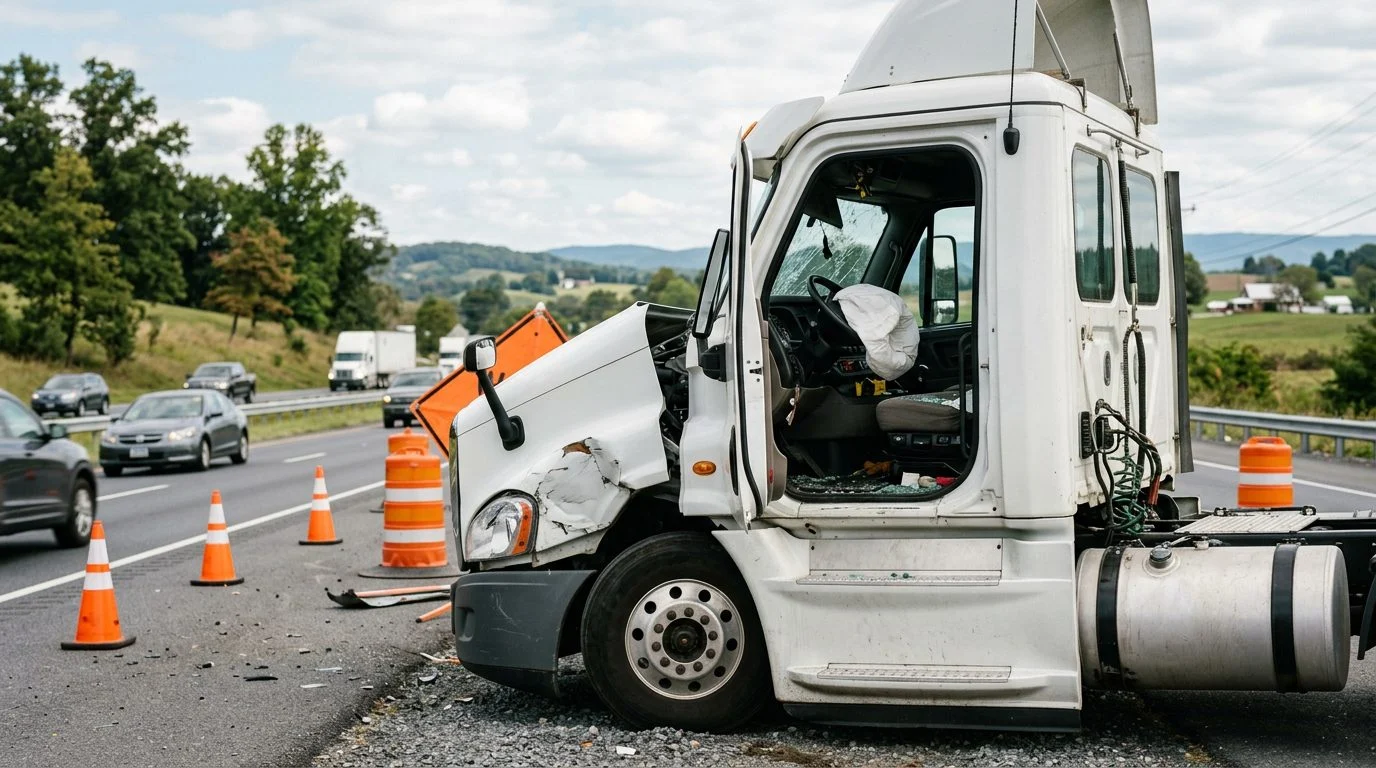
The firm handles car accidents, truck accidents, commercial vehicle accidents, catastrophic injuries, traumatic brain injury, spinal cord injury and wrongful death claims.
Work zone cases turn on the facts described above: the road set-up, the police report, the vehicles and the records. The firm reviews those facts and explains the options a person may have under Virginia law. Each case is different, so no one can predict how a specific claim will turn out.
Which areas does the firm serve?
The firm serves clients from its Winchester and Harrisonburg locations. It serves people across the Shenandoah Valley and in Richmond and Henrico County.