
Wrongful Death | Virginia
When a Commercial Vehicle Crash Takes a Loved One, Families Need Clear Answers
A plain-language guide to the losses Virginia law lets a family address after a truck or commercial vehicle death, from the Shenandoah Valley to Richmond.
Published November 29, 2026
A sudden death after a crash with a truck or other commercial vehicle leaves a family with hard questions about money, deadlines and paperwork. Va. Code § 8.01-52 provides that a jury or court may award damages for sorrow, mental anguish and solace, which may include society, companionship, comfort, guidance, kindly offices and advice of the decedent; for reasonably expected loss of the decedent’s income and of the services, protection, care and assistance the decedent provided; for expenses of care, treatment and hospitalization incident to the injury resulting in death; for reasonable funeral expenses; and for punitive damages where the conduct was willful or wanton, or showed such recklessness as evinces a conscious disregard for the safety of others (Va. Code § 8.01-52).
This guide explains each category in plain words, who brings the claim, and the timeline. Federal crash data defines a large truck as a vehicle over 10,000 pounds gross vehicle weight rating, per NHTSA large truck crash statistics.
Who Brings a Wrongful Death Claim in Virginia
A Virginia wrongful death action is filed by the decedent’s personal representative within two years of the death (Va. Code §§ 8.01-50(C), 8.01-244(B)), on behalf of the family members the statute protects. The filing rules appear in Va. Code § 8.01-50 and Va. Code § 8.01-244.
The personal representative is the person who handles the deceased person’s estate. Family members generally do not file the case themselves; the personal representative brings the action. For fetal death actions, the natural mother brings the action in her own name; if she dies or is under a disability, the administrator of her estate, her guardian, or her qualified personal representative may initiate or maintain it. They share in any recovery.
Who shares depends on family ties. A surviving spouse and children come first. Parents may share in some situations: if there are children or grandchildren of the decedent, parents share only if they regularly received support or services from the decedent within 12 months before the death; if the decedent left a surviving spouse and parent or parents but no child or grandchild, the award goes to the surviving spouse and those parents without that support requirement; if there is no surviving spouse, child or grandchild, the parents, brothers and sisters, and any other relative primarily dependent on the decedent and in the same household, share without that support requirement, but a parent whose parental rights were terminated is not eligible, under Va. Code § 8.01-53.
Deciding early who will handle the estate can prevent delays later. For the broader picture of these crashes, read the firm’s commercial vehicle accidents guide.
If your family is facing this loss, you do not have to sort through the questions alone, and the firm is glad to talk through your facts. Talk it through with Correll Law Firm — we can walk you through how a situation like yours is usually handled and what your options are.

Sorrow, Companionship and Other Losses the Family Can Pursue
Virginia wrongful death damages cover the family’s sorrow, mental anguish and loss of the decedent’s companionship, guidance and care; lost income and services; medical expenses from the injury; funeral expenses; and, for willful or wanton conduct, punitive damages (Va. Code § 8.01-52).
The sorrow and loss category focuses on the people left behind. The statute names society, companionship, comfort, guidance, kindly offices and advice the decedent gave. In daily life, that might mean a parent’s steady advice or a spouse’s company at the dinner table.
The claim covers the family’s losses and also punitive damages, which may be recovered for willful or wanton conduct, or such recklessness as evinces a conscious disregard for the safety of others.
The statute lets the jury or the court award damages that seem fair and just. Families who keep short notes about daily routines often find those details help explain the loss clearly.
Lost Income and Household Services
Virginia allows recovery for the reasonably expected loss of the decedent’s income and of the services, protection, care and assistance the decedent provided (Va. Code § 8.01-52).
Income means what the decedent would reasonably have earned over time, based on the job, the pay and the work history. Services are the everyday help a family relied on. That can include childcare, meals, home repairs, yard work, rides to school or medical visits, and care for an older relative.
The word “reasonably” matters. The claim rests on evidence about what the family would reasonably have received, not on guesses.
Useful records include pay stubs, tax returns, employer statements, and a list of the household tasks the decedent handled. The same statute says competent expert testimony is admissible to prove these losses, so outside witnesses may analyze the numbers.
Medical and Funeral Expenses From the Crash
Under the same statute, the damages listed for care, treatment and hospitalization incident to the injury resulting in death, and for reasonable funeral expenses, must be specifically stated by the jury or the court (Va. Code § 8.01-52).
Medical expenses can include the ambulance ride, emergency room care, surgery and hospital stays that followed the crash. Funeral expenses must be reasonable, so itemized contracts and invoices from the funeral home are worth keeping.
The statute divides medical and funeral amounts among the creditors who provided those services, as their interests appear.
Families sometimes throw away statements after paying. Keep every bill, insurance explanation and receipt, even the ones marked paid.
Punitive Damages for Willful or Wanton Conduct
Virginia allows punitive damages for actual malice, or for willful or wanton conduct or recklessness showing a conscious disregard for the safety of others, capped at $350,000 (Va. Code § 8.01-38.1).
Ordinary negligence does not meet it. A moment of carelessness is different from conduct that shows a conscious disregard for others.
The jury is not told about the $350,000 limit. If a verdict goes above it, the judge reduces the award to that maximum amount (Va. Code § 8.01-38.1). Punitive damages are not part of every wrongful death case.
Crash Reporting Duties Under Virginia Law
Virginia requires a driver involved in a crash with injury or death to stop and report it to police immediately (Va. Code §§ 46.2-371, 46.2-894).
Under § 46.2-894, the driver of any vehicle involved in an accident in which a person is killed or injured, or in which an attended vehicle or other attended property is damaged, must immediately stop as close to the scene of the accident as possible without obstructing traffic. The driver must give a name, address, driver’s license number and vehicle registration number to State Police or local law enforcement, or to the person struck and injured if such person appears capable of understanding and retaining the information, or to the driver or other occupant of the vehicle collided with, or the custodian of the damaged property. The driver must also give reasonable help to anyone injured.
If injuries prevent the driver from complying, the driver must report as soon as reasonably possible.
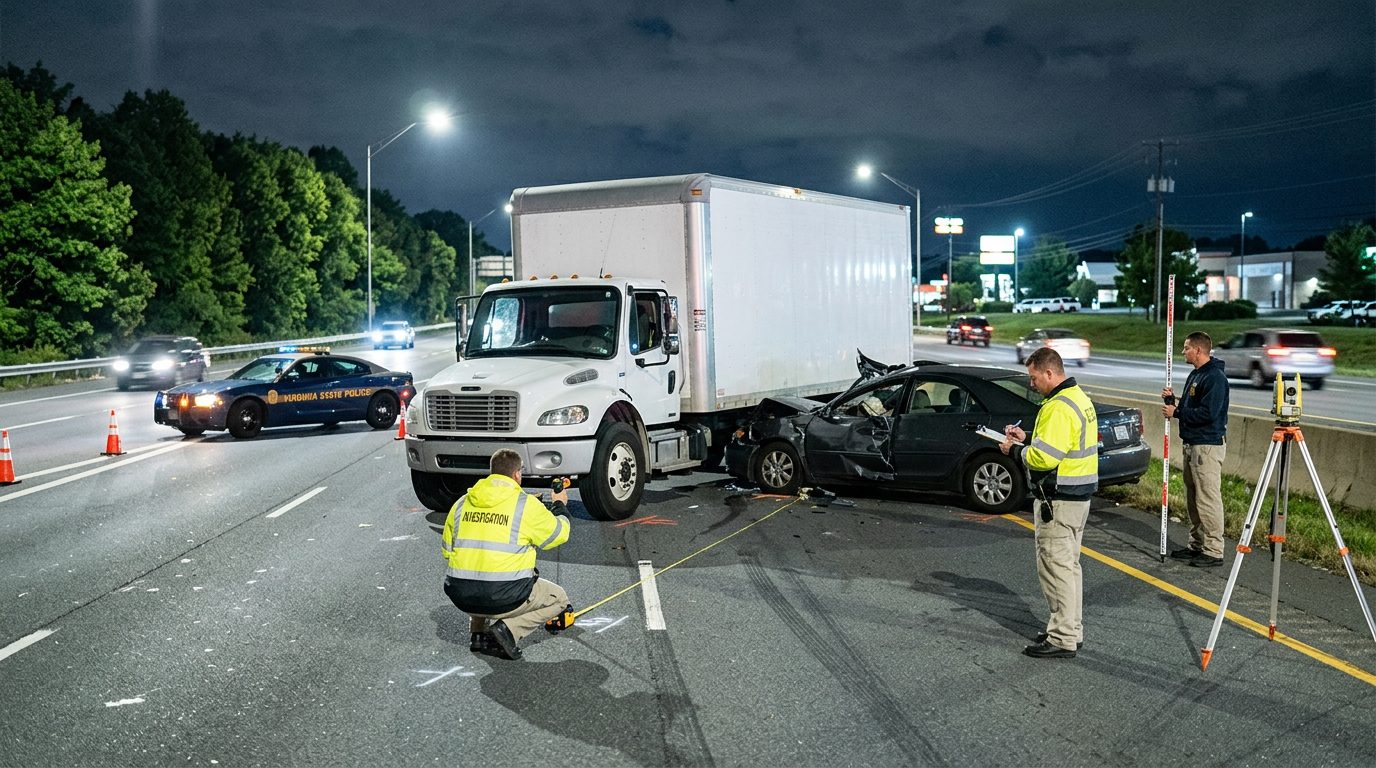
The police report becomes a central record of the crash. Families should ask for a copy and note the report number early. Statewide crash data, including commercial motor vehicle crashes, is published each year in the Virginia DMV traffic crash report.
The two-year period for filing a wrongful death action is the deadline to file a lawsuit, not the deadline to report a crash (Va. Code § 8.01-244(B)).
Not sure what your next step is?
Talk it through with Correll Law Firm — we can walk you through how a situation like yours is usually handled and what your options are.

Records and Timing to Track Before Speaking With a Lawyer
Families can start by gathering the police report, medical and hospital records, funeral receipts, pay records, and any photos or messages about the crash.
Write down the date of death. The two-year filing period under Va. Code § 8.01-244 runs from that date, so tracking it from the start helps.
Keep copies of letters from insurance companies, with dates. A simple folder for every bill and letter keeps the family’s facts in order.
Every case turns on its own facts. The family may wish to talk with a lawyer about those facts before deciding how to proceed. Organized records make that conversation more useful.