
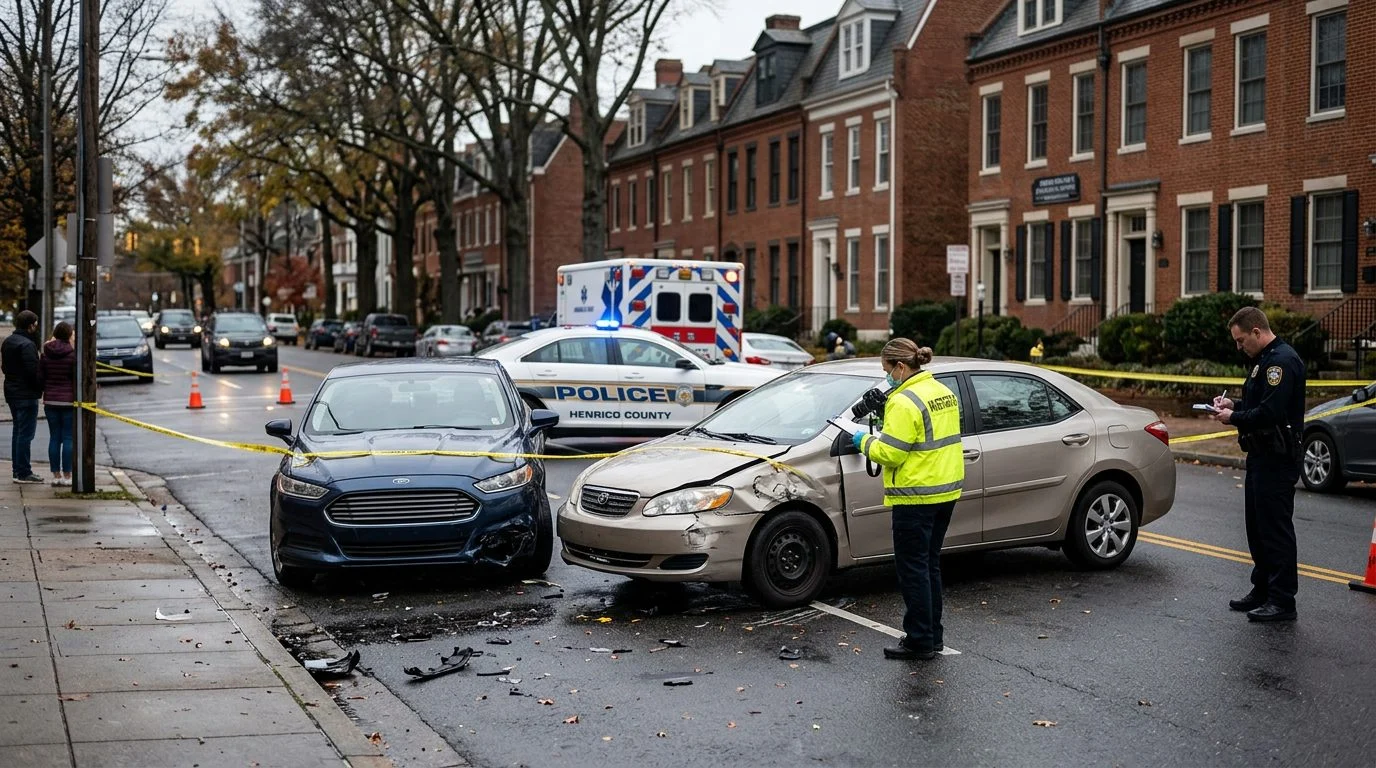
Car and Truck Accidents | Winchester, Harrisonburg and Virginia
Making Sense of Fault After a Crash
Reports, photos, witness accounts and company records each tell part of the story. Here is how they fit together.
Published November 21, 2026
After a crash, most people want to know who caused it. The answer usually comes from several kinds of evidence weighed together: the police report, statements, vehicle damage, traffic rules and, in truck crashes, company records.
Why Fault Matters After a Crash
Fault is the question of who caused the crash, and the answer shapes who may be responsible for the losses that follow.
Those losses often include medical bills, lost income, vehicle repairs and pain that lasts long after the crash. When one driver’s conduct caused the harm, that driver or the driver’s insurer may be asked to cover those losses. If fault is unclear, the other side may dispute the facts, and the question can stay open for months.
Early evidence matters for that reason. Skid marks fade, vehicles get repaired, and witnesses drive away. A hurt driver may not remember details clearly, especially after a head injury. Recording what happened while it is fresh gives everyone a better starting point.
The firm represents people hurt in car and commercial truck crashes, including people with catastrophic injuries and families in wrongful death cases. The firm has offices in Winchester and Harrisonburg. It serves people from the Shenandoah Valley to Richmond and Henrico County.
If a crash left you or someone you love hurt, you may have a claim, and the firm can talk through the facts with you. Talk it through with Correll Law Firm — we can walk you through how a situation like yours is usually handled and what your options are.
Who Decides Fault
Insurance adjusters, police officers and courts may each look at how a crash happened.
Insurance adjusters review a claim when it is made. They gather the police report, statements, photos and records. Then they form a view on who is most likely at fault. That view guides how the insurer responds to the claim.
Police officers document what they see at the scene. They may note apparent causes and traffic violations. Their report is valuable evidence, but it is not a final legal ruling.
If a lawsuit is filed, a judge or jury decides fault based on the evidence presented in court. Each group works from different information, so their views can differ. An adjuster may see a claim as clear early. A court may hear a fuller picture later.
Does a traffic ticket decide fault?
No. A ticket can be part of the evidence.
What the Police Report Shows
A police crash report records what the responding officer saw, heard and was told at the scene.
Reports usually list the parties, vehicles, roadway conditions, weather and a diagram of the crash. They often include the officer’s observations and any citations issued. Read the report carefully. Names, lane positions and directions of travel can be recorded wrong, and errors matter because insurers and courts often start with the report.
Virginia requires a driver involved in a crash with injury or death to stop and report it to police immediately (Va. Code §§ 46.2-371, 46.2-894). The two-year period is the deadline to file a lawsuit, not to report a crash (Va. Code § 8.01-243).
A report reflects only what the officer could see and learn at that time. It is one record among several, not the whole story.
Statements From Drivers and Witnesses
Statements from drivers and witnesses describe what each person saw, heard and did before the impact.
Investigators compare these accounts for consistency. An account that matches the damage, the signal timing and the layout of the road usually carries more weight than one that does not. Small details, like which lane a car was in or whether brake lights came on, can separate a reliable account from one that drifts over time.
Timing matters. Memory fades, so early accounts tend to capture details that are later lost. A driver who was badly shaken or hit their head may recall events differently at first and more clearly later. Stick to what you observed, and be honest about gaps.
Independent witnesses matter because they have no stake in the outcome. Insurers and courts weigh their accounts against those of the drivers, who each have a reason to describe events favorably. A witness who saw the light change is useful, even if they did not see the impact. Note how to reach each witness while the scene is still fresh.
Physical Evidence: Location and Pattern of Damage
Vehicle damage can show how a crash happened, though it rarely proves fault on its own.
Front-to-rear damage is a common example. It often suggests the rear driver did not leave enough room or did not brake in time. That is not automatic proof. A lead car may stop suddenly, or a driver may cut into a gap.
The location of damage on each vehicle can show the direction and angle of impact. A low mark on a bumper points to a different kind of contact than a crushed door panel. Investigators look at both vehicles together.
Sideswipes raise the question of who sideswiped who. Matching paint transfer, the height of damage on each car and the direction of scraping on both vehicles can show which way each car was moving.
Vehicles are often repaired or sold quickly, and the evidence leaves with them. Photograph both vehicles from several angles before any repair, and keep damaged parts if you can.
Traffic Laws, Signage and Right-of-Way
Traffic laws give investigators a standard for judging each driver’s conduct at the time of the crash.
Right-of-way rules, traffic signals, stop signs, lane markings and speed limits form that standard. A driver who ran a red light or failed to yield has a hard time explaining it. The timing of the signal and the driver’s line of sight become key facts.
Weather, lighting and road conditions are weighed alongside the rules. A rainy night or low sun glare can change what a reasonable driver could see.
Not sure what your next step is?
Talk it through with Correll Law Firm — we can walk you through how a situation like yours is usually handled and what your options are.
How Insurers Evaluate Fault and How Long It Can Take
An insurer usually reviews the evidence it can collect before deciding who is most likely at fault, and that review takes time.
Typically, the insurer reviews the report, requests statements, examines damage photos and checks medical records when injuries are claimed. Each step adds time, especially when parties disagree or witnesses are hard to reach.
Court deadlines run on a separate clock. Virginia generally allows two years from the date of injury to file a personal injury lawsuit (Va. Code § 8.01-243(A)); the clock runs from the date of injury, not the date of discovery, with narrow exceptions. Some claims carry notice requirements that run out sooner.
Your own policy may matter too.
Keep records of medical visits, bills and missed work from the start. Dates and amounts are easy to record now and hard to rebuild later.
How long does it take for insurance to determine fault?
It depends on the facts, including how many parties are involved and whether injuries are still being treated. A claim can wait longer when the evidence is disputed.
What Makes Fault Harder to Determine
Fault is harder to sort out when accounts conflict, witnesses are missing or vehicle data is lost.
Virginia follows contributory negligence: if you are found even partly at fault, you may be barred from recovering, with limited exceptions. Talk to a lawyer about your facts.
Serious injuries can complicate the record. A traumatic brain injury can affect memory and attention, so an early statement may later differ from what a person recalls. Medical records made at different times help show what was documented, and when.
Fault in Commercial Truck and Commercial Vehicle Crashes
Truck and commercial vehicle crashes often involve more parties and more records, which can make fault clearer or more contested.
The parties can include the driver, the motor carrier that employs the driver, the vehicle’s owner and others tied to maintenance or loading. Each may hold records that bear on what happened.
Federal rules require some of these records. A motor carrier must keep records of duty status and supporting documents for each driver for not less than six months from the date of receipt (49 C.F.R. § 395.8). Drivers must prepare a written inspection report for each vehicle they operate, except for intermodal equipment tendered by an intermodal equipment provider, and drivers are not required to prepare a report if no defect or deficiency is discovered by or reported to them; carriers must keep those reports for three months, unless the rules do not apply: private motor carriers of passengers (nonbusiness), driveaway-towaway operations, or carriers operating only one commercial motor vehicle (49 C.F.R. § 396.11).
After certain crashes, an employer must test surviving drivers for alcohol as soon as practicable (49 C.F.R. § 382.303). After certain crashes, the test must be given as soon as practicable, and which drivers must be tested depends on the type of crash and the driver’s citation status (49 C.F.R. § 382.303).
These are minimum retention periods, so records can be discarded once they expire. Early preservation matters. A delay can mean a record is no longer available to review.
Do trucking companies have to keep records after a crash?
Federal rules set minimum retention periods for certain driver and vehicle records. Those periods are short, so the timing of a request for records can matter.
When a Crash Causes Death: Fault and Wrongful Death
When a crash causes a death, the same fault questions apply, but a separate legal action carries them forward.
Virginia law makes any person or corporation, or any ship or vessel, that causes a death through a wrongful act, neglect, or default liable in an action for damages, even though the injured person has died, but only if the injured person could have sued for it had they lived (Va. Code § 8.01-50). A Virginia wrongful death action is filed by the decedent’s personal representative within two years of the death (Va. Code §§ 8.01-50(C), 8.01-244(B)), on behalf of the family members the statute protects.
The fault evidence looks much like the evidence in any crash: the police report, statements, damage, traffic rules and, for trucks, company records. A brain injury that leads to death days or weeks later can make the timeline harder to trace. Medical records from the crash through the death help show that link.
Families facing this often have many questions at once. The firm handles wrongful death matters for families in the areas it serves, and the questions above apply to these matters as well.