
Truck Accidents | Virginia
Truck Accident Lawsuit Deadline in Virginia: Understanding the Two-Year Rule
Commercial truck crashes involve more parties, more paperwork and more insurers. Knowing how timing works from the start helps protect your claim.
Published October 28, 2026
The short answer for most truck accident injury claims
Virginia generally allows two years from the date of injury to file a personal injury lawsuit (Va. Code § 8.01-243(A)); the clock runs from the date of injury, not the date of discovery, with narrow exceptions. Some claims carry written notice requirements that run out sooner, and the duty to report a crash applies immediately; both are covered below.
Truck crashes often involve several drivers, a trucking company and more than one insurer. That makes dates easy to lose track of. Writing a simple timeline starting from the day of the crash helps. For an overview of how these claims work, read the firm’s guide to truck accident claims.
Not sure what your next step is?
Talk it through with Correll Law Firm — we can walk you through how a situation like yours is usually handled and what your options are.

When the two-year clock starts
The clock starts on the date of injury. In most truck crashes, that is the date of the crash itself.
Va. Code § 8.01-230 says the period begins when the injury is sustained. It does not wait for the damage to be discovered, unless another statute or an equitable claim applies.
Some injuries show up days or weeks later. A headache or neck pain can grow into a serious condition over time. The law still looks back to the date of injury. Waiting to see how symptoms develop can use up part of the two years.
The facts of each situation decide how this rule applies. That is one reason people with questions about their own timing may wish to speak with a lawyer early.
Wrongful death claims after a fatal truck crash
A Virginia wrongful death action is filed by the decedent’s personal representative within two years of the death (Va. Code §§ 8.01-50(C), 8.01-244(B)), on behalf of the family members the statute protects.
The wrongful death statutes are Va. Code § 8.01-244 and Va. Code § 8.01-50.
Virginia wrongful death damages cover the family’s sorrow, mental anguish and loss of the decedent’s companionship, guidance and care; lost income and services; medical expenses from the injury; funeral expenses; and, for willful or wanton conduct, punitive damages (Va. Code § 8.01-52).
The wrongful death period runs from the death, not the crash. If someone is hurt in a crash and dies later, the injury clock and the death clock may both be running. Both dates matter, so note each one.
Claims that may carry shorter notice requirements
Some claims require written notice before a lawsuit, and that notice can run out sooner than the two-year lawsuit deadline. Under Va. Code § 15.2-209, a negligence claim against a county, city or town is barred unless a written statement of the claim, including the time and place of injury, is filed within six months after the claim accrues. Failure to file does not bar the claim if the locality’s attorney, chief executive, or mayor, or an insurer covering the claim, had actual knowledge of it within that period. If the claimant was under a disability when the cause of action accrued, the tolling provisions of § 8.01-229 apply.
A claim against the Commonwealth or a transportation district requires a written statement within one year (Va. Code § 8.01-195.6). Va. Code § 8.01-195.6 reads: “Failure to provide such statement shall not bar a claim against the Commonwealth or a transportation district, provided that (i) for claims against the Commonwealth, the Division of Risk Management or any insurer or entity providing coverage or indemnification of the claim or the Attorney General or (ii) for claims against a transportation district, the chairman of the commission of the transportation district, had actual knowledge of the claim, which includes the nature of the claim, the time and place at which the injury is alleged to have occurred, and the agency or agencies alleged to be liable, within one year after such cause of action accrued.” Va. Code § 8.01-195.6 reads: “Every claim cognizable against the Commonwealth or a transportation district shall be forever barred unless the claimant or his agent, attorney or representative has filed a written statement of the nature of the claim, which includes the time and place at which the injury is alleged to have occurred and the agency or agencies alleged to be liable, within one year after such cause of action accrued.” Both statutes include actual-knowledge provisions, so the facts of each case matter.
A truck crash can involve more than one party, including a driver and a trucking company. A road owner may also be involved in some crashes. Identifying each possible party early keeps the timeline clear.
Reporting the crash is a separate duty with its own timing
Virginia requires a driver involved in a crash with injury or death to stop and report it to police immediately (Va. Code §§ 46.2-371, 46.2-894).
The two-year period is the deadline to file a lawsuit, not to report a crash (Va. Code § 8.01-243). The reporting duty comes right away, at the scene.
The driver must also give reasonable help to anyone hurt. That can include taking the injured person to a doctor or hospital when treatment is apparent or requested. The full duties appear in Va. Code § 46.2-894.
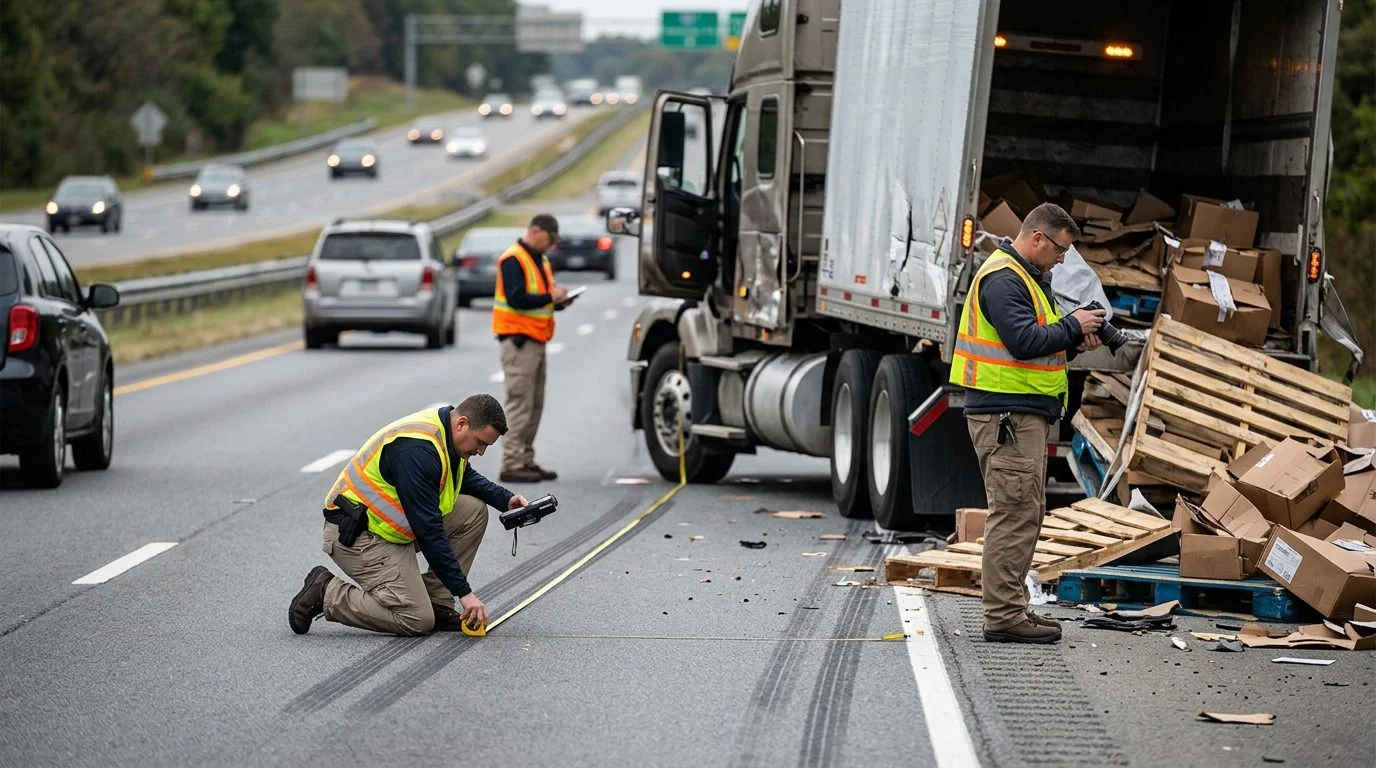
Notes made at the scene help later. Photos, the time and place, and names of witnesses can all matter when a claim is reviewed.
Why timing affects proof in truck crash claims
Trucking companies keep records such as driver logs, maintenance files and inspection reports. Waiting can make some of these records harder to gather. Memories of the scene can also fade.
Federal rules require drug and alcohol testing of commercial driver’s license drivers after certain crashes, along with other testing rules. Details are on the FMCSA testing page.
For a fuller discussion of the proof these cases can depend on, read about evidence needed to prove a commercial truck driver was at fault.
Fault can also affect a claim. Virginia follows contributory negligence: if you are found even partly at fault, you may be barred from recovering, with limited exceptions. Talk to a lawyer about your facts.
Not sure what your next step is?
Talk it through with Correll Law Firm — we can walk you through how a situation like yours is usually handled and what your options are.

Related questions about injuries and compensation
A claim’s timing depends on its type, and the losses it covers depend on the injuries involved.
To see the kinds of losses a truck crash claim may cover, read about what compensation you can recover in a truck accident lawsuit in Virginia.
For the injuries that often lead to these claims, see which injuries qualify for a serious injury claim in Virginia.
Keep three dates in mind after a truck crash: the date of injury, the date of death if one occurs, and any written notice deadline. The two-year rule is the starting point, but the other dates can change the timeline.