
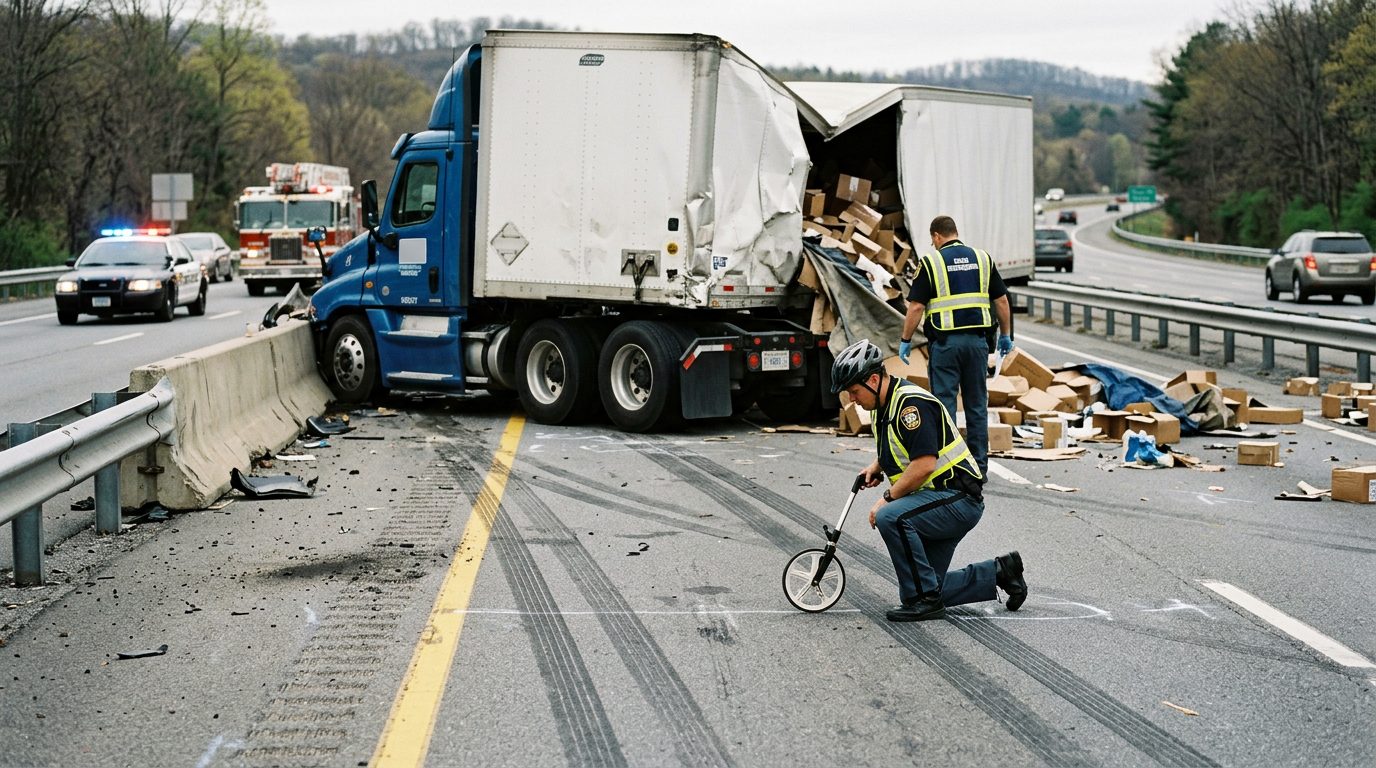
Truck Accidents | Virginia
Virginia Truck Accident Settlements: What Affects Them
A plain-language guide to the crash facts, injuries and records that often shape a truck accident claim in Virginia.
Where the firm works
VA
Serving the Shenandoah Valley, Richmond and Henrico County
Published October 27, 2026
If you are asking how much most truck accident settlements are, the short answer is that no reliable single figure exists. This page does not publish an average, a typical range or a chart of amounts. Instead, it explains what shapes a settlement discussion and why a number from another website may not fit your situation. It is written for people hurt in a truck or commercial vehicle crash, and for families facing a wrongful death, in the Shenandoah Valley, Richmond, Henrico County and nearby areas.
Why no single “typical” truck accident settlement can be stated
No reliable typical figure applies to every truck crash, so this page does not offer one. The question assumes one number fits most cases. Crashes differ in how they happened, who was hurt, how badly, and what treatment followed. A meaningful average would need verified, sourced data, and this page does not contain it.
Many websites post wide ranges of dollar amounts for truck settlements. Those figures often come from one firm’s own cases or from unnamed databases. They are not tied to a government agency, a peer-reviewed study or a recognized research body. That makes them a weak guide to any one claim. Reading them can leave a person with the wrong picture of their own situation.
The rest of this page explains what shapes a settlement discussion. It does not quote figures or timelines. Its goal is to help you ask better questions. The firm’s truck accident claims page covers the practice area in more detail.
Not sure what your next step is?
Talk it through with Correll Law Firm — we can walk you through how a situation like yours is usually handled and what your options are.

What a settlement discussion depends on
Settlement discussions turn on the facts of the crash, the injuries and the records that document them. An attorney may review how the crash happened. That can include police reports, photos, witness statements and any video. The attorney may also review medical records, bills and the treatment you received. Documented losses, such as time away from work and the care you need, are part of that review.
Each of these items is something to examine. None is a rule that raises or lowers an amount. A strong record does not promise a result. A gap in the records does not automatically decide a case either.
Long-term effects differ from person to person. Recovery from a traumatic brain injury or a spinal cord injury can change over months or years. Your treating doctors are the right source for your prognosis. A lawyer cannot predict that from a web page, and neither can this article.
Why commercial truck crashes can involve more parties and records
A commercial truck crash can involve more people and companies than a typical car crash. Each one may hold different records. The driver, the trucking company, the vehicle owner, a leasing company or a freight broker may each play a role.
Federal rules require carriers to keep certain records, but only for limited periods. When a driver finds or is told of a defect, the driver vehicle inspection report must be kept for three months from the date the written report was prepared; no report is required if no defect was found or reported (49 C.F.R. § 396.11). Maintenance records must be kept for one year, and for six months after the vehicle leaves the carrier’s control (49 C.F.R. § 396.3). Driver qualification files are kept while the driver works for the carrier and for three years after (49 C.F.R. § 391.51).
Records a lawyer may request include crash reports, driver duty logs, inspection and repair files, and hiring files. These are items to review. They are not proof of fault by themselves. Who chose the carrier can matter too.
Fault and partial fault under Virginia law
Under Virginia law, a finding of partial fault can bar recovery. Virginia follows contributory negligence: if you are found even partly at fault, you may be barred from recovering, with limited exceptions. Talk to a lawyer about your facts.
Fault is worked out from the specific facts of the crash. Video, witness accounts and the crash report are common sources a lawyer may review with you. No single item decides how fault is viewed. Commercial trucks add questions about the driver’s hours and the vehicle’s condition, which is why the records above can matter to fault.
If you are unsure how the crash happened, you may wish to talk through the full facts with a lawyer before drawing conclusions. Writing down what you remember while it is fresh is a simple habit that many people find helpful.
Filing deadlines and crash reporting
Virginia sets a general filing deadline for personal injury lawsuits. A separate reporting duty applies right after a crash. Virginia generally allows two years from the date of injury to file a personal injury lawsuit (Va. Code § 8.01-243(A)); the clock runs from the date of injury, not the date of discovery, with narrow exceptions. Va. Code § 8.01-243(A) provides that, unless otherwise provided in this section or by other statute, every action for personal injuries, whatever the theory of recovery, shall be brought within two years after the cause of action accrues (Va. Code § 8.01-243).
Some claims carry notice requirements that run out sooner. A lawyer may review those for your situation.
Virginia requires a driver involved in a crash with injury or death to stop and report it to police immediately (Va. Code §§ 46.2-371, 46.2-894). The two-year period is the deadline to file a lawsuit, not to report a crash. The reporting duty is set out at Va. Code § 46.2-894, which also requires reasonable assistance to an injured person.
Wrongful death and catastrophic injury claims
A wrongful death claim in Virginia follows its own rules, separate from an injury claim. A Virginia wrongful death action is filed by the decedent’s personal representative within two years of the death (Va. Code §§ 8.01-50(C), 8.01-244(B)), on behalf of the family members the statute protects. They share in any recovery.
Under § 8.01-55, the personal representative of the deceased may compromise any claim to damages arising under § 8.01-50, with the approval of the court in which the action was brought, or, if no action has been brought, with the consent of a circuit court. That is true whether or not a lawsuit has been filed (Va. Code § 8.01-55).
Catastrophic injuries, including traumatic brain injury and spinal cord injury, often involve long recovery periods and ongoing care needs. Those medical details come from treating providers and vary widely by person. This page cannot predict how any injury will progress or how a claim may proceed.
Not sure what your next step is?
Talk it through with Correll Law Firm — we can walk you through how a situation like yours is usually handled and what your options are.
Common questions readers ask about settlement offers and timing
Whether an offer is fair cannot be judged from a single number. An offer is measured against the facts of the crash, the injuries and the records. It is not measured against a figure from someone else’s case. Comparing your situation to other crashes or to figures on other sites rarely answers that question.
Timing is also hard to state in general. Medical treatment, record requests and any required court approval can all affect how long a matter takes. No timeline can be predicted from this page. A lawyer may discuss how timing could look in your specific situation.
The firm handles truck accidents, commercial vehicle crashes, car accidents, catastrophic injuries and wrongful death matters. The firm’s offices are in Winchester and Harrisonburg. It represents people from the Shenandoah Valley to Richmond and Henrico County.
Is a truck accident settlement offer fair?
No single number can answer that. An offer is measured against the facts of the crash, the injuries and the documented losses.
How long does a truck accident settlement take?
No timeline can be stated here. Medical care, records and court steps can all affect timing.
Does a wrongful death settlement need court approval in Virginia?
Yes. A personal representative needs court approval to compromise a wrongful death claim under Virginia law.
If you are researching after a truck crash, or weighing a loss in your family, these questions are a reasonable place to begin.