
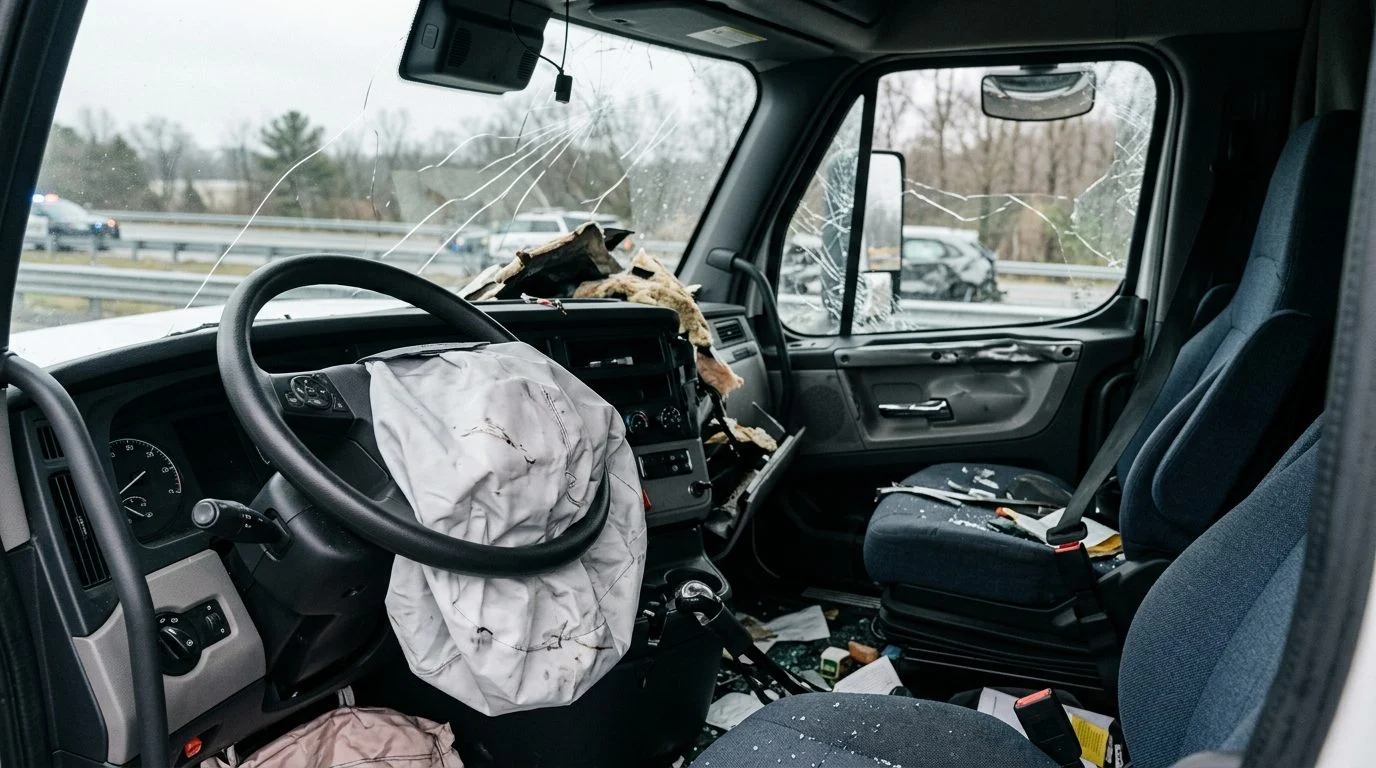
Ligament Damage From a Semi Truck Crash: The Basics of a Virginia Claim
Ligament tears often do not show up on a standard X-ray. Here is how medical records, crash facts and day-to-day impact fit together when a truck crash leaves a serious knee, ankle, shoulder or spine injury.
Published November 3, 2026
What Ligament Damage Means After a Large Truck Crash
Ligament damage is an injury to the tough bands of tissue that connect bones at a joint. A sprain stretches a ligament. A tear partly or fully separates it.
Ligaments help hold the knee, ankle, shoulder, wrist and spine steady. A semi-truck crash can put enough force on these joints to injure them. Sudden jolts, twisting, and being pinned or thrown can all stretch or tear ligaments. This can happen even when no bone breaks.
Some ligament injuries are not obvious at the scene. Pain, swelling or a joint that feels unstable can appear hours or days later. Many people feel shaken and assume they are fine. That delay is one reason prompt medical care matters, both for recovery and for a clear medical record.
Not sure what your next step is?
Talk it through with Correll Law Firm — we can walk you through how a situation like yours is usually handled and what your options are.

Can Ligament Damage in a Virginia Truck Crash Support a Claim?
Each injury situation depends on its own facts. Losses can include medical bills, lost income and pain and suffering.
Causation is the key link.
A ligament injury is handled like other physical injuries in this analysis. The outcome depends on how the crash happened and how the injury was diagnosed and treated. Every case turns on its own facts. No one can say in advance what a claim will be worth.
How Ligament Injuries Are Diagnosed and Documented
Ligament injuries are usually found through a physical exam. Imaging such as X-rays or an MRI may follow when a doctor orders it. Care often starts at an emergency room, urgent care or a physician’s office, then moves to follow-up visits and, when needed, an orthopedic provider.
Records matter because the other side may argue that a tear was old or unrelated to the crash. Clear notes help answer that. They should show when symptoms began, what the person reported, what treatment followed, and how the joint changed over time.
Honest history matters too. A past injury to the same joint does not end the analysis by itself. Treating providers’ records help show what changed after the crash. Keep copies of bills, prescriptions, imaging results and any time missed from work.
Trucking-Specific Evidence That Can Matter
Truck crashes often leave more records than car crashes do. The police report and photos are a start. Federal rules also require an employer to test surviving drivers for alcohol and controlled substances after certain crashes. Those rules apply when the crash involved the loss of human life, for drivers performing safety-sensitive functions with respect to the vehicle, or when a driver receives a citation for a moving traffic violation arising from the crash, within the time limits the regulation sets, if the crash involved someone receiving medical treatment away from the scene or a vehicle needing a tow because of disabling damage (49 C.F.R. § 382.303).
If an alcohol test is not given within two hours, the employer must keep a record of the reasons.
Carriers must also keep vehicle inspection, repair and maintenance records. They keep them for one year, and for six months after the vehicle leaves their control (federal vehicle maintenance rules). Because these records have set retention periods, requesting them early helps.
Other useful evidence includes witness names, dash-camera video, vehicle damage photos, and how the truck was driven. Speed, following distance and driver attention can all bear on fault. That matters when both a driver and a trucking company may bear responsibility.
Partial Fault and How It Can Affect a Ligament Claim
Fault is often disputed after a truck crash. Virginia follows contributory negligence: if you are found even partly at fault, you may be barred from recovering, with limited exceptions. Talk to a lawyer about your facts.
Early photos, witness names and dash-camera footage can help show what happened. That evidence often matters most when drivers describe the crash differently.
Time Limits, Crash Reporting and Notice Rules
Virginia generally allows two years from the date of injury to file a personal injury lawsuit (Va. Code § 8.01-243(A)); the clock runs from the date of injury, not the date of discovery, with narrow exceptions. Under Va. Code § 8.01-243, unless that section or another statute provides otherwise, every action for personal injuries, whatever the theory of recovery, shall be brought within two years after the cause of action accrues.
Virginia requires a driver involved in a crash with injury or death to stop and report it to police immediately (Va. Code §§ 46.2-371, 46.2-894). The two-year period is the deadline to file a lawsuit, not the deadline to report a crash (Va. Code § 8.01-243).
Claims against a county, city or town can carry a shorter rule. Under Va. Code § 15.2-209, a written statement of the claim, including the nature of the claim and the time and place at which the injury is alleged to have occurred, must generally be filed within six months after the claim accrues, with the county, city or town attorney or the chief executive or mayor. An exception applies when the attorney, chief executive or mayor of the locality, or any insurer or entity providing coverage or indemnification of the claim, had actual knowledge of the claim within six months after the claim accrued, where that knowledge includes the nature of the claim and the time and place at which the injury is alleged to have occurred. Readers should not assume the full two years applies to every claim.
Not sure what your next step is?
Talk it through with Correll Law Firm — we can walk you through how a situation like yours is usually handled and what your options are.
Losses a Ligament Injury Claim May Include
Losses usually fall into a few groups. They include medical care for the crash injury, lost income, and pain, suffering and reduced quality of life. Lost work time is easier to show with employer letters and pay records. Virginia law says provable lost income is not reduced because of reimbursement from another source, and that reimbursement cannot be admitted into evidence (Va. Code § 8.01-35).
Punitive damages are a separate category.
Virginia allows punitive damages for actual malice, or for willful or wanton conduct or recklessness showing a conscious disregard for the safety of others, capped at $350,000 (Va. Code § 8.01-38.1). Under Va. Code § 8.01-38.1, the total punitive damages awarded against all defendants found liable may not exceed $350,000; the jury is not told of this limit, and if a jury returns a larger punitive award, the judge reduces it to that amount. The jury must find that the conduct met this standard.

Frequently Asked Questions About Ligament Injuries and Truck Crash Claims
Can ligament damage from a semi truck crash in Virginia support a claim if no bones broke?
Yes, a ligament tear can be shown through imaging and treatment records. Whether it supports a claim depends on the facts.
Does a past injury to the same joint end a claim?
No single fact decides it. Treating providers’ records help show what changed after the crash.
Does the firm handle truck crash claims for people in Richmond and Henrico County?
The firm represents people from the Shenandoah Valley to Richmond and Henrico County. Its offices are in Winchester and Harrisonburg.