
Truck Accidents | Richmond and Henrico County
Truck Accident Claims Guide for Richmond-Area Crashes
Plain-language answers for people hurt in commercial truck crashes on Richmond and Henrico County roads, from Correll Law Firm in Winchester, Virginia.
Published October 22, 2026
A truck crash injury claim asks for compensation from the people responsible for a crash with a large truck. This guide explains how these claims work in Virginia, which deadlines apply and which records matter. It is written for readers in the Richmond area and Henrico County, and for families facing a serious loss. The sections below cover who can be involved, common injuries, Virginia’s deadlines and what the process looks like.
What a Truck Crash Injury Claim Covers and Who It Is For
A truck crash injury claim seeks money for losses caused by a crash with a semi, box truck or other commercial vehicle. It can be brought by:
- Drivers and passengers in cars, SUVs and pickups hit by a truck.
- Pedestrians and cyclists struck by a truck.
- Families, when a truck crash causes a death.
A crash with a passenger vehicle often involves two drivers. A commercial vehicle crash can involve more people and companies, such as the driver, the company that runs the truck and the company that owns it. Each of those groups keeps its own records, which can make a claim more detailed. The firm handles car accidents, truck accidents and commercial vehicle accidents. Many people feel unsure whether a crash is “serious enough” to pursue. That question depends on the injuries and facts of each crash.
If a truck crash left you or someone you love hurt, you may have a claim, and the firm can talk through your facts with you. Talk it through with Correll Law Firm — we can walk you through how a situation like yours is usually handled and what your options are.

Truck Crashes on Richmond-Area Roads
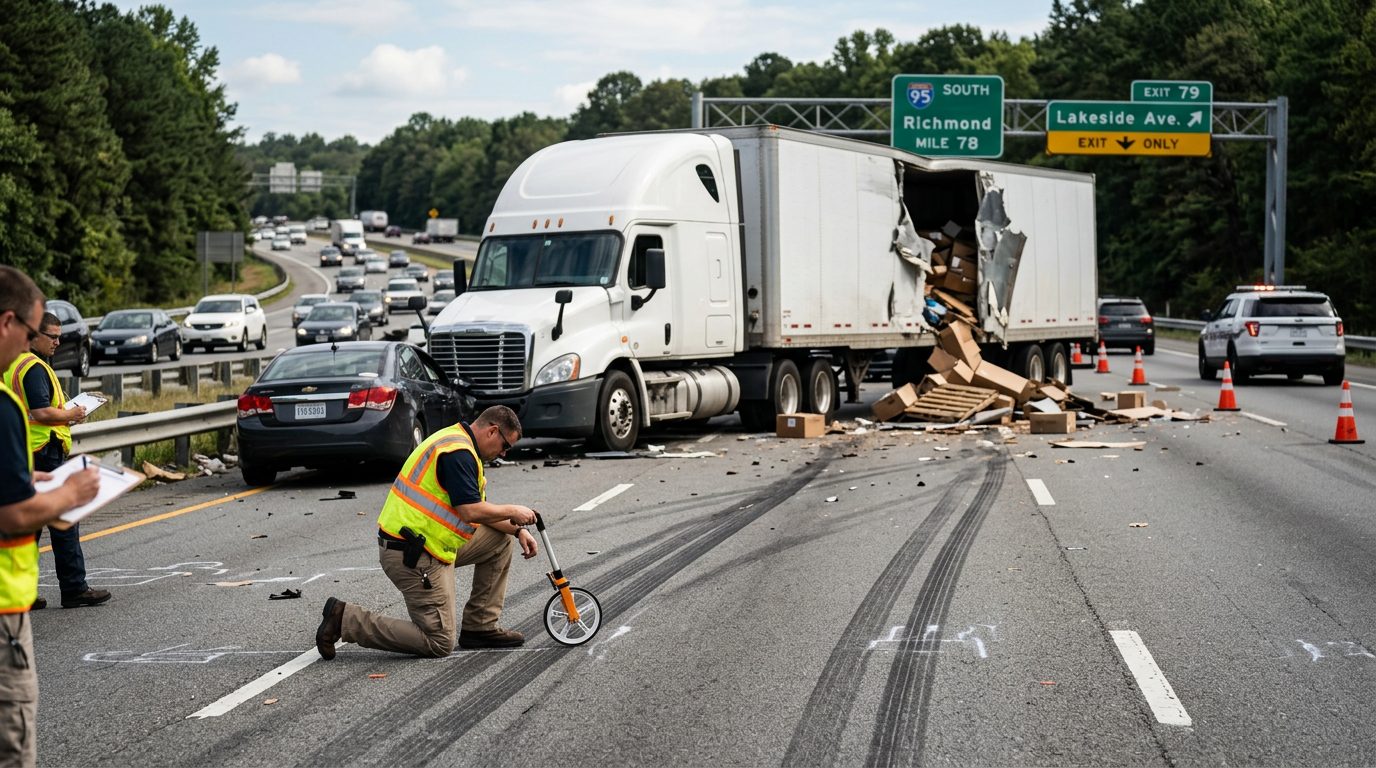
Truck crashes on busy Richmond-area roads can involve merging, lane changes, rear-end impacts and rollovers. Interstates such as I-95, I-295 and I-64 carry heavy truck traffic in the region. Heavy trucks need much more distance to stop than a passenger car. Their blind spots are also large, especially along the sides and directly behind the trailer. A driver who cannot see a car beside the truck may not know it is there. A loaded truck can take longer to slow down, which can leave a car driver less time to react.
Crash claims can involve people from the City of Richmond and Henrico County. The firm’s offices are in Winchester and Harrisonburg, Virginia. It represents people from the Shenandoah Valley to Richmond and Henrico County.
Common Injuries in Heavy Truck Crashes
Heavy truck crashes can cause catastrophic injuries, and some injuries take time to show their full effects. Common examples include:
- Catastrophic injuries, such as serious fractures, internal injuries, amputations and burns that change how a person lives and works.
- Traumatic brain injury, an injury to the brain from a blow or sudden jolt. Headaches, memory trouble and mood changes can appear or shift over days or weeks.
- Spinal cord injury, damage to the nerves that carry signals between the brain and body. It can affect movement, feeling and bladder control, and it may need long-term care.
Early medical records matter. They show what the injured person reported and when. A fuller picture often comes after ongoing treatment and follow-up visits. Keeping every appointment note and discharge summary helps show how the injury has changed over time.
Who May Share Responsibility for a Truck Crash
Several people or companies may share responsibility for a truck crash, and the answer depends on the facts. Possible parties include the truck driver, the motor carrier that operates the truck, the vehicle owner, a maintenance or repair company, a cargo loading company, and a trailer or parts maker.
Paperwork can show how a truck was operated and maintained. Federal rules require motor carriers to keep a record of duty status for each driver for each 24-hour period (49 C.F.R. § 395.8). Inspection reports must be kept for fourteen months and be available to officials on demand (49 C.F.R. § 396.21). Carriers also keep a driver qualification file for each driver they employ (49 C.F.R. § 391.51).
Electronic data from the truck and dispatch messages may also help show what happened. Records help investigators ask focused questions. They do not decide fault on their own.
Deadlines, Crash Reporting and Fault Questions
Virginia generally allows two years from the date of injury to file a personal injury lawsuit (Va. Code § 8.01-243(A)); the clock runs from the date of injury, not the date of discovery, with narrow exceptions.
Virginia requires a driver involved in a crash with injury or death to stop and report it to police immediately (Va. Code §§ 46.2-371, 46.2-894). The two-year period is the deadline to file a lawsuit, not to report a crash (Va. Code § 8.01-243).
Practical steps can protect a claim. Keep medical records, photos, the police report number and a note of missed work. Write down what you remember soon after the crash, while details are fresh.
How a Truck Crash Claim Moves Forward
A truck crash claim generally moves through five steps, from first contact to a possible lawsuit.
- You describe the crash, your injuries and any paperwork you have.
- Investigation. The firm gathers the police report, medical records, truck company records and witness statements.
- Medical picture. Treatment, follow-up visits and future care needs are documented. Outside medical professionals may review records and give opinions.
- Claim and negotiation. A written request for compensation is prepared and sent. Insurers respond, and the back-and-forth can take time.
- Lawsuit if needed. If the claim does not resolve, a lawsuit may be filed. Timelines vary, and each claim moves at its own pace.
Not sure what your next step is?
Talk it through with Correll Law Firm — we can walk you through how a situation like yours is usually handled and what your options are.
Wrongful Death Claims After a Fatal Truck Crash
A Virginia wrongful death action is filed by the decedent’s personal representative within two years of the death (Va. Code §§ 8.01-50(C), 8.01-244(B)), on behalf of the family members the statute protects. The personal representative is the person handling the deceased person’s legal affairs. Family members generally do not file the claim, but actions for fetal death under subsection B are brought by and in the name of the natural mother; if she dies or is under a disability as defined in § 8.01-2, the administrator of her estate, her guardian, or her personal representative qualified to bring such action may initiate or maintain it (Va. Code § 8.01-50(C)). They share in what is recovered, and the law decides who qualifies.
Virginia wrongful death damages cover the family’s sorrow, mental anguish and loss of the decedent’s companionship, guidance and care; lost income and services; medical expenses from the injury; funeral expenses; and, for willful or wanton conduct, punitive damages (Va. Code § 8.01-52).
Virginia allows punitive damages for actual malice, or for willful or wanton conduct or recklessness showing a conscious disregard for the safety of others, capped at $350,000 (Va. Code § 8.01-38.1).
Why People Bring Truck Crash Claims to the Firm
The firm handles car, truck and commercial vehicle crash claims, catastrophic injuries, traumatic brain injury, spinal cord injury and wrongful death. Those are the practice areas covered in this guide.
The firm’s offices are in Winchester and Harrisonburg, Virginia. It represents people from the Shenandoah Valley to Richmond and Henrico County. The firm’s support staff, including assistants and office staff, help families gather records and organize paperwork. Clear records make a claim easier to review, so gathering them early is a practical first step.
Frequently Asked Questions
Short answers to common questions follow.
How much are truck accident settlements?
Value depends on the injuries, the evidence and the facts of each crash. One claim cannot tell you what another is worth.
What should I avoid saying after a truck crash?
Avoid guessing about how the crash happened or downplaying your injuries. Keep notes of what each insurer and other person said to you.
Which injuries are hardest to document early?
Traumatic brain injury and some spinal cord injuries can show symptoms that develop over time. Ongoing medical records help show the full picture.
Should I speak with a lawyer after a truck crash?
A person may wish to speak with a lawyer about the facts of their own crash.