
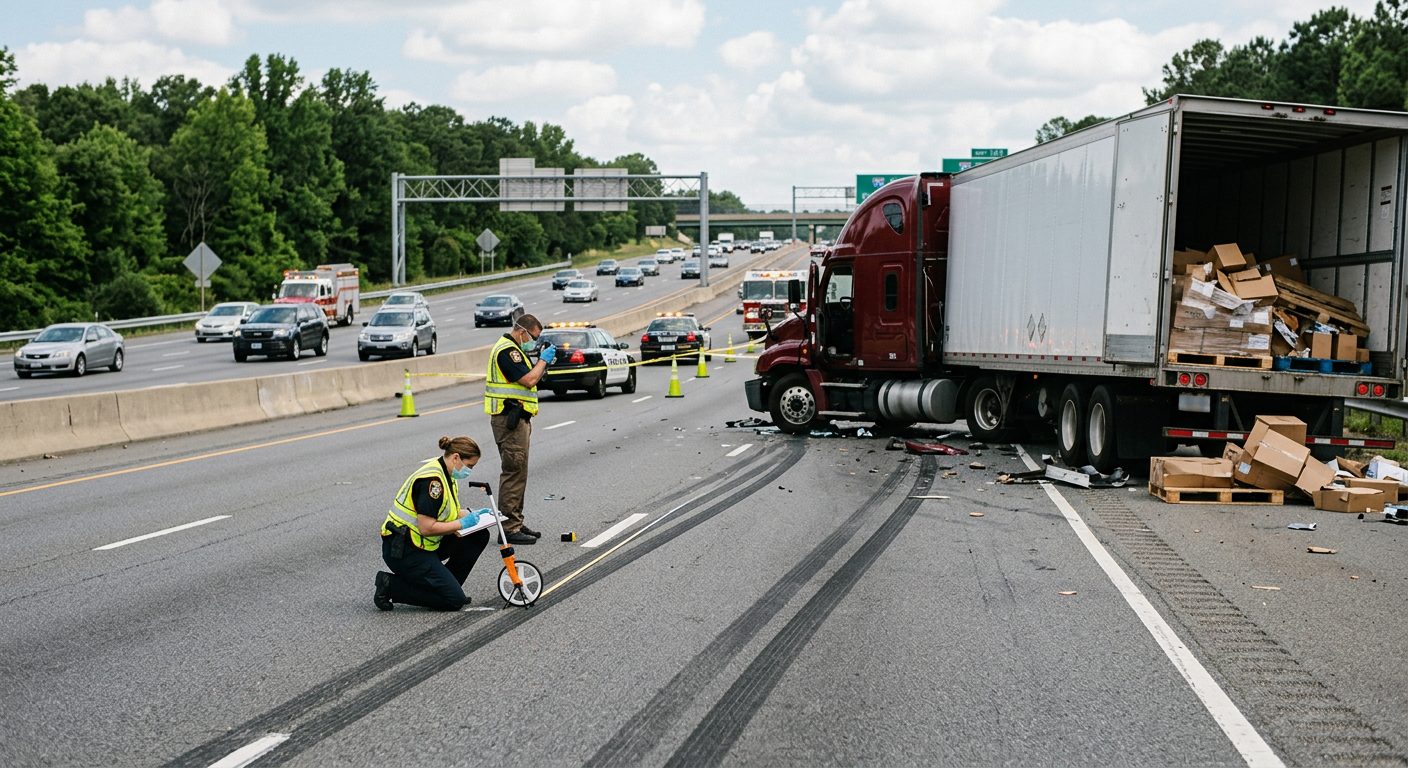
Truck Accidents | Richmond and Henrico County
A Semi Truck Crash on I-95 Can Change Everything in a Moment
Here is what to focus on first, what to keep track of, and how Correll Law Firm approaches serious truck and car crash cases from Richmond to the Shenandoah Valley.
Published October 22, 2026
If you are wondering what to do after a crash with a semi truck on I-95 near Richmond, start with safety, 911, and medical care. Then keep a clear record of what happened. This guide walks through those steps in order, using Virginia law where it applies.
Why a Crash with a Semi Truck on I-95 Is Different
A crash with a semi truck usually involves more parties and more records than a crash between two cars. Interstate trucks are generally subject to federal safety rules. The Federal Motor Carrier Safety Administration publishes hours-of-service rules that limit how long commercial drivers may drive and set required rest and break periods.
A truck crash can involve the driver, the trucking company, the company that leases the truck, the cargo owner, and several insurers. Each one may hold its own records. The details you collect early help keep the story straight.
I-95 runs through Henrico County and the Richmond area. Correll Law Firm, based in Winchester with an office in Harrisonburg, serves people hurt in Richmond and Henrico County.
If you are shaken, or you are reading this for someone else, the steps below are written to be followed in order.
Not sure what your next step is?
Talk it through with Correll Law Firm — we can walk you through how a situation like yours is usually handled and what your options are.

Step 1: Call 911 and Stop at the Scene
Virginia requires a driver involved in a crash with injury or death to stop and report it to police immediately (Va. Code §§ 46.2-371, 46.2-894). This duty starts at the scene. The statutes are Va. Code § 46.2-371 and Va. Code § 46.2-894.
The second statute also requires the driver to give reasonable help to anyone hurt. That includes taking the injured person to a physician or hospital when treatment is apparent or requested.
If you can do it safely, move your vehicle onto the shoulder and turn on your hazard lights. Stay out of the travel lanes on I-95, where traffic moves fast around a large truck. Tell the 911 operator about injuries, fire, or fuel leaks.
Step 2: Get Medical Attention, Even If You Feel Okay
Get checked by a medical provider as soon as you can, even if you feel fine at the scene. Some injuries are not obvious right away.
Tell every provider about every symptom. That includes headaches, dizziness, numbness, and neck or back pain. Describe how the crash happened, so the record shows how you were hurt.
Keep copies of visit notes, test results, and prescriptions. These records document your injuries and treatment over time. Keep follow-up visits too, because gaps in care can leave gaps in the record.
Step 3: Document the Scene Before Leaving
Photos and notes made at the scene are hard to recreate later. Take them only when you can do so safely.
- Photos of both vehicles, the truck’s cab and trailer, lane markings, road signs, weather, and the road surface.
- The truck’s company name, DOT number, unit number, and trailer number, if you can see them.
- The driver’s name, address, license number, and vehicle registration number, which Virginia law requires the driver to report after an accident in which a person is killed or injured or in which an attended vehicle or other attended property is damaged (Va. Code § 46.2-894). Virginia law requires the driver to share these details (Va. Code § 46.2-894).
- Names and contact details of witnesses.
- The time, your direction of travel, and the nearest exit or mile marker on I-95.
Federal rules add records you cannot collect yourself. 49 C.F.R. § 382.303 requires the employer to test its surviving drivers for alcohol after certain crashes. An alcohol test not given within two hours must be explained in the employer’s records. Testing attempts stop after eight hours.
No driver or motor carrier may make a false report about it (49 C.F.R. § 395.8).
Step 4: Be Careful With Insurance Companies and Recorded Statements
Share the basic facts, and avoid guessing about anything else. The trucking company’s insurer may contact you soon after the crash. Your own insurer may also reach out.
- Stick to what you saw, heard, and felt.
- Do not guess about speed, distance, or who caused the crash.
- Avoid saying you are fine or that the crash was your fault before you know your injuries.
- If an adjuster asks for a recorded statement, you may wish to speak with a lawyer before you agree.
- Write down each caller’s name, the date, and what they asked.
Tell your own insurer about the crash promptly, and write down the date you did so.
Should You File an Insurance Claim If You Are Not at Fault?
Filing a claim and deciding who is at fault are separate questions. Reporting the crash does not settle blame.
Virginia follows contributory negligence: if you are found even partly at fault, you may be barred from recovering, with limited exceptions (Contributory negligence bars recovery in Virginia). Talk to a lawyer about your facts.
Fault can be shared by more than one party.
Keep copies of every claim letter, the claim number, and each adjuster’s contact details. Written records make later questions easier to answer.
Not sure what your next step is?
Talk it through with Correll Law Firm — we can walk you through how a situation like yours is usually handled and what your options are.
Common Questions About Truck Crashes on I-95
Most drivers and families ask the same few questions in the first days after a truck crash.
What do I do if a semi hits my car?
Follow the steps above in order: get to safety, call 911, get medical care, then document the scene.
Can I speak with the trucking company directly?
You may choose whether to respond. You may wish to speak with a lawyer before giving any statement.
What if the driver is from another state?
Trucks that cross state lines are generally subject to federal rules. The carrier’s records may matter in that case.
Are there deadlines?
Virginia generally allows two years from the date of injury to file a personal injury lawsuit (Va. Code § 8.01-243(A)); the clock runs from the date of injury, not the date of discovery, with narrow exceptions. The statute is Va. Code § 8.01-243. Some claims carry notice requirements that run out sooner. The two-year period applies to filing a lawsuit, not to reporting a crash.
Who is responsible when a truck driver works for a company?

When It May Be Worth Talking With a Lawyer About Your Crash
A conversation with a lawyer may be worth considering after a serious injury, a family member’s death, unclear fault, or a crash involving a commercial carrier.
Correll Law Firm, based in Winchester with an office in Harrisonburg, handles car accidents, truck and commercial vehicle accidents, catastrophic injuries, traumatic brain injury, spinal cord injury, and wrongful death. The firm serves people from the Shenandoah Valley to Richmond and Henrico County.
Keep the crash report number, your photos and notes, medical records, and any insurer letters together. Each one answers a different question later. Organized records from the start make the next steps easier to follow.