
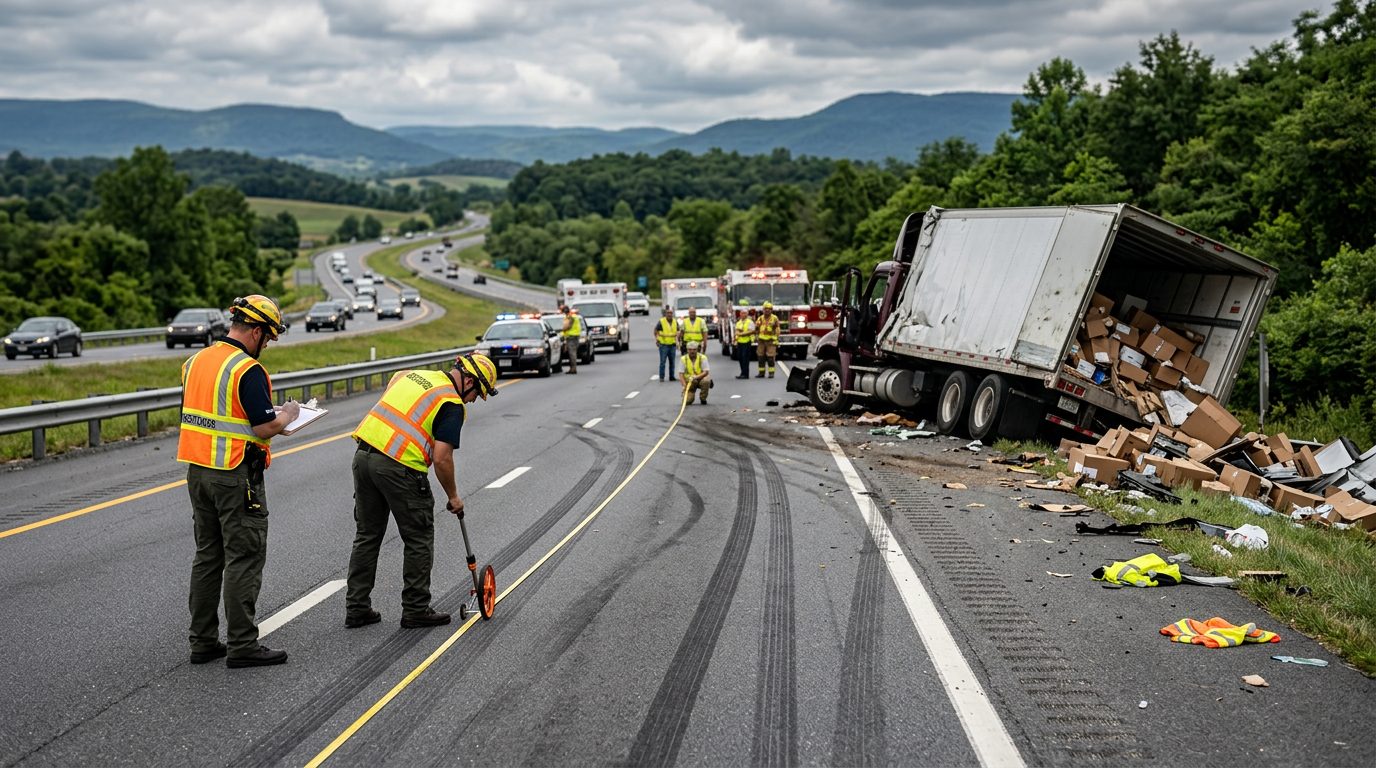
Truck Accidents | Shenandoah Valley, Virginia
Truck Accident Claims in the Shenandoah Valley
Published October 29, 2026
A truck accident claim asks for money after a crash with a commercial vehicle, such as a tractor-trailer. Virginia sets filing deadlines, and key evidence can disappear quickly. This guide explains how these claims work so you can make informed decisions about your next step. Correll Law Firm is a truck accidents law firm serving the Shenandoah Valley, including families in wrongful death cases.
What a Truck Accident Claim Involves in the Shenandoah Valley
A truck accident claim is a request for compensation after a crash involving a commercial vehicle. Commercial vehicles include tractor-trailers, box trucks, delivery vans and dump trucks.
These crashes differ from car crashes in several ways. A loaded truck is far heavier than a car and needs much more distance to stop. Many trucks run for a company, so a carrier, shipper or other business may be involved alongside the driver.
Interstate 81 and the highways that carry freight through the valley see heavy truck traffic. Crashes on these routes can involve more than one party, which makes the facts harder to sort out early.
Talk it through with Correll Law Firm — we can walk you through how a situation like yours is usually handled and what your options are.

Injuries and Losses This Practice Handles
The firm handles claims for catastrophic injuries, traumatic brain injury, spinal cord injury and wrongful death.
Catastrophic injuries can change a person’s ability to work, care for family or live on their own. Examples include amputations, severe fractures and organ damage.
A traumatic brain injury happens when a blow or jolt damages the brain. It can affect memory, mood, speech and daily function. Some symptoms are not obvious right after a crash, so early medical evaluation helps create a clear record.
A spinal cord injury can affect movement and feeling. Early medical records help show how the injury began and what care followed.
When a crash causes a death, the claim must be brought by and in the name of the personal representative of the deceased person. The timing and filing rules for these claims are explained below.
Who May Be Responsible in a Commercial Truck Crash
More than one party may be responsible in a commercial truck crash. The answer turns on the details of each crash.
- The truck driver
- The motor carrier that employs or leases the driver
- The owner of the truck
- A maintenance contractor that serviced the vehicle
- A company that loaded the cargo
Federal rules require motor carriers to investigate each driver they employ, other than a person regularly employed by the carrier for a continuous period that began before January 1, 1971, and keep written records of those inquiries (49 C.F.R. § 391.23). Those files can show how a company screened and supervised its driver.
Virginia follows contributory negligence: if you are found even partly at fault, you may be barred from recovering, with limited exceptions. Talk to a lawyer about your facts.
An investigation may take time, because records and vehicle data can arrive in stages.
Evidence That Is Time-Sensitive After a Truck Crash
Evidence from a truck crash can be lost or changed quickly, so early records matter. Virginia requires a driver involved in a crash with injury or death to stop and report it to police immediately (Va. Code §§ 46.2-371, 46.2-894).
The reporting duty is separate from the deadline for filing a lawsuit. Reporting covers the crash record. The filing deadline covers the court case.
Gather or preserve these items as soon as you can:
- The police crash report and its report number
- Photos of the scene, the vehicles and the damage
- Contact details for any witnesses
- Medical records and bills
- A personal journal of symptoms, missed work and appointments
Trucking companies keep records too. Federal rules require a motor carrier to have each driver record the driver’s duty status for each 24-hour period, except for a private motor carrier of passengers (nonbusiness) (49 C.F.R. § 395.8). Federal rules also let carriers keep records by any technology that accurately reflects all of the information and remains accessible in a form that can be accurately reproduced later for reference (49 C.F.R. § 379.7). Asking early for those records to be kept helps protect them.
How a Truck Accident Claim Typically Moves Forward
Most truck claims move through review, investigation, medical documentation, insurance talks and, if needed, a lawsuit.
- Initial review of the crash, the injuries and the records.
- Investigation of the vehicle, company files and driver records.
- Medical documentation that shows how the injuries occurred and how they affect daily life.
- Settlement discussions with insurers, which can take months.
- If a fair resolution is not reached, a lawsuit filed in court, followed by discovery and possibly trial.
Virginia generally allows two years from the date of injury to file a personal injury lawsuit (Va. Code § 8.01-243(A)); the clock runs from the date of injury, not the date of discovery, with narrow exceptions.
Some claims carry notice requirements that run out sooner than two years. Wrongful death claims follow their own timeline.
A Virginia wrongful death action is filed by the decedent’s personal representative within two years of the death (Va. Code §§ 8.01-50(C), 8.01-244(B)), on behalf of the family members the statute protects. Family members share in any recovery. They do not file the action themselves.
What Damages May Be Recoverable
In an injury claim, recoverable losses can include medical bills from the injury, lost income and other losses the facts support.
Virginia wrongful death damages cover the family’s sorrow, mental anguish and loss of the decedent’s companionship, guidance and care; lost income and services; medical expenses from the injury; funeral expenses; and, for willful or wanton conduct, punitive damages (Va. Code § 8.01-52).
Punitive damages are a separate question. Virginia allows punitive damages for actual malice, or for willful or wanton conduct or recklessness showing a conscious disregard for the safety of others, capped at $350,000 (Va. Code § 8.01-38.1). Virginia’s punitive damages rule is set out in Va. Code § 8.01-38.1.
Damages depend on the facts of each case, and no amount can be promised.
Not sure what your next step is?
Talk it through with Correll Law Firm — we can walk you through how a situation like yours is usually handled and what your options are.
Truck Accidents Law Firm Shenandoah Valley: What the Firm Handles
Correll Law Firm represents people seriously hurt in car and commercial truck crashes, and families in wrongful death cases.
The firm has offices in Winchester and Harrisonburg. It serves people from the Shenandoah Valley, the Front Royal area, Richmond and Henrico County.
The firm focuses on serious injury and wrongful death matters. It handles commercial vehicle claims alongside car accident claims.
Helpful items to gather before a first conversation include:
- Details of the crash, including the date, time and location
- The police report
- Names of medical providers and records already on hand
- Insurance letters received so far

Common Questions About Truck Accident Claims
Below are short answers to common questions about truck crash claims in Virginia.
Can I still have a claim if the truck driver left the scene?
A claim may still be possible. Tell police what you saw as soon as you can, and write down any witness details.
How long do I have to file?
Filing deadlines are set by statute. The section above explains the two-year rule and the wrongful death timeline.
Can I still recover if I was partly at fault?
The rule explained above can bar recovery, so the facts of your crash matter a great deal.
Will my medical treatment be part of the claim?
Medical records document the injury and help connect it to the crash. Keep them in one place.
Why speak with a lawyer early?
A lawyer can review your facts, records and deadlines. You may wish to do so early.