
Truck Accidents | Virginia
Truck Accident Evidence to Prove Driver Fault in Virginia
Commercial truck crashes often leave behind records that are gone within days. Here is what evidence can show who was at fault, and why it matters to move quickly.
Published October 28, 2026
The evidence needed to prove a commercial truck driver was at fault shows what the driver did, or failed to do, before and during the crash. That usually includes scene marks, a police report, driver logs, maintenance and training records, onboard data and witness accounts. No single record settles the question. Together, they build the picture.
Why Evidence Decides Fault in a Truck Crash
Fault is shown by proof, not by the crash itself. A collision alone does not show who caused it. Someone has to show what the driver did, what the driver failed to do, and how that led to the crash.
How hard is it to prove negligence? It depends on the facts. Commercial truck crashes often leave more records than car crashes. Carriers keep logs, maintenance files and driver records, and federal rules require many of them. That paper trail can help, but it has to be gathered and read carefully.
The evidence falls into a few groups:
- Scene evidence, such as marks, debris and final rest positions
- Police records, including the crash report and officer observations
- Driver records, including hours, logs, licensing and testing
- Equipment records, including maintenance, inspections and onboard data
- Witness accounts and medical records
- Questions about shared fault
For a broader view of how these claims work, see the truck accident claims overview.
If a commercial truck crash has left you or someone you love hurt, you do not have to sort through the evidence alone. Talk it through with Correll Law Firm — we can walk you through how a situation like yours is usually handled and what your options are.

Physical Evidence From the Crash Scene
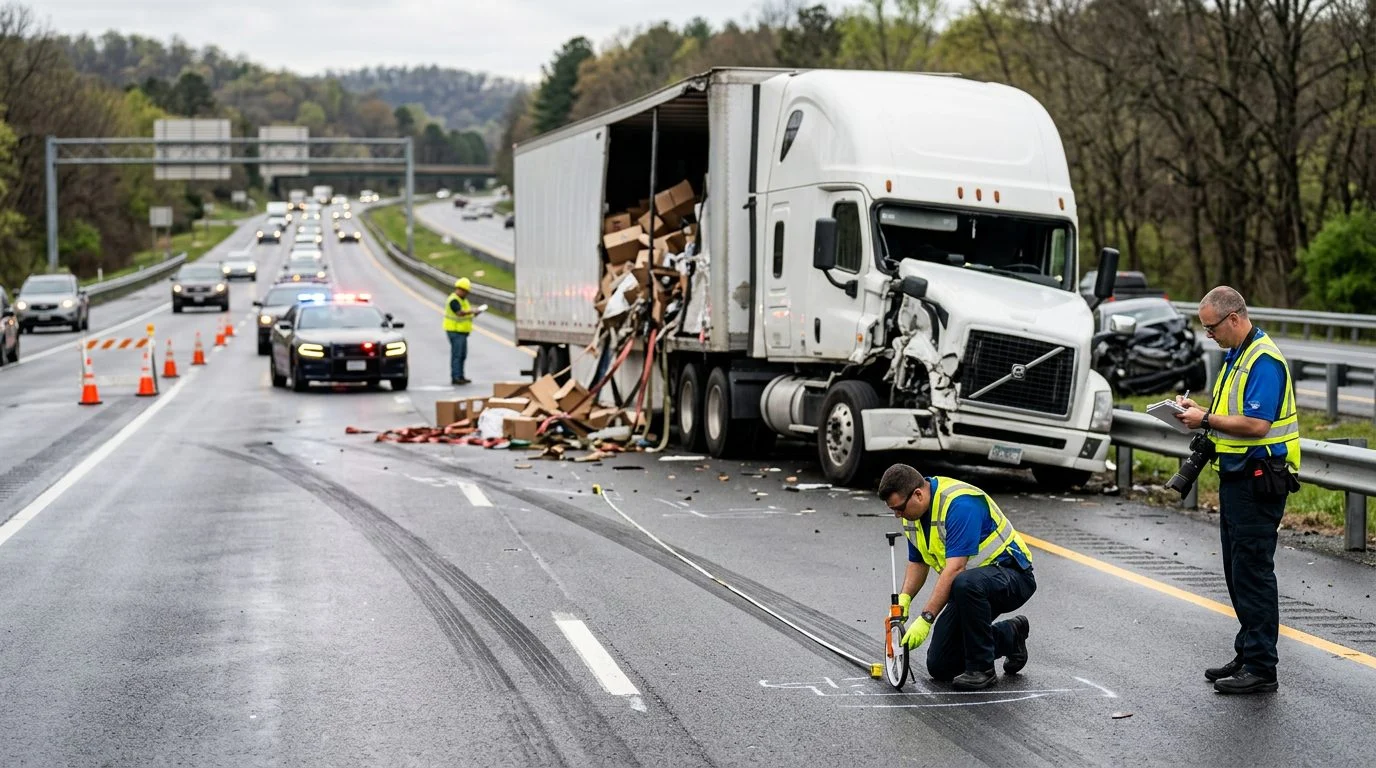
Scene evidence shows where vehicles were, how they moved and how fast they may have been going. Skid marks, yaw marks, gouges in the pavement and debris fields all carry clues. Each one can be measured and compared with the driver’s account.
Lane position and sight lines matter too. The locations of the truck, the other vehicles and any debris can show whether a truck drifted, changed lanes or failed to stop. Road surface, weather and lighting are recorded as well. Those conditions change what a careful driver should have done. 49 C.F.R. § 392.14 requires extreme caution and reduced speed when hazardous conditions, such as those caused by snow, ice, sleet, fog, mist, rain, dust, or smoke, adversely affect visibility or traction.
Photographs and measurements matter most when taken early. Scenes change quickly once traffic resumes and vehicles move. Prompt documentation keeps details from being lost.
Scene evidence works best alongside the driver and equipment records described below. A skid mark shows that brakes were applied. The logs and maintenance file help explain why.
Police Reports and the Duty to Report a Crash
A police report records what the investigating officer saw, heard and was told at the scene. Virginia requires a driver involved in a crash with injury or death to stop and report it to police immediately (Va. Code §§ 46.2-371, 46.2-894).
A typical report can include diagrams, witness names, statements, citations and notes about factors the officer believed contributed. The report is one piece of evidence. It is not a final finding of fault.
An officer’s citation, or the lack of one, does not answer who was at fault by itself. Officers may not have seen the crash itself. Later records can change the picture, so read the report alongside the other evidence.
The two-year period discussed later is, unless otherwise provided in that section or by other statute, a deadline to file a lawsuit for personal injuries or for damages resulting from fraud, running from when the cause of action accrues (Va. Code § 8.01-243). It is not a deadline to report a crash. Readers in the Shenandoah Valley can see how local crash information fits into a wider review on the Shenandoah Valley truck accident page.
Driver Logs, Hours of Service and Electronic Records
Driver logs show when a driver was working, driving and resting. Those times can be checked against the time of the crash. Under 49 C.F.R. § 395.8, a motor carrier must require each driver to record duty status for each 24-hour period. Under 49 C.F.R. § 395.8(f)(1), drivers shall keep their records of duty status current to the time shown for the last change of duty status.
Federal hours-of-service limits apply to many commercial drivers.
Many carriers use electronic logging devices (ELDs). Under 49 C.F.R. § 395.30, a driver must review ELD records, correct inaccurate entries and certify their accuracy. A carrier must not alter or erase the original hours-of-service information. Gaps, late entries and edits can become a line of questions.
The driver qualification file is another source. Under 49 C.F.R. § 391.51, a carrier keeps a file for each driver. It can include the application, driving record checks and medical examiner’s certificate. The file is kept as long as the driver works for the carrier and for three years after, except as provided in paragraph (d), under which certain records may be removed from the file three years after the date of execution.
Under 49 C.F.R. § 382.303, if a required post-accident alcohol test is not given within two hours, the employer must prepare and keep on file a record of the reasons the test was not promptly administered. The employer’s record of those reasons is kept on file and must be submitted to the FMCSA upon request.
Maintenance, Inspection and Onboard Camera Data
Maintenance records show whether the truck was kept in safe condition. Under 49 C.F.R. § 396.3, every motor carrier must systematically inspect, repair and maintain the vehicles under its control. Parts such as steering, suspension and wheels must be in safe and proper operating condition at all times.
Many trucks also carry onboard data. This can include forward-facing or driver-facing cameras, engine data and telematics that record speed, braking and following distance. Such data can show what the truck was doing in the seconds before a crash.
That data is useful only if it survives. Video and electronic data can be overwritten on routine schedules. Asking for it and saving it early protects it.
Cargo is part of the picture too. Under 49 C.F.R. § 393.100, cargo must be secured so it does not shift in a way that adversely affects the vehicle’s stability or maneuverability. Load records can show how the cargo was secured.
Witnesses, Medical Records and Reconstruction Analysis
Witness statements written soon after a crash can capture details that drivers do not. An independent witness may describe the truck’s speed, a lane change or a missed signal. Those accounts can conflict with physical evidence. Reconciling the two is part of building the record.
Medical records link injuries to the crash. Records from the first hours and days after a collision help show what the impact caused. The injury categories page covers the injury types discussed in this area.
Outside reconstruction professionals may use scene measurements, vehicle data and video. They can analyze speed, reaction time and what avoidance was possible. Their analysis is their own work, not the firm’s.
Causation is a central question.
Not sure what your next step is?
Talk it through with Correll Law Firm — we can walk you through how a situation like yours is usually handled and what your options are.
How Shared Fault and Time Limits Affect the Evidence
Shared fault depends on the facts. The record should cover every driver’s conduct, not only the truck driver’s. Evidence about other drivers, road conditions or a third party can change how a crash is reconstructed.
Virginia follows contributory negligence: if you are found even partly at fault, you may be barred from recovering, with limited exceptions. Talk to a lawyer about your facts.
Virginia generally allows two years from the date of injury to file a personal injury lawsuit (Va. Code § 8.01-243(A)); the clock runs from the date of injury, not the date of discovery, with narrow exceptions.
Readers in Richmond and Henrico County can review Richmond truck crash information. It is general information only.

When the Driver’s Conduct May Support Punitive Damages
Punitive damages are a separate question with a higher standard. Virginia allows punitive damages for actual malice, or for willful or wanton conduct or recklessness showing a conscious disregard for the safety of others, capped at $350,000 (Va. Code § 8.01-38.1).
The jury must find that the conduct met this standard. For punitive damages, the jury must find that the conduct met the standard set out in the statute.
The records in earlier sections are the kind of proof used to show what a driver knew or chose to do. Logs, data, maintenance files and training records can all bear on that question.
Consider this hypothetical, which describes no real matter. A driver’s log shows a rest break that camera footage contradicts. The electronic records also show edits made after the crash. Read together, those records could raise questions about whether the driver knew hours were being exceeded. Those questions belong to the jury to weigh.
Frequently asked questions
What evidence is needed to prove a commercial truck driver was at fault?
Evidence can include scene marks, the police report, driver logs, maintenance records, onboard camera data and witness statements. No single item decides fault on its own.
Is a police report enough to prove fault?
No. A police report is one piece of evidence. It is not a final finding of who was at fault.
Can dashcam footage help prove fault in a truck crash?
Yes, when it exists and is preserved. Video can show speed, lane position and road conditions at the time of the crash.