
Wrongful Death | Virginia
When a Company Vehicle Crash Causes a Death: Who Can Sue in Virginia?
Plain-language guidance for families across the Shenandoah Valley, Richmond and Henrico County after a fatal crash involving a company vehicle.
Published October 28, 2026
Introduction: Why a Company Vehicle Changes the Question
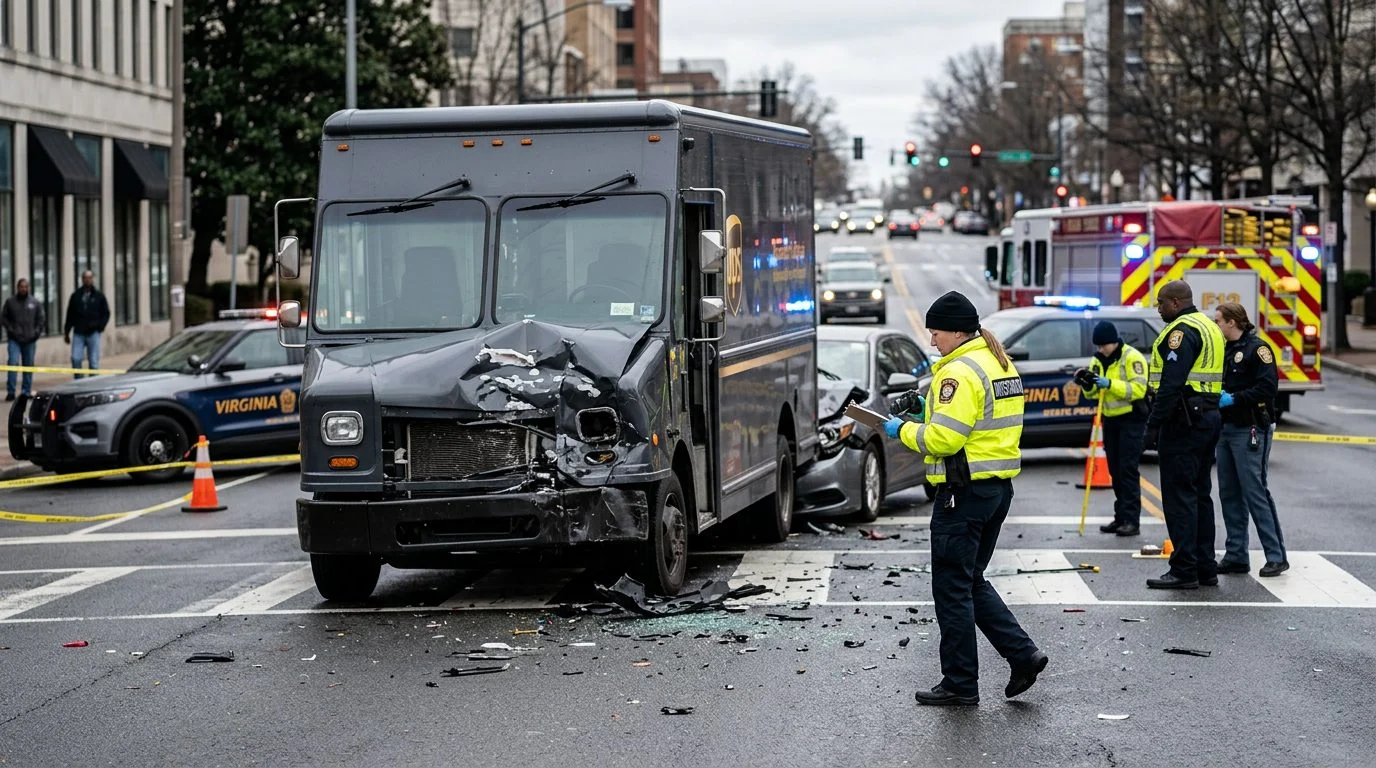
After a fatal crash involving a company, fleet or commercial vehicle in Virginia, the claim is filed by the decedent’s personal representative. Which other people or companies may be sued depends on the facts of the crash.
A crash between two private drivers usually involves two people and two insurance policies. A crash involving a company truck, delivery van or fleet car can involve more people. The driver, the company, the vehicle owner and others may each have a role. Each may hold different records and carry different insurance.
This page answers one question: who can a Virginia family sue after a death in a company vehicle crash? The firm handles car accidents, truck accidents, commercial vehicle accidents and wrongful death claims. It represents families across the Shenandoah Valley, Richmond and Henrico County, and serves families from its Winchester and Harrisonburg locations.
The sections below cover the wrongful death claim, possible defendants, commercial vehicle records, hit-and-run cases, fault arguments, deadlines and damages. Families often read this while grieving, so a clear map helps.
If a company vehicle played a part in your family's loss, you do not have to work out the questions alone. Talk it through with Correll Law Firm — we can walk you through how a situation like yours is usually handled and what your options are.
Wrongful Death: Who Files and Who Shares in the Recovery
Under Va. Code § 8.01-50, the personal representative of the deceased person files the wrongful death action, and for fetal death actions the natural mother brings the action; family members share in any recovery under the article. Virginia law puts it this way.
A Virginia wrongful death action is filed by the decedent’s personal representative within two years of the death (Va. Code § 8.01-50, § 8.01-244), on behalf of the family members the statute protects.
The personal representative is the person appointed to manage the decedent’s estate. Family members do not file the case themselves, except that for a fetal death action under subsection B, the action is brought by and in the name of the natural mother; if she dies or is under a disability, such action may be initiated or maintained by the administrator of the natural mother’s estate, her guardian, or her personal representative qualified to bring such action. They share in the recovery instead.
Virginia law also sets out which relatives belong to that group. The group is fixed when the verdict is entered if the jury makes the specification, or when the judgment is rendered if the court specifies the distribution (Va. Code § 8.01-53).
Families often hear about the personal representative only after a death. The role can feel unfamiliar. A short explanation early keeps decisions clear during a hard time.
Which Parties May Be Named When a Company Owns or Operates the Vehicle
The driver, and possibly the company that owned, leased or ran the vehicle, may each be examined after a company vehicle crash. Others who had a role in the vehicle’s condition or the trip may also come into the picture.
Common questions include who owned the vehicle, who assigned the driver to the trip, and what the driver was doing for the company at the time. These are facts about the work, not labels. The answers shape which people and insurers matter to the claim.
A company’s role can also change which insurance policies and records matter. That is why ownership and control questions are worth asking early. A driver’s job duties and the purpose of the trip often become central to those questions.
Commercial Trucks and Fleet Vehicles: Records That Often Matter
Federal rules create several company records that can matter after a commercial truck crash. The driver’s qualification file is one of the most important.
Federal rules require each motor carrier to keep a driver qualification file for each driver it employs (49 C.F.R. § 391.51). The file includes the driver’s application, motor vehicle records, road test record and medical examiner’s certificate. The carrier keeps it while the driver works there and for three years after, except that records paragraph (d) allows to be removed may be removed three years after their date of execution.
Carriers subject to hours-of-service rules must also require drivers to record their duty status for each 24-hour period, except for a private motor carrier of passengers (nonbusiness) (49 C.F.R. § 395.8). Many carriers must use an electronic logging device (ELD), though the rule lists some exceptions.
These records can show what the company knew or should have known about the driver and the vehicle. The company usually holds them, not the family. Identifying them early helps keep them from being lost or changed. Some records may sit with a maintenance shop or another third party, so the list can grow as the facts come out.
Hit-and-Run and Drivers Who Leave the Scene
A driver in a crash with injury or death must stop and report it to police right away. Virginia law puts it this way.
Virginia requires a driver involved in a crash with injury or death, or some person acting for the driver, to immediately give notice of the accident to a law-enforcement officer (Va. Code § 46.2-371), and to stop at the scene (§ 46.2-894).
That duty to report is separate from the deadline to sue. The two-year period discussed later in this article is the deadline to file a lawsuit, not the deadline to report a crash (Va. Code § 8.01-243).
When the driver flees or cannot be found, the police crash report and the investigation become central. The Virginia DMV publishes information about crash records and how to obtain them (Virginia DMV crash records).
If the vehicle later turns out to belong to a company, the questions about who may be sued can change. A family may not learn who owned the vehicle until the investigation is well along. What the investigation establishes will shape those questions.
Vehicle Defects and Fault Arguments in a Fatal Crash
A part failure, a design problem, a faulty repair or a missed maintenance step can be part of how a fatal crash happened. Investigators look at each possibility on its own facts.
Those possibilities can involve people other than the driver, such as a repair shop or a maintenance contractor. Each one raises its own questions about what was done, and when.
Virginia follows contributory negligence: if you are found even partly at fault, you may be barred from recovering, with limited exceptions. Talk to a lawyer about your facts.
Insurers and other parties may raise fault arguments about the person who died. Those arguments are weighed on the evidence. That includes the crash report, vehicle data and witness accounts. A fault question is decided on the whole record, not on one statement from one person.
Not sure what your next step is?
Talk it through with Correll Law Firm — we can walk you through how a situation like yours is usually handled and what your options are.
Filing Deadlines for Families and Injured Survivors
Virginia generally allows two years from the date of injury to file a personal injury lawsuit (Va. Code § 8.01-243(A)); the clock runs from the date of injury, not the date of discovery, with narrow exceptions.
Some claims carry notice requirements that run out sooner. Families should not assume they have the full period for every claim in the same crash.
Va. Code § 8.01-243 sets a two-year period for personal injury actions that runs from when the cause of action accrues, unless otherwise provided in this section or by other statute; it does not address when a wrongful death deadline starts. A crash that injures one relative and kills another can therefore involve two different starting dates.
Acting early helps keep evidence available. Witnesses move, and vehicle data can be overwritten. Early steps protect the facts that the claim depends on.
Damages in a Virginia Wrongful Death Claim
Virginia wrongful death damages cover the family’s losses, and the statute lists the categories. Virginia wrongful death damages cover the family’s sorrow, mental anguish and loss of the decedent’s companionship, guidance and care; lost income and services; medical expenses from the injury; funeral expenses; and, for willful or wanton conduct, punitive damages (Va. Code § 8.01-52).
Punitive damages follow a separate standard. Under Virginia law, the relevant standard is willful or wanton conduct, or such recklessness as evinces a conscious disregard for the safety of others (Va. Code § 8.01-52).
The jury must find that the conduct met this standard before punitive damages can be awarded.
Evidence and Related Guides for the Family
The main evidence in these cases is the police crash report, company and vehicle records, and the family’s own papers. The police report records the crash facts as the investigating agency documented them.
Family papers can include medical bills, funeral bills, records of the decedent’s income and records of the support the decedent gave. These help show the losses listed in the damages section.
The firm also has related guides. Its guide on getting a police report after a fatal crash in Virginia covers the request steps. Families whose relative survived a company vehicle crash may find its guides on life care plans and home modifications after spinal cord injury helpful.
Common Questions
Who files a wrongful death lawsuit in Virginia?
The decedent’s personal representative files it, on behalf of the family members the statute protects.
Can a family sue a company after a company vehicle crash?
It may be possible. The answer turns on who owned, controlled and drove the vehicle, and what the records show.
How long do families have to file?
A Virginia wrongful death action must be filed within two years of the death.