
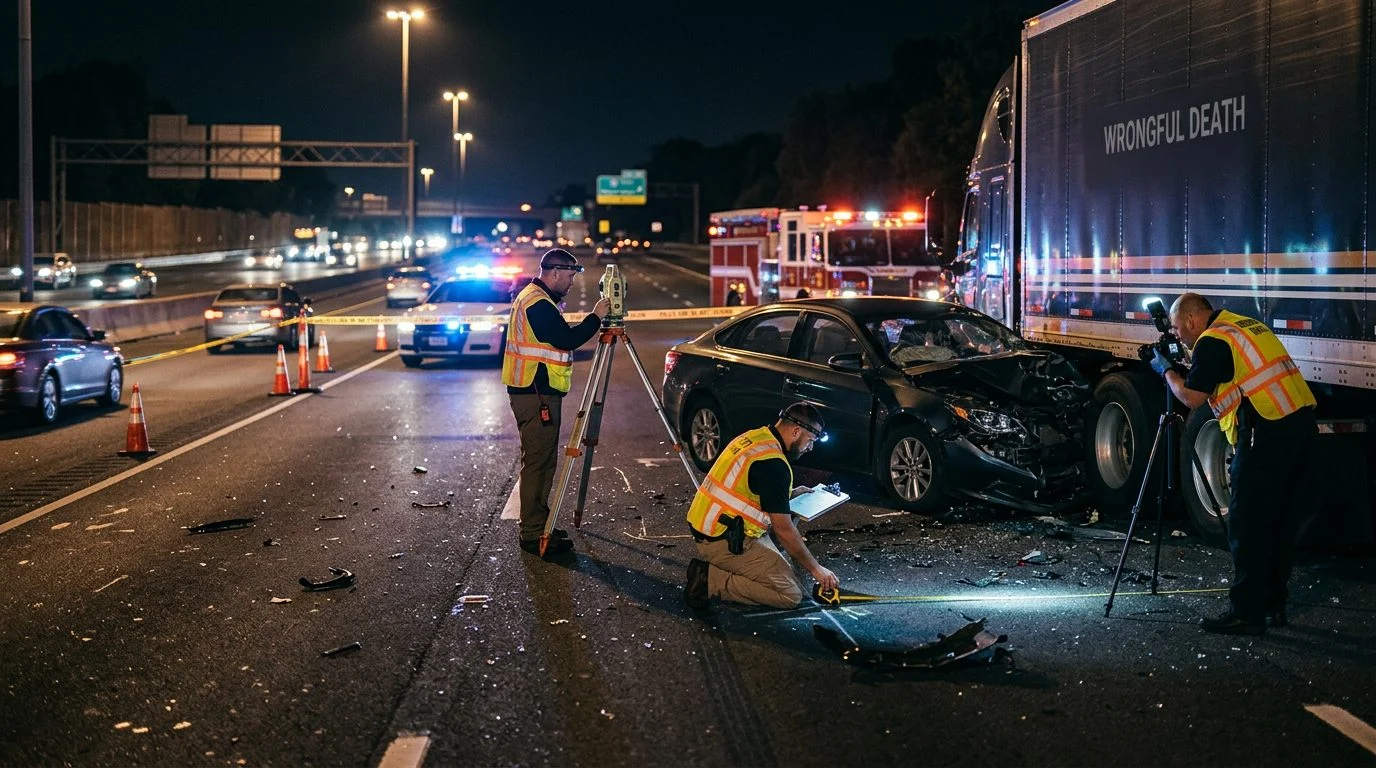
Wrongful Death | Virginia
Losing Someone in a Crash: Key Facts for Virginia Families
Months after a fatal crash, families often have questions about the process, the paperwork and who can take action. Here is a plain-language guide from Correll Law Firm.
Published November 3, 2026
The short answer: a death months after a crash can still support a claim
Yes. A family whose loved one died months after a crash in Virginia may still have a wrongful death claim, if the death is linked to the crash injuries. Va. Code § 8.01-50 allows this kind of action when a wrongful act, neglect or default causes a death that would have let the injured person sue had death not followed.
The date of the death matters as much as the date of the crash. Virginia’s deadline runs from the death, so a delayed death does not automatically end a claim. Whether a particular death qualifies depends on the facts. This page explains general Virginia rules. It is not advice about one family’s situation, and families may wish to talk with a lawyer about their own facts.
Not sure what your next step is?
Talk it through with Correll Law Firm — we can walk you through how a situation like yours is usually handled and what your options are.

The two-year clock runs from the date of death
The deadline is two years from the date of death, not from the date of the crash (Va. Code § 8.01-244). A Virginia wrongful death action is filed by the decedent’s personal representative within two years of the death (Va. Code §§ 8.01-50(C), 8.01-244(B)), on behalf of the family members the statute protects.
The clock starts when the person died. Va. Code § 8.01-244 sets that period for actions under the wrongful death statute.
Early steps help a family stay ready inside that window. Gathering crash reports, hospital records and bills while details are still clear can save time later. Families who wait may find records harder to locate.
Who brings the claim and who shares in any recovery
The decedent’s personal representative files the case, and family members share in any recovery. Family members usually do not file the case themselves.
A personal representative is the person appointed to handle the estate of the person who died. Under subsection C of Va. Code § 8.01-50, the action is brought by and in the name of the personal representative of the deceased person.
The statute also sets who shares in the money. Va. Code § 8.01-53 names the surviving spouse and children first. If there is no surviving spouse, children of the deceased, or children of any deceased child of the deceased, the award goes to the parents, brothers and sisters of the deceased, and to any other relative who is primarily dependent on the decedent for support or services and is also a member of the same household as the decedent, under Va. Code § 8.01-53, except that no parent whose parental rights and responsibilities have been terminated by a court of competent jurisdiction or pursuant to a permanent entrustment agreement with a child welfare agency shall be eligible as a beneficiary. Va. Code § 8.01-53 reads: “only if there is a surviving spouse, children of the deceased, or children of any deceased child of the deceased, the parents of the decedent if any of such parents, within 12 months prior to the decedent’s death, regularly received support or regularly received services from the decedent for necessaries, including living expenses, food, shelter, health care expenses, or in-home assistance or care, or (ii) if there is no surviving spouse, children of the deceased, or children of any deceased child of the deceased, then to the parents, brothers and sisters of the deceased, and to any other relative who is primarily dependent on the decedent for support or services and is also a member of the.” Sharing is not the same as filing. Each share follows the statute’s order, not who handled the paperwork.
Families who have not yet named a personal representative may wish to raise that question early. The case cannot move forward in the family’s name alone.
Proving that the crash caused a death that came later
The central question is whether the crash injuries caused the death, directly or through later complications.
In plain terms, a later death can connect to a crash if it follows naturally from the injury. A new, unrelated event that breaks that chain can change the answer.
Severe brain and spinal cord injuries can lead to later problems, such as infections, blood clots or breathing trouble. When a death follows one of these, the question becomes how the complication traces back to the crash. Medical records, the treatment timeline and a medical review of those records help show that path. A written timeline of hospital stays, setbacks and changes in condition can also help. A death from a cause unrelated to the crash is handled differently. Readers can learn more about catastrophic injuries.
What the family may be able to recover
Families facing a wrongful death often have many questions about what a claim may involve, and the details depend on the facts of each case. Virginia wrongful death damages cover the family’s sorrow, mental anguish and loss of the decedent’s companionship, guidance and care; lost income and services; medical expenses from the injury; funeral expenses; and, for willful or wanton conduct, punitive damages (Va. Code § 8.01-52).
The statute does not list damages for the injured person’s own suffering before death.
Punitive damages need a closer look. Va. Code § 8.01-52 allows them for willful or wanton conduct, or such recklessness as evinces a conscious disregard for the safety of others. Virginia allows punitive damages for actual malice, or for willful or wanton conduct or recklessness showing a conscious disregard for the safety of others, capped at $350,000 (Va. Code § 8.01-38.1). The jury must find that the conduct met this standard. Ordinary negligence alone does not meet that standard.

Evidence to preserve when a death follows a crash months later
Early on, families should gather the crash report, hospital and rehabilitation records, medical bills, and records of time family members took off work to care for the injured person. Those papers help show the path from the crash to the death.
Virginia requires a driver involved in a crash with injury or death to stop and report it to police immediately (Va. Code §§ 46.2-371, 46.2-894). When the conduct is a felony violation of § 46.2-894, Va. Code § 8.01-44.5:1 says punitive damages may be awarded to the plaintiff.
When a commercial truck is involved, company records can matter. Federal rules require motor carriers to keep records of duty status, including driver logs, for at least six months from receipt (49 C.F.R. § 395.8). Inspection and maintenance records must be kept for one year, and for six months after the vehicle leaves the carrier’s control (49 C.F.R. § 396.3). Because those periods are short, families may wish to ask about these records early. Readers can learn more about truck accidents.
The firm represents families from the Shenandoah Valley to Richmond and Henrico County.
Can a family sue if the injured person settled before dying?
Virginia law says that if the injured person settled the injury claim and accepted satisfaction before dying, no action shall be maintained by the personal representative (Va. Code § 8.01-51).
Is reporting a crash the same as filing a lawsuit?
No. Reporting a crash to police is a separate duty, and the two-year period applies to filing a lawsuit.