
Truck & Car Crash Claims | Virginia
What a Truck Driver's CDL Can Show After a Crash
A plain-language guide for people hurt in crashes with commercial vehicles, from the Shenandoah Valley to Richmond and Henrico County.
Published November 19, 2026
A crash with a commercial truck or bus can leave you badly hurt and full of questions about the driver’s paperwork. A commercial driver’s license, or CDL, is one record that can help show who was behind the wheel and whether that driver was licensed for the vehicle. When a commercial driver is involved, the driver’s CDL is reviewed alongside the crash report, the carrier’s files and the rest of the evidence in a Virginia crash claim.
This guide explains what those records can show, how they fit with Virginia’s fault and time-limit rules, and what they mean when a crash causes a death.
What Is a Commercial Driver’s License, and Why Does It Matter?
A commercial driver’s license is the license a person needs to drive a commercial motor vehicle. Federal rules generally say no one may legally operate one without a CDL that meets federal standards and was issued by the driver’s home state (49 C.F.R. § 383.23). That makes the CDL a useful starting point. It shows the license class the driver held.
A CDL alone does not show who caused a crash. A driver can hold a valid license and still make a bad decision on the road. Answering the fault question takes the crash report, the carrier’s records and the other evidence in the case. For a broader look at these crashes, read the commercial vehicle accident guide.
Not sure what your next step is?
Talk it through with Correll Law Firm — we can walk you through how a situation like yours is usually handled and what your options are.

What Does the Crash Report Show About the Driver?
A crash report is usually the first written record of the drivers, vehicles and conditions involved. Virginia requires a driver involved in a crash with injury or death to stop and report it to police immediately (Va. Code §§ 46.2-371, 46.2-894).
After an accident in which a person is killed or injured or in which an attended vehicle or other attended property is damaged, the driver must give his or her name, address, license number and vehicle registration number to police or to the other people involved (Va. Code § 46.2-894). The driver must give reasonable help to any injured person, too (Va. Code § 46.2-894).
These details can be checked against the CDL and the carrier’s records later. If the report and later records do not line up, that gap can matter in the claim.
One point is easy to mix up.
What Can Driver Licensing Records Show?
Licensing records show the license class and any endorsements the driver holds. An endorsement is an added approval for certain types of vehicles. Federal rules require a state-issued endorsement for vehicles such as double or triple trailers, passenger vehicles, tank vehicles, hazardous materials haulers and school buses (49 C.F.R. § 383.93).
Each endorsement requires its own tests. A license alone does not show that a driver was approved for every vehicle type. The Virginia DMV hazardous materials endorsement page explains how that endorsement is obtained and renewed in Virginia.
Useful questions include whether the license matched the vehicle, and whether the driver held any endorsement the vehicle required. Fuller driving history usually comes through the claim process, not from the scene.
What Can Carrier Records Show About the Trucking Company?
Carrier records show what the trucking company collected and checked about the driver. Federal rules require each motor carrier to keep a driver qualification file for every driver it employs (49 C.F.R. § 391.51). That file can include the driver’s application, motor vehicle records from licensing authorities, road test records, annual record reviews and a medical examiner’s certificate.
The carrier must keep that file for as long as the driver works there and for three years after, except for records that may be removed under paragraph (d) of 49 C.F.R. § 391.51. Carriers also keep a driver investigation history file. It holds responses from previous employers about the driver’s safety history, or documentation of good faith efforts to contact them (49 C.F.R. § 391.53). Federal rules also allow records to be kept electronically, if they stay accurate and can be reproduced later (49 C.F.R. § 379.7).
These files can help show what the carrier knew or could have checked before the crash. Whether they show a carrier fell short depends on the facts. Because retention periods are set by rule, it can help to act early and keep copies of anything already in hand.
How Does Partial Fault Affect a Commercial Vehicle Claim?
Virginia follows contributory negligence: if you are found even partly at fault, you may be barred from recovering, with limited exceptions. Talk to a lawyer about your facts.
What Are the Time Limits, and When Do Punitive Damages Apply?
Virginia generally allows two years from the date of injury to file a personal injury lawsuit (Va. Code § 8.01-243(A)); the clock runs from the date of injury, not the date of discovery, with narrow exceptions. Some claims carry notice requirements that run out sooner, so timing deserves early attention.
Virginia allows punitive damages for actual malice, or for willful or wanton conduct or recklessness showing a conscious disregard for the safety of others, capped at $350,000 (Va. Code § 8.01-38.1).
Not sure what your next step is?
Talk it through with Correll Law Firm — we can walk you through how a situation like yours is usually handled and what your options are.
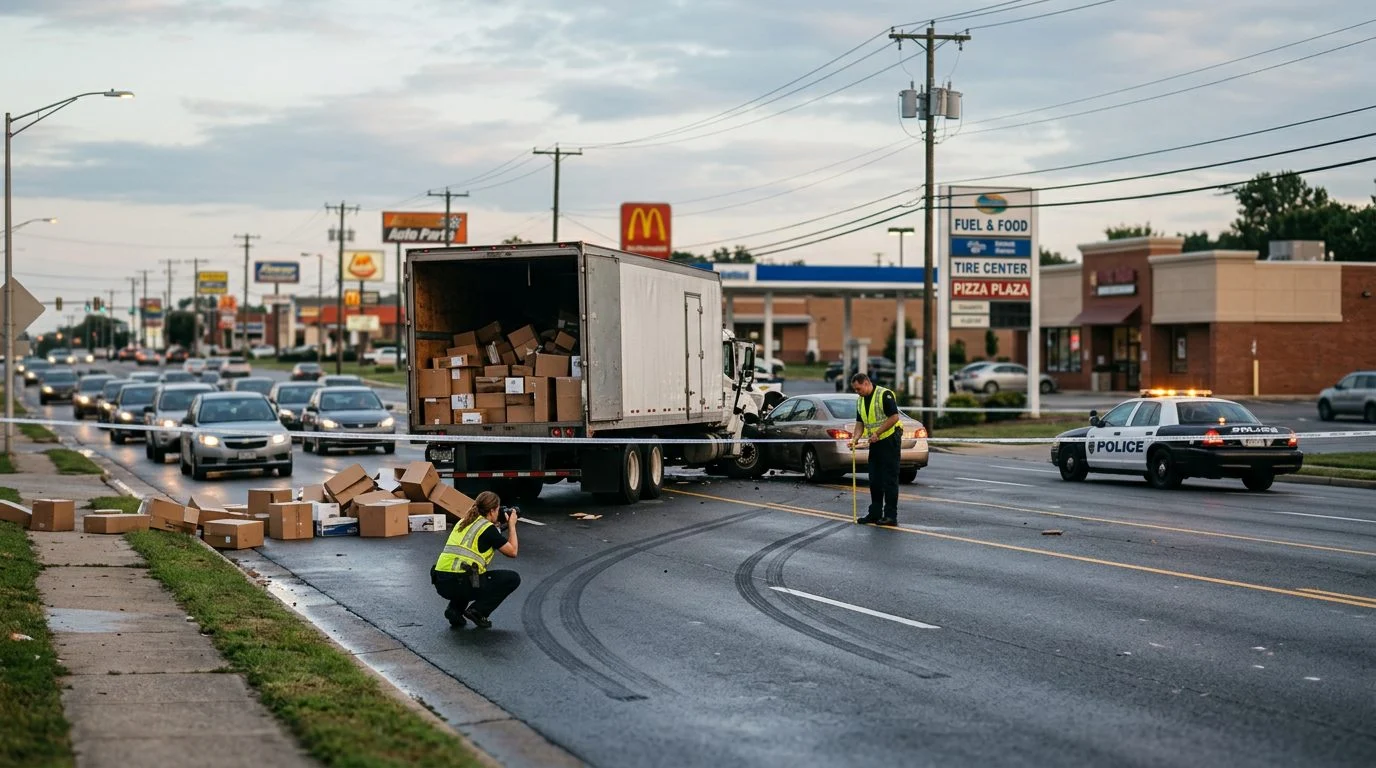
When a Commercial Vehicle Crash Causes a Death
A Virginia wrongful death action is filed by the decedent’s personal representative within two years of the death (Va. Code §§ 8.01-50(C), 8.01-244(B)), on behalf of the family members the statute protects.
Virginia wrongful death damages cover the family’s sorrow, mental anguish and loss of the decedent’s companionship, guidance and care; lost income and services; medical expenses from the injury; funeral expenses; and, for willful or wanton conduct, punitive damages (Va. Code § 8.01-52).
Family members do not file the case. The crash report, the driver’s license details and the carrier’s files can serve as evidence in that claim, just as they can in an injury claim.
Keep track of these items when you can:
- The crash report number and a copy of the report
- The driver’s name and license details, as the driver gave them at the scene
- The truck’s registration and the carrier’s name and contact details
- Photos, witness names and contact information
- Medical and funeral receipts
For the medical side of an injury, see medical care after a commercial truck crash in Virginia. Keeping these records together makes a Virginia crash claim easier to follow from the start.