
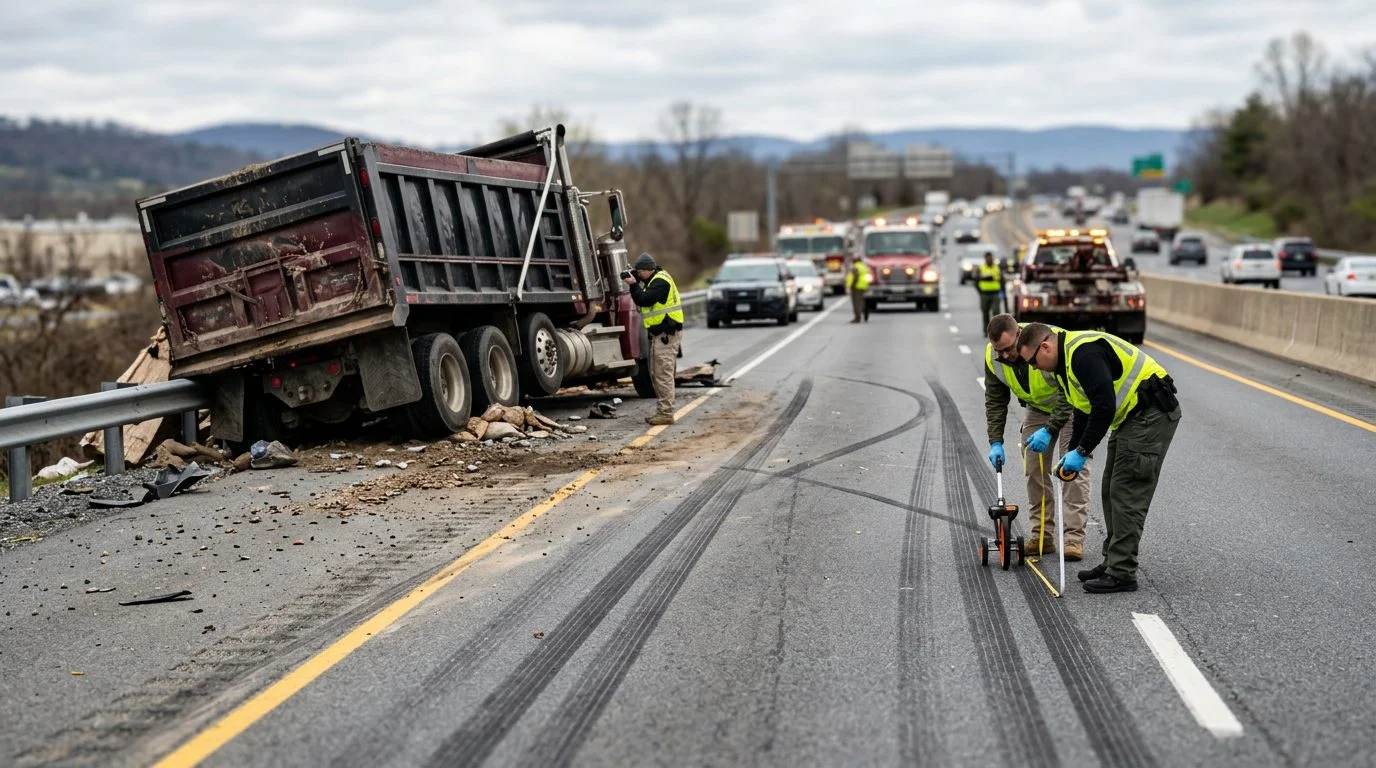
Dump truck accidents in Harrisonburg
Hurt in a Dump Truck Crash? We Can Help You Understand Your Options
Correll Law Firm represents people seriously injured in car and commercial truck crashes, including dump truck collisions across the Shenandoah Valley. Here is what to know about these cases.
Published November 2, 2026
A dump truck accident claim asks who may be responsible for injuries or a death caused by a dump truck, and what Virginia law allows. If you are researching a dump truck accident lawyer Harrisonburg, this guide explains the parties, evidence and deadlines that often matter most.
What a dump truck accident claim involves
A dump truck accident claim seeks compensation for people hurt, or families of people killed, in a crash involving a dump truck. Dump trucks usually haul dirt, gravel, asphalt and debris for construction crews, hauling companies, quarries and road or utility projects.
Because the truck is used for business, more parties may be involved than in a typical car crash. The employer, the company that sent the load and the people who run the job site can all play a part.
Correll Law Firm represents people seriously hurt in car and commercial truck crashes, people with catastrophic injuries, and families in wrongful death cases. The firm has offices in Winchester and Harrisonburg. Its Harrisonburg office serves Rockingham County and the wider Shenandoah Valley.
If a dump truck crash has changed your life or a loved one's, you may have a claim worth reviewing, and the firm is ready to talk through your facts. Talk it through with Correll Law Firm — we can walk you through how a situation like yours is usually handled and what your options are.
Who can be responsible when a dump truck is involved?
More than one party may be responsible, and the facts about who controlled the truck and the work decide who gets examined. Possible parties include:
- The driver, for the driver’s own conduct behind the wheel.
- The employer or hauling company that hired, assigned or dispatched the driver and the load.
- The truck or equipment owner, if it is a different company from the operator.
- A maintenance contractor, if poor repairs played a role.
- The site operator or general contractor, based on who ran the work zone.
- The party that loaded or secured the cargo.
Federal rules require the motor carrier to make sure drivers follow the rules that apply to them (49 C.F.R. § 390.11).
A contractor cannot escape by pointing to finished work. Under Va. Code § 8.01-39, in any civil action alleging that personal injury, death by wrongful act or damage to property resulted from the negligence of or breach of warranty by an independent contractor, it is not a defense that the contractor finished its work or that the owner accepted it.
What crashes and injuries are common with dump trucks?
Dump truck crashes often involve backing in work zones, rollovers on soft or uneven ground, shifting or spilling loads, and brake or steering problems. Investigators often look at how the load was placed, whether the ground was stable and when the truck was last inspected.
Under 49 C.F.R. § 393.106(b), cargo must be firmly immobilized or secured on or within a vehicle by structures of adequate strength, dunnage or dunnage bags, shoring bars, tiedowns or a combination of these, but under § 393.106(a) those rules do not apply to bulk commodities that lack structure or fixed shape, such as sand and gravel, when they are transported in a tank, hopper, box or similar device that forms part of the structure of the commercial motor vehicle (49 C.F.R. § 393.106). Federal rules also require motor carriers to systematically inspect, repair and maintain vehicles under their control (49 C.F.R. § 396.3).
The firm handles claims involving traumatic brain injury, spinal cord injury and other catastrophic injuries. These injuries can affect work, income and daily life over the long term. Some symptoms appear or worsen after the crash, so prompt medical evaluation protects health and creates a clear record.
What evidence matters, and why does it disappear fast?
The evidence that matters most is often the evidence that can be lost first. Useful evidence includes:
- Photos and video of the scene and vehicles, taken early.
- Names and contact details of witnesses.
- The police report and crash details.
- Driver logs, dispatch records and load tickets.
- Maintenance and inspection logs.
- Work-zone plans and site safety records.
- Onboard or electronic truck data.
Federal rules require maintenance records to be kept for one year where the vehicle is housed or maintained, and for six months after it leaves the carrier’s control (49 C.F.R. § 396.3). That short window is one reason to ask for records early. The FMCSA describes federal drug and alcohol testing rules, including testing after certain accidents (FMCSA).
Virginia requires a driver involved in a crash with injury or death to stop and report it to police immediately (Va. Code §§ 46.2-371, 46.2-894). The two-year period is the deadline to file a lawsuit, not to report a crash (Va. Code § 8.01-243).
Keep medical records, bills, wage records and a daily injury journal. Before giving a recorded statement to an insurer, you may wish to understand how it could be used.
What are Virginia’s deadlines and fault rules?
Virginia generally gives two years to file a personal injury lawsuit, but some claims have shorter notice rules (Va. Code § 8.01-243). The approved rule reads: Virginia generally allows two years from the date of injury to file a personal injury lawsuit (Va. Code § 8.01-243(A)); the clock runs from the date of injury, not the date of discovery, with narrow exceptions.
Wrongful death cases follow their own timing. A Virginia wrongful death action is filed by the decedent’s personal representative within two years of the death (Va. Code §§ 8.01-50(C), 8.01-244(B)), on behalf of the family members the statute protects. They share in the recovery, and the statute sets out who qualifies (Va. Code § 8.01-53).
Fault matters too. Virginia follows contributory negligence: if you are found even partly at fault, you may be barred from recovering, with limited exceptions. Talk to a lawyer about your facts.
How does a dump truck claim usually move forward?
A dump truck claim usually moves through a case evaluation, investigation, documentation and then negotiation or a lawsuit. The steps below show the general path.
- Case evaluation. You describe the crash, your injuries, your treatment and any papers you have. The firm reviews whether the facts may support a claim.
- Preservation and investigation. Written requests go to the trucking, hauling and site parties asking them to keep records. The firm obtains the crash report and identifies insurers.
- Medical and damages documentation. Treating providers’ records show the injury, the treatment and the effect on work and daily life.
- Negotiation or suit. The firm communicates with insurers and the parties identified. If a fair resolution is not reached, a lawsuit may be filed.
Timelines depend on the facts and on how quickly records and insurers respond. You may wish to take time to weigh your options before deciding.
Not sure what your next step is?
Talk it through with Correll Law Firm — we can walk you through how a situation like yours is usually handled and what your options are.
Why do people contact Correll Law Firm about these claims?
Correll Law Firm has offices in Winchester and Harrisonburg. The firm handles car accidents, truck accidents, commercial vehicle accidents, catastrophic injuries, traumatic brain injury, spinal cord injury and wrongful death.
For a dump truck matter, the firm’s work includes identifying responsible parties, requesting records, coordinating with medical providers and handling communications with insurers. The firm serves people from Harrisonburg, Rockingham County, Front Royal and the Shenandoah Valley. It also serves people in Richmond and Henrico County.

Frequently asked questions about dump truck crash claims
Can I make a claim if the dump truck was on a private job site?
A private job site can still lead to a claim against the parties who controlled the truck or the work.
Can I sue the trucking company if the driver worked for it?
A company may be part of a claim depending on how it employed and assigned the driver. Investigation identifies those facts.
What should I do right after a dump truck crash?
Get medical care, even if you feel fine at first. Photograph the scene and vehicles, and write down witness names and what you remember.