
Truck Accidents | Winchester, Harrisonburg and the Shenandoah Valley
Hurt in a Dump Truck Crash? Start With the Facts That Matter
Dump trucks are heavy, and the injuries they cause can be severe. Here is how Virginia families can think through what comes next.
Published November 11, 2026
If a dump truck or construction vehicle hit you or someone you love, you may be facing serious injuries, lost work and many questions. A dump truck crash injury lawyer in Virginia can review the crash, the records and the parties involved. These crashes often differ from ordinary car accidents in who may be responsible, what evidence exists and how serious the harm can be. This page explains those differences, the Virginia rules that may apply and what to expect.
What Makes a Dump Truck or Construction Vehicle Crash Different
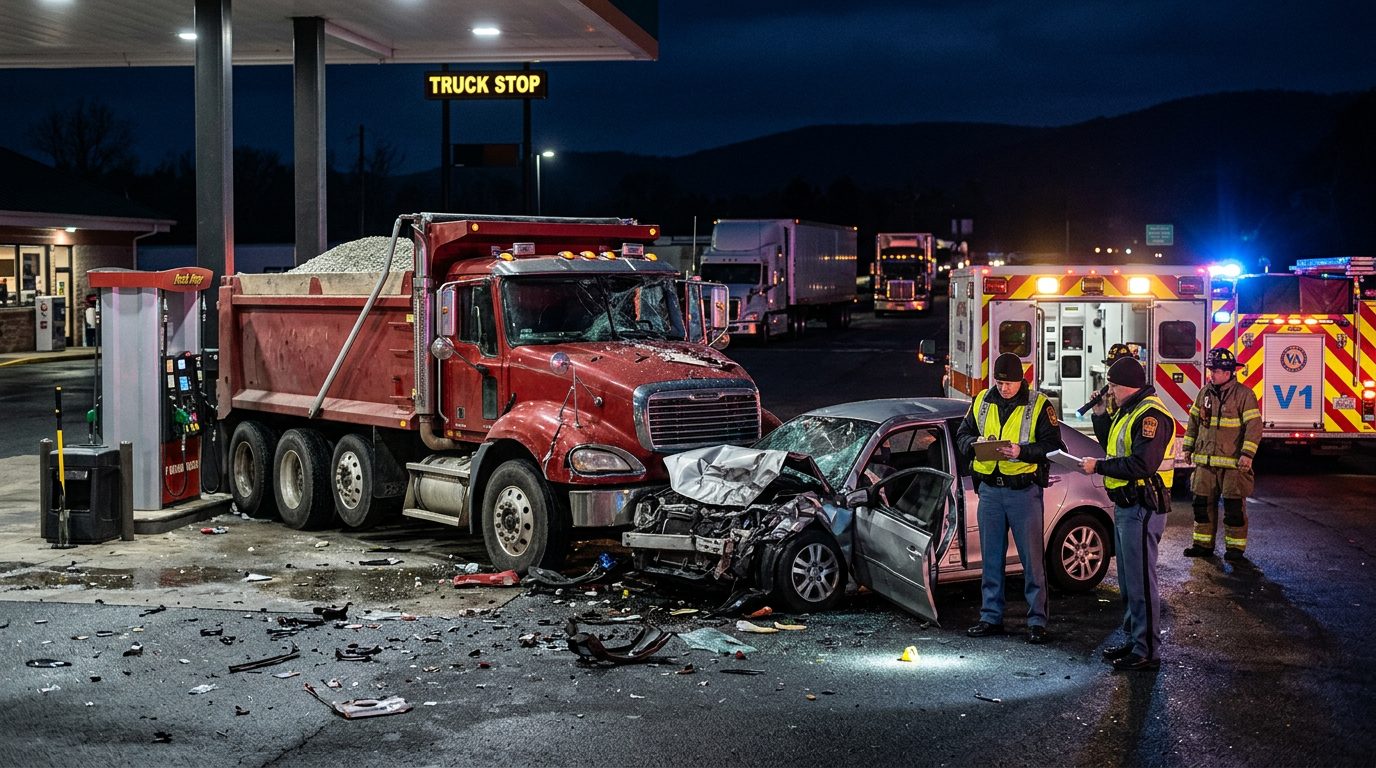
Dump truck and construction vehicle crashes differ because the vehicles are heavy, often loaded, and frequently work on public roads near active job sites. That can change how a crash happens and how badly people get hurt.
Common crash patterns include:
- Backing, tipping or dumping a load, which can cause sudden movement near other vehicles
- Rollovers and debris that spill onto the roadway
- Sudden stops in work zones, where traffic may slow without warning
Many of these vehicles belong to construction companies, subcontractors or equipment rental fleets. The vehicle, the driver, the load and the company records may sit with several organizations at once.
Commercial records can matter. Federal rules require a motor carrier subject to the requirements of 49 C.F.R. part 395, except a private motor carrier of passengers (nonbusiness), to have each driver record duty status for each 24-hour period (49 C.F.R. § 395.8). Driver qualification files, maintenance logs and inspection reports may also matter, depending on the facts. Evidence can disappear quickly, so early steps often shape what can be proven later.
Not sure what your next step is?
Talk it through with Correll Law Firm — we can walk you through how a situation like yours is usually handled and what your options are.

Who Can Be Held Responsible After a Dump Truck or Construction Vehicle Crash
More than one party may be responsible, and the facts decide who. Possible parties include:
- The driver of the dump truck or construction vehicle
- The company that employed or dispatched the driver
- The owner of the vehicle, which may differ from the operator
- Contractors responsible for maintenance, loading, equipment or a work zone, where the facts support their role
- Other drivers whose conduct contributed to the crash
One crash can therefore involve several possible defendants. Each party’s role is reviewed before anyone is named.
What the Firm’s Dump Truck and Construction Vehicle Crash Work Covers
The firm handles personal injury and wrongful death claims that arise from crashes involving dump trucks and other construction vehicles. That work includes:
- Serious injury claims from collisions with dump trucks, construction trucks and related construction vehicles
- Catastrophic injury claims, including traumatic brain injury and spinal cord injury
- Wrongful death claims for families after a fatal crash
- Investigation of the vehicle, the load, the work site and company records tied to the crash
- Claims involving a commercial vehicle and its operator, alongside the firm’s commercial vehicle accident work
Brain injuries show why these cases can be serious. The Administration for Community Living reports that automobile crashes can cause traumatic brain injuries, which involve severe brain damage.
What to Expect From the First Steps Through Resolution
The first steps focus on medical care, reporting the crash and preserving evidence. Later steps build on those early actions. A matter often moves through these stages:
- Medical care: getting treated and following the medical advice for the injury.
- Reporting: making sure the crash is reported to police, as covered below.
- Evidence: keeping photos, witness names and any records from the scene.
- Records requests: asking the employer and vehicle operator for their files, which can take weeks or months.
- Medical review: reviewing treatment needs, including how catastrophic injuries may progress over time.
- Investigation: looking at the vehicle’s condition, the load, the work site and driver files. 49 C.F.R. § 391.51 requires a motor carrier to maintain a driver qualification file for each driver it employs.
- Negotiation or a lawsuit: discussing the claim with insurers and the commercial carrier, and preparing for court if needed.
Timelines vary with the injury, the number of parties and whether a lawsuit is filed. Each matter follows its own steps.
Virginia Deadlines and Reporting Rules That Affect These Claims
Crash reporting comes first. Virginia requires a driver involved in a crash with injury or death to stop and report it to police immediately (Va. Code §§ 46.2-371, 46.2-894). The two-year period below is the deadline to file a lawsuit, not the deadline to report a crash (Va. Code § 8.01-243).
Virginia generally allows two years from the date of injury to file a personal injury lawsuit (Va. Code § 8.01-243(A)); the clock runs from the date of injury, not the date of discovery, with narrow exceptions. Some claims carry notice requirements that run out sooner.
Claims against a county, city or town follow a shorter notice rule. A written statement of the claim generally must be filed within six months after the claim accrued, and the statute is strictly construed (Va. Code § 15.2-209). Va. Code § 15.2-209 reads: “Failure to provide such statement shall not bar a claim against any county, city, or town, provided that the attorney, chief executive, or mayor of such locality, or any insurer or entity providing coverage or indemnification of the claim, had actual knowledge of the claim, which includes the nature of the claim and the time and place at which the injury is alleged to have occurred, within six months after such cause of action accrued.” Va. Code § 15.2-209 reads: “Every claim cognizable against any county, city, or town for negligence shall be forever barred unless the claimant or his agent, attorney, or representative has filed a written statement of the nature of the claim, which includes the time and place at which the injury is alleged to have occurred, within six months after such cause of action accrued.”
Fault rules also matter. Virginia follows contributory negligence: if you are found even partly at fault, you may be barred from recovering, with limited exceptions. Talk to a lawyer about your facts.
Damages in Dump Truck and Construction Vehicle Crash Claims
Damages depend on the injuries, the evidence and the law that applies to the facts. For an injured person who survives, a claim may include:
- Medical bills, rehabilitation and the cost of ongoing care
- Lost income and reduced ability to earn in the future
- Non-economic harm (losses that have no price tag), such as pain, disability and loss of enjoyment of life, shown through how the injury changes daily living
For families, Virginia has a separate wrongful death claim. A Virginia wrongful death action is filed by the decedent’s personal representative within two years of the death (Va. Code §§ 8.01-50(C), 8.01-244(B)), on behalf of the family members the statute protects.
The statute sets out who shares, including a surviving spouse and children (Va. Code § 8.01-53).
Virginia wrongful death damages cover the family’s sorrow, mental anguish and loss of the decedent’s companionship, guidance and care; lost income and services; medical expenses from the injury; funeral expenses; and, for willful or wanton conduct, punitive damages (Va. Code § 8.01-52).
Not sure what your next step is?
Talk it through with Correll Law Firm — we can walk you through how a situation like yours is usually handled and what your options are.
Why the Firm Handles These Cases
The firm is based in Winchester, Virginia, and has an office in Harrisonburg. It focuses on car accidents, truck accidents, commercial vehicle accidents, catastrophic injuries, traumatic brain injury, spinal cord injury and wrongful death.
The firm’s support staff help with records requests and medical documentation. Commercial crash cases depend heavily on both. The firm serves people in Richmond, Henrico County and the Shenandoah Valley, as well as Winchester and Harrisonburg.

Frequently Asked Questions About Dump Truck and Construction Vehicle Crashes
Is a dump truck crash handled differently from a car accident?
Often, yes. The vehicle’s weight, the commercial owner or operator, and the company records can change who is involved.
Should I talk to a dump truck crash injury lawyer in Virginia early?
You may wish to, because evidence and deadlines both matter.
What records matter most?
Photos, the police report, medical records, witness contact details and, when they can be obtained, commercial records such as duty-status logs.
Can a family bring a claim if a loved one died in a construction vehicle crash?
Yes. Virginia wrongful death claims are filed by the decedent’s personal representative for the family members the statute protects.