
Truck Accidents | Winchester, Harrisonburg and Virginia
Hazardous Materials Truck Crash Injuries in Virginia
Correll Law Firm helps people hurt in crashes involving dangerous cargo, and the families of those who did not survive, across the Shenandoah Valley, Richmond and Henrico County.
Published November 28, 2026
A crash with a tanker or other hazardous materials truck can hurt you in two ways at once: the impact and the cargo. Injured people and families often ask what to do first.
The short answer is to get medical care, tell providers what material was involved, and keep records of the truck, the cargo and the scene. This guide explains the risks, the evidence, who may be responsible and how Virginia’s rules apply.
What Makes a Hazardous Materials Truck Crash Different
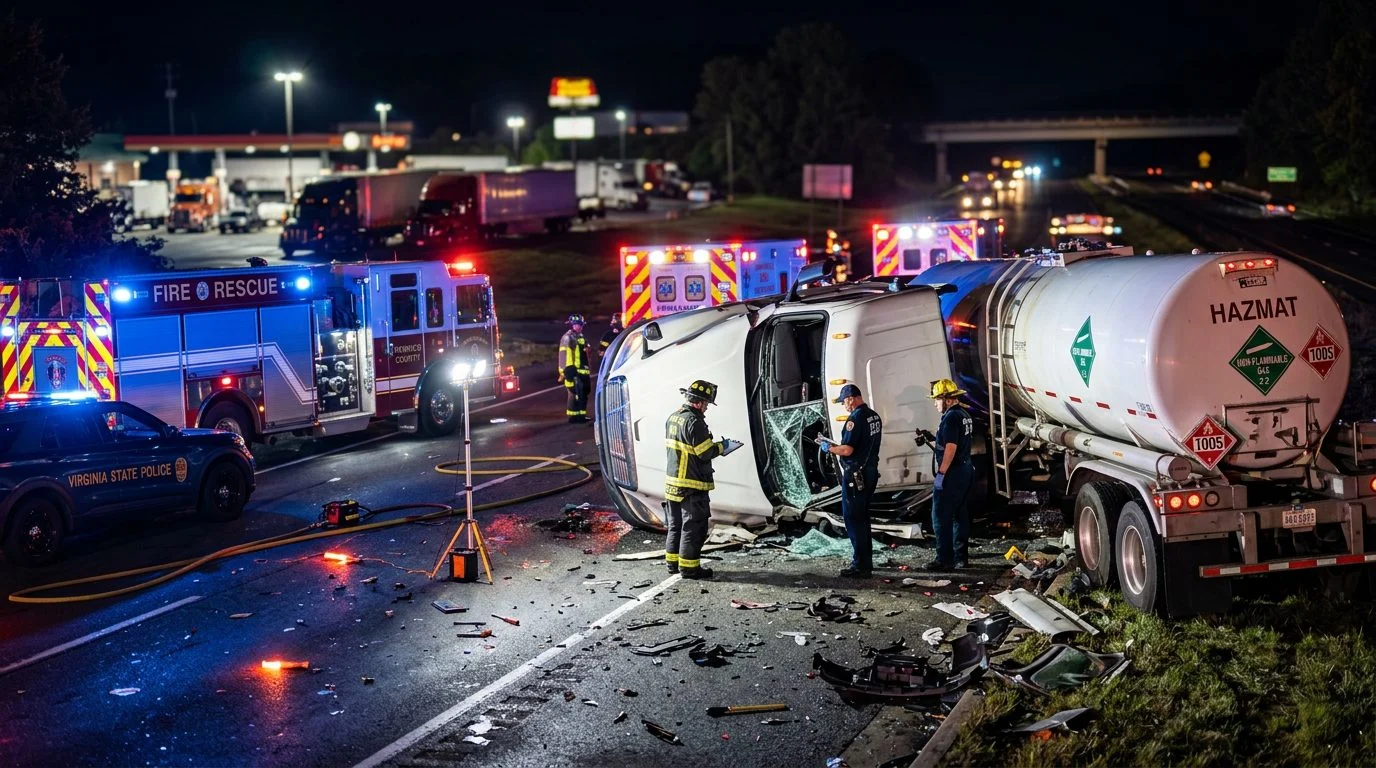
A hazardous materials truck crash differs because the cargo can create a second danger after the impact. Hazardous materials are loads that can be dangerous if they leak, spill or burn. Common examples include fuel, chemicals, compressed gases and other materials carried in tanks or sealed containers.
Tanker and hazmat trucks often display placards (large diamond-shaped signs) and labels that identify the cargo. Photos of those markings can later help show what the truck carried.
At the scene, an injured person may face two problems. One is the injury from the impact. The other is the risk that the material was released and affected the driver, passengers, responders or bystanders.
Scenes are often cleared quickly, and trucks are often moved or repaired. Early photos and early requests matter for that reason.
This page is for injured people, drivers, passengers, bystanders and families of people who died in a crash involving hazardous cargo.
If a hazardous materials truck crash changed your life or your family's, you may have a claim, and the firm offers a free case evaluation to talk through the facts. Talk it through with Correll Law Firm — we can walk you through how a situation like yours is usually handled and what your options are.

Injuries and Exposure Risks After a Hazmat Crash
Exposure to a released material can cause burns, breathing problems, and skin or eye irritation. Some symptoms can appear hours or days after the crash, not right away.
That is why a medical evaluation matters even when a person feels fine. Tell every provider what material was involved, if known, and note the time of the crash.
Brain and spinal cord injuries can also happen in a tanker rollover or a hard impact. These injuries can change a person’s life and may need long-term care. The firm handles catastrophic injuries, including traumatic brain injury and spinal cord injury.
A medical record that describes the exposure and the timeline of symptoms can matter later. It helps link the harm to what happened at the scene.
Evidence to Preserve After a Hazardous Cargo Crash
Preserving evidence starts with the crash report, which Virginia law requires right away. Virginia requires a driver involved in a crash with injury or death to stop and report it to police immediately (Va. Code §§ 46.2-371, 46.2-894). Under Va. Code § 46.2-371, the driver of any vehicle involved in an accident resulting in injury to or death of any person, or some person acting for the driver, shall immediately give notice of the accident to a law-enforcement officer, and a willful failure to make that report constitutes a Class 4 misdemeanor.
The two-year period discussed later in this guide is the deadline to file a lawsuit for personal injuries, unless this section or another statute provides otherwise (Va. Code § 8.01-243). It is not the deadline to report a crash.
Evidence that is easy to lose includes:
- Photos of placards, labels and the scene
- The crash report number and the names of responding officers
- Names and contact details of witnesses
- Shipping papers and cargo documents
- Clothing or items that may have been exposed to the material
Federal rules also set how long carriers keep certain records. A driver’s record of duty status must show shipping document numbers or the shipper and commodity name (49 C.F.R. § 395.8). Vehicle inspection and maintenance records must be kept where the vehicle is housed for one year, and for six months after it leaves the carrier’s control (49 C.F.R. § 396.3). Drug and alcohol testing records follow their own retention periods (49 C.F.R. § 382.401).
Because these periods are set, early requests for records can help keep them from being lost.
Who May Be Responsible for a Hazmat Truck Crash
More than one party may be responsible for a hazardous materials truck crash, depending on the facts. Possible parties include the driver, the motor carrier that operates the truck, the company that loaded or shipped the cargo, and maintenance contractors.
Virginia allows punitive damages for actual malice, or for willful or wanton conduct or recklessness showing a conscious disregard for the safety of others, capped at $350,000 (Va. Code § 8.01-38.1). Under Va. Code § 8.01-38.1, for an action accruing on or after July 1, 1988, the trier of fact determines the total punitive damages awarded against all defendants found liable, and that total may not exceed $350,000. The jury is not advised of this limit.
Some federal vehicle standards aim to reduce harm in truck crashes. One rear impact guard rule for trailers aims to reduce deaths and serious injuries when light vehicles hit the rear of a trailer (49 C.F.R. § 571.223). Whether a rule like this bears on a crash depends on the facts. See the truck underride guards guide for more detail.
When a Hazardous Materials Truck Crash Is Fatal
Virginia law allows a wrongful death action when a wrongful act, neglect, or default causes a death, where that act would have entitled the injured person to maintain an action had death not ensued (Va. Code § 8.01-50). The rule reads as follows.
A Virginia wrongful death action is filed by the decedent’s personal representative within two years of the death (Va. Code §§ 8.01-50(C), 8.01-244(B)), on behalf of the family members the statute protects. Family members do not file the case. They share in the recovery. The timing rule is in Va. Code § 8.01-244.
Virginia wrongful death damages cover the family’s sorrow, mental anguish and loss of the decedent’s companionship, guidance and care; lost income and services; medical expenses from the injury; funeral expenses; and, for willful or wanton conduct, punitive damages (Va. Code § 8.01-52).
Families may be asked for the death certificate, medical and emergency response records and the crash report. For detail on funeral-related expenses, see the funeral expenses guide.
Time Limits, Partial Fault and the Claim Process
Time limits and fault rules shape how a claim moves forward. Virginia generally allows two years from the date of injury to file a personal injury lawsuit (Va. Code § 8.01-243(A)); the clock runs from the date of injury, not the date of discovery, with narrow exceptions. Under Va. Code § 8.01-243(A), unless otherwise provided in that section or by other statute, every action for personal injuries, whatever the theory of recovery, shall be brought within two years after the cause of action accrues.
Some claims carry notice requirements that run out sooner.
Virginia follows contributory negligence: if you are found even partly at fault, you may be barred from recovering, with limited exceptions. Talk to a lawyer about your facts.
A claim usually moves through these stages, in order:
- Intake of the facts and records
- Investigation and evidence requests
- Medical documentation
- Negotiation with insurers
- Filing a lawsuit, if needed
The stages do not follow a fixed schedule. Timing depends on the injuries, the records and whether a lawsuit is filed.
Not sure what your next step is?
Talk it through with Correll Law Firm — we can walk you through how a situation like yours is usually handled and what your options are.
Why Injured People Bring These Claims to the Firm
The firm is based in Winchester and has an office in Harrisonburg. It handles car accidents, truck and commercial vehicle accidents, catastrophic injuries including brain and spinal cord injuries, and wrongful death.
The firm serves people across the Shenandoah Valley, Richmond and Henrico County. The firm has support staff, including assistants and office staff, who help with records requests and client communication.
This section describes the firm’s work and nothing more. Each claim turns on its own facts.

Frequently Asked Questions
Should I see a doctor if I feel fine after a hazardous cargo crash?
Yes, a medical evaluation is a useful step. Some exposure symptoms appear hours or days later, so tell providers what material was involved.
Can I still have a claim if the cargo was not identified at the scene?
Possibly. Identification may come from placards, shipping papers or the crash report, and the facts of each crash decide what can be shown.
Who files a wrongful death case in Virginia?
The decedent’s personal representative files it on behalf of the family members the statute protects. Family members share in the recovery.
Is the two-year period the same as the deadline to report the crash?
No. Virginia requires an immediate report to police, while the two-year period limits when a lawsuit can be filed.