
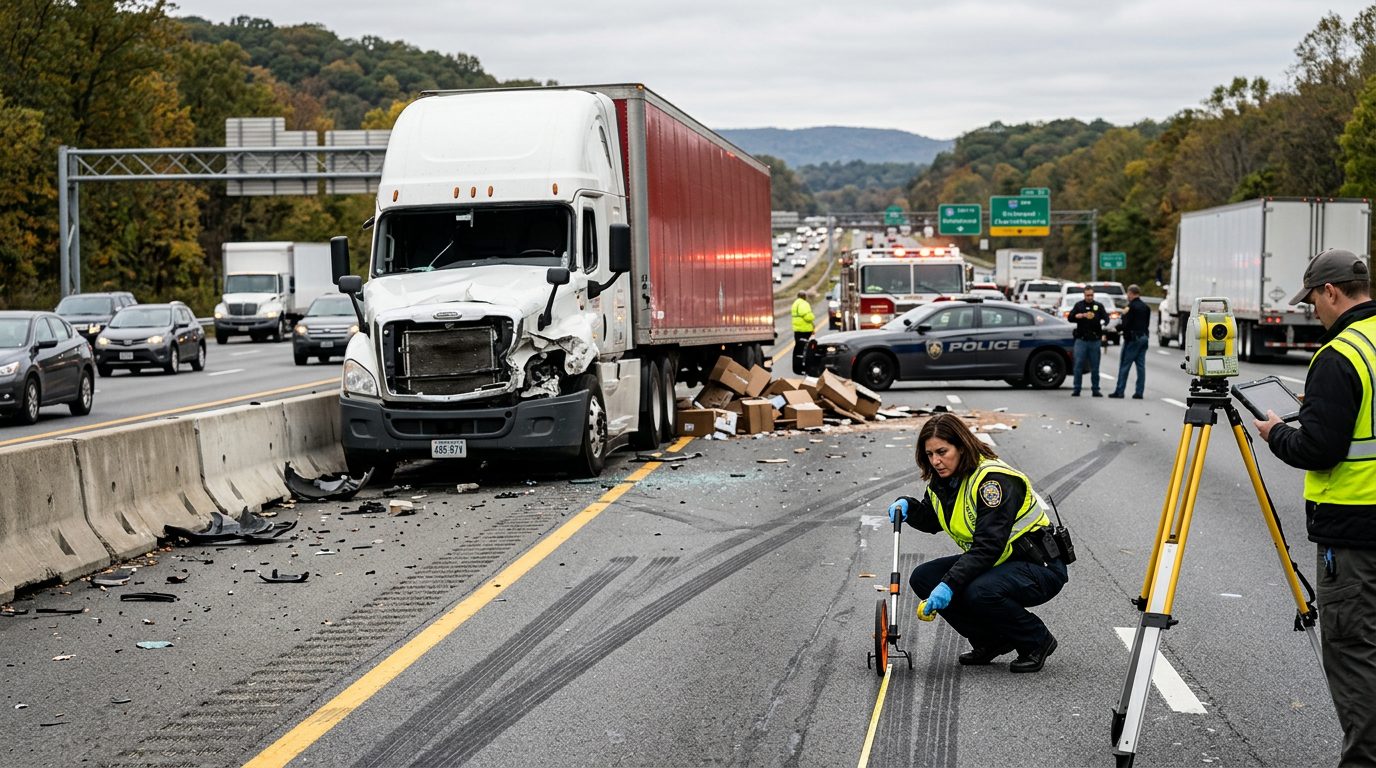
Commercial truck accidents | Richmond and Henrico County
Navigating a Commercial Truck Accident Case in Richmond
A crash with a commercial truck can involve more parties and more records than a typical car collision. Here is how the path can look for families in Richmond and Henrico County.
Published November 27, 2026
A crash with a commercial truck can leave you hurt, worried and facing questions you never expected. If you were hurt in a truck crash in Richmond, you may be asking who could be responsible, which records matter and which deadlines may apply under Virginia law.
Virginia statutes and federal trucking rules shape each step. This guide explains that path in plain language for readers in Richmond and Henrico County.
What a Commercial Truck Accident Case Involves
A commercial truck accident case is a claim that arises from a crash with a commercial truck or commercial vehicle that causes injury or death. These crashes differ from ordinary car crashes in important ways.
Commercial trucks are often run by companies, governed by federal safety rules and insured under larger policies. That means a truck case can involve company files, driver logs and more than one party. A typical car crash often does not.
This guide is for drivers, passengers, pedestrians and cyclists hurt in a truck crash. It also helps families who lose someone in a fatal crash. Many of these readers live in Richmond, Henrico County or other parts of Virginia.
The firm handles car accidents, truck and commercial vehicle accidents, catastrophic injuries including brain and spinal cord injuries, and wrongful death. A single crash can involve more than one of these areas.
Not sure what your next step is?
Talk it through with Correll Law Firm — we can walk you through how a situation like yours is usually handled and what your options are.

Who May Be Responsible in a Truck Crash
Several parties may share responsibility, and the facts of the crash decide who they are. Possible parties include:
- the truck driver
- the motor carrier that employs the driver
- the owner of the truck or trailer
- a company that leases the equipment
- a cargo loader or shipper
- a maintenance or repair contractor
- a parts or equipment maker
Each party may have its own insurance, so the claim picture can be complex. Claims against different parties may also carry different timing and notice rules, so early review helps.
Reporting the Crash and Documenting the Scene
Virginia requires a driver involved in a crash with injury or death to stop and report it to police immediately (Va. Code §§ 46.2-371, 46.2-894). The two-year period discussed below is the deadline to file a lawsuit, not the deadline to report a crash (Va. Code § 8.01-243).
Scene details fade fast. Useful steps include:
- photos of the vehicles, the trailer’s position, skid marks and road conditions
- the truck’s company name, DOT number and unit number
- names and details of witnesses
- the police report number
Medical care matters too. Brain and spinal cord injuries may not show symptoms right away. Get evaluated promptly, and keep every bill, discharge paper and follow-up note. Write a personal timeline of symptoms and missed work as soon as you can, while the details are fresh.
Evidence That Can Disappear Quickly
Trucking records can be lost or overwritten, so early attention to them matters. Federal rules require motor carriers to keep records of duty status and supporting documents for at least six months from the date of receipt (49 C.F.R. § 395.8).
Driver qualification files are another key record. A motor carrier keeps them while the driver works for it and for three years after, except that certain listed records may be removed from the file three years after they were executed (49 C.F.R. § 391.51).
Driver qualification files must include items such as the driver’s application and motor vehicle record under 49 C.F.R. § 391.51, and electronic logging devices that record duty status are covered by a different rule. Maintenance, inspection and repair records for the tractor and trailer, including brake and tire records, can also matter. Dispatch messages, bills of lading and delivery schedules may show the timeline of the trip.
Your own evidence matters just as much. Photos, witness details and medical records are in your hands from the start. Waiting to gather them can make them harder to recover.
How a Truck Crash Case Typically Moves Forward
A truck case usually moves through review, investigation, damages, negotiation and, if needed, a lawsuit. Each stage builds on the one before it.
- Initial review. The firm looks at the crash report, medical records and employment details to understand the injuries and the parties.
- Investigation. Company and vehicle records are requested and reviewed. When the facts call for it, outside accident reconstruction and medical professionals may be consulted.
- Damages documentation. Medical treatment, rehabilitation, lost income and changes to daily life are organized into a clear record.
- Claim and negotiation. The claim is presented to insurers and to the parties’ representatives.
- Litigation, if needed. A lawsuit can be filed. Discovery, the exchange of records and depositions, follows. Some cases end in mediation or settlement, and some go to trial.
The timeline changes with each crash and each injury, so no fixed schedule applies to every case.
Deadlines and Notice Requirements to Know
Two deadlines matter most in a Virginia injury case. The first is for a personal injury lawsuit.
Virginia generally allows two years from the date of injury to file a personal injury lawsuit (Va. Code § 8.01-243(A)); the clock runs from the date of injury, not the date of discovery, with narrow exceptions. You can read the statute at Va. Code § 8.01-243.
For a fatal crash, a separate rule applies. A Virginia wrongful death action is filed by the decedent’s personal representative within two years of the death (Va. Code §§ 8.01-50(C), 8.01-244(B)), on behalf of the family members the statute protects. Who shares in that recovery is set by Va. Code § 8.01-53.
Some claims carry notice requirements that run out sooner. Those dates can arrive before the two-year date, so early review helps you see which deadlines may apply.
Not sure what your next step is?
Talk it through with Correll Law Firm — we can walk you through how a situation like yours is usually handled and what your options are.
Fault, Defenses and Damages in Catastrophic Cases
Fault is often the central issue in a truck case, and Virginia’s rule is strict. Virginia follows contributory negligence: if you are found even partly at fault, you may be barred from recovering, with limited exceptions. Talk to a lawyer about your facts.
Trucking companies and insurers may dispute how the crash happened, whether the driver was tired, or whether an injury came from the crash. The evidence in the file decides those questions.
Punitive damages are a separate issue. Virginia allows punitive damages for actual malice, or for willful or wanton conduct or recklessness showing a conscious disregard for the safety of others, capped at $350,000 (Va. Code § 8.01-38.1). Under Va. Code § 8.01-38.1, the jury decides the amount of any punitive damages award without being told of the statutory limit, and if a verdict exceeds that limit, the judge reduces the award to the amount the statute allows.
Catastrophic injuries can bring large changes to life. Common categories include medical care, rehabilitation, lost earning capacity and long-term care needs. Brain and spinal cord injuries often need evaluation over time, so the full picture may take time to develop.
Working With a Firm Based in Winchester and Harrisonburg
The firm has offices in Winchester and Harrisonburg, and it serves people in Richmond and Henrico County. The firm does not have a Richmond or Henrico County office.
The firm serves people from Richmond, Henrico County, the Shenandoah Valley and other parts of Virginia. The practice areas it handles are the case types covered in this guide.
The firm has support staff who help organize records, paperwork and scheduling. Those tasks matter in a truck case, where files can be large and deadlines can overlap.

Frequently Asked Questions
Does every truck crash case go to court?
Not every case does. The facts, the parties and the evidence shape the path.
Do I need a lawyer for a truck crash claim?
You may wish to talk with a lawyer about your facts. A lawyer can explain how Virginia law applies to your situation.
What if the truck came from another state?
The carrier’s home base and operating authority can affect which records and parties are involved. Those details are worth checking early.