
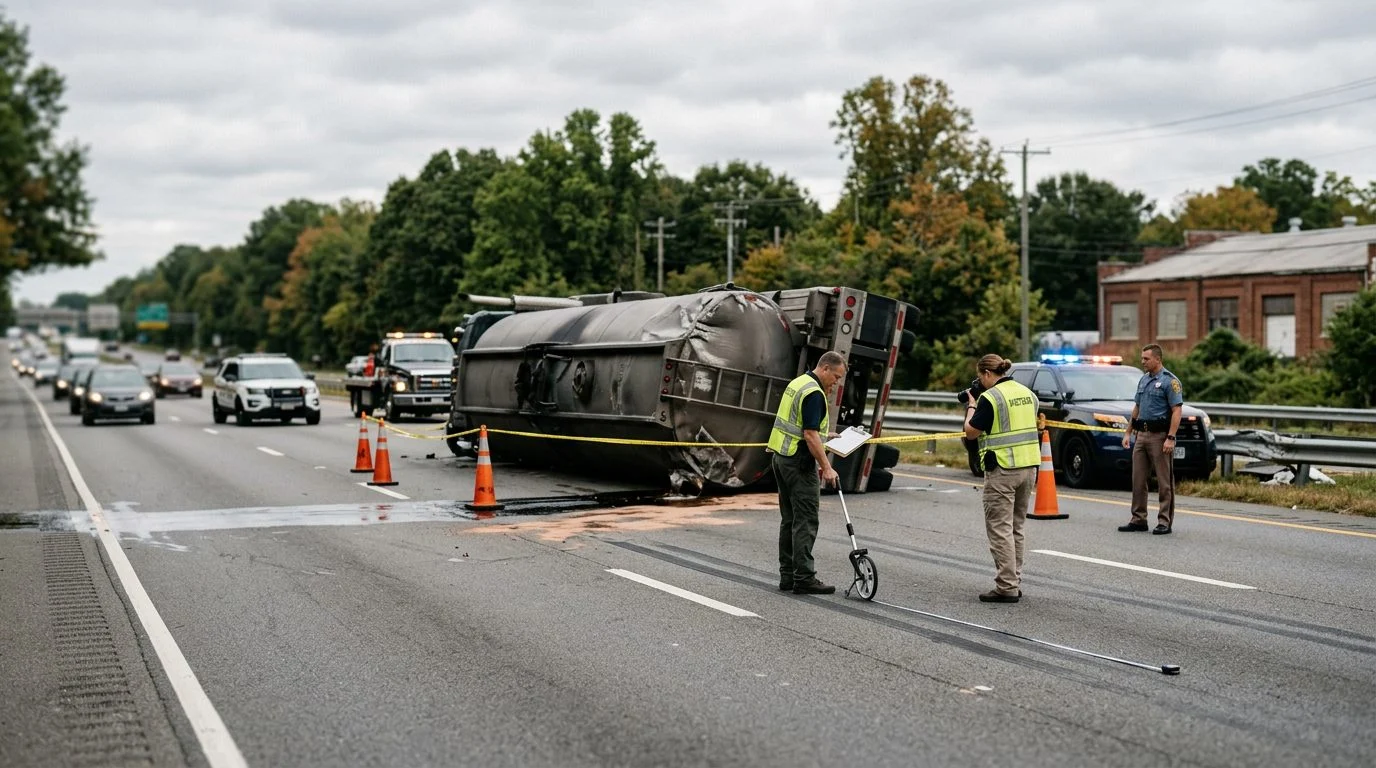
Truck Accidents | Richmond and Henrico County
Tanker Truck Crash Help for Richmond and Henrico Families
A tanker crash can bring hazards, complicated records and difficult questions at a hard time. Here is how these cases tend to differ from other vehicle crashes.
Published November 29, 2026
For someone hurt in a tanker truck crash near Richmond, the first questions are usually simple: what happened, who may be responsible, and what Virginia law allows. A tanker truck accident claim is a commercial vehicle injury claim. It can involve the driver, the trucking company, and others, not only the other motorist.
What a Tanker Truck Accident Case Involves
A tanker truck accident case is an injury claim involving a truck built to haul liquids or gases in bulk. Tankers often carry fuel, chemicals, or other liquid loads on highways and local roads around Richmond and Henrico County.
Because the truck is a commercial vehicle, a claim may involve several parties:
- The driver who was operating the truck
- The company that operates the truck or dispatched the trip
- Other drivers, passengers, or pedestrians hurt in the crash
This page is written for three groups. They are people hurt in a tanker crash in Richmond or Henrico County, families of someone killed in one, and Shenandoah Valley residents hurt on Richmond-area roads. The firm handles car accidents, truck and commercial vehicle accidents, catastrophic injuries including brain and spinal cord injuries, and wrongful death.
If a tanker truck crash changed your life or your family's, you do not have to work out the next steps alone. Talk it through with Correll Law Firm — we can walk you through how a situation like yours is usually handled and what your options are.

Why Tanker Crashes Raise Different Questions
Tanker crashes raise questions that many other crashes do not, mostly because of what the truck carries. Four issues set these cases apart.
- Moving liquid. Liquid cargo can shift during braking, turns, or sudden lane changes. That movement can affect how the truck handles and how the crash unfolds.
- Hazardous loads. Some tankers carry materials that can leak, vaporize, or catch fire. Spills and cleanup can add injuries and delays beyond the impact itself.
- Fast-changing scenes. Crashes may bring road closures, emergency response, and chemical releases. Physical evidence can be moved or lost quickly.
- Records. Driver logs, maintenance and inspection files, cargo papers, and data from the truck may all bear on what happened.
Which records matter most turns on the details of each crash. That is why the review starts with the crash itself.
What the Firm’s Representation Covers
The firm represents people hurt in tanker and commercial vehicle crashes, along with families who lose a loved one in one. Claims can include:
- Injury claims for drivers, passengers, pedestrians, and other motorists
- Catastrophic injury claims, including traumatic brain injury and spinal cord injury, which often need long-term medical planning and careful documentation
- Wrongful death claims for families after a fatal tanker crash
When the facts call for technical analysis, the firm may work with investigators, medical providers, and accident reconstruction professionals. The firm also handles communication with insurers and claim paperwork, so the injured person can focus on recovery.
What to Expect: Steps and Timeline
Most tanker truck claims follow the same general steps, but the timing varies with the injuries and the parties involved.
- First conversation. The injured person or family describes the crash, the injuries, and current treatment.
- Preserving evidence. Early requests cover the crash report, photos, vehicle data, and carrier records.
- Investigation. The firm reviews the scene, medical records, and the parties to identify who may be responsible.
- Claim presentation. A demand goes to the responsible insurers, backed by documented facts and losses.
- Lawsuit if needed. A lawsuit is filed when a fair resolution cannot be reached through negotiation.
Scenes change quickly, so early requests usually matter most for physical evidence. A tanker scene may also involve fuel or chemical cleanup, which can bring in more agencies and more sources of records.
Key Virginia Rules That Shape a Tanker Crash Claim
These rules apply to most crash claims in Virginia, and each one can change how a tanker case is handled.
- Crash reporting. Virginia requires a driver involved in a crash with injury or death to stop and report it to police immediately (Va. Code §§ 46.2-371, 46.2-894). The two-year period below is the deadline to file a lawsuit, not to report a crash.
- Filing deadline. Virginia generally allows two years from the date of injury to file a personal injury lawsuit (Va. Code § 8.01-243(A)); the clock runs from the date of injury, not the date of discovery, with narrow exceptions. Some claims carry notice requirements that run out sooner.
- Partial fault. Virginia follows contributory negligence: if you are found even partly at fault, you may be barred from recovering, with limited exceptions. Talk to a lawyer about your facts.
- Wrongful death. A Virginia wrongful death action is filed by the decedent’s personal representative within two years of the death (Va. Code §§ 8.01-50(C), 8.01-244(B)), on behalf of the family members the statute protects. Family members share in any recovery, and the personal representative brings the case; for fetal death actions the natural mother brings it, but if she dies or is under a disability as defined in § 8.01-2, her estate’s administrator, her guardian, or her qualified personal representative may initiate or maintain the action (Va. Code § 8.01-50(C)).
- Wrongful death damages. Virginia wrongful death damages cover the family’s sorrow, mental anguish and loss of the decedent’s companionship, guidance and care; lost income and services; medical expenses from the injury; funeral expenses; and, for willful or wanton conduct, punitive damages (Va. Code § 8.01-52). Virginia allows punitive damages for actual malice, or for willful or wanton conduct or recklessness showing a conscious disregard for the safety of others, capped at $350,000 (Va. Code § 8.01-38.1).
Why the Firm Handles These Claims
The firm’s offices are in Winchester and Harrisonburg. It represents people in Richmond and Henrico County and across the Shenandoah Valley.
The firm reviews each tanker claim under Virginia’s reporting duties, filing deadlines, and damages rules from the start. Those rules shape what is possible, so they are reviewed first.
In commercial crashes, key information is often held by the trucking company and its records, not the injured person. Requesting those records early is a central step. Every claim turns on its own facts.
Not sure what your next step is?
Talk it through with Correll Law Firm — we can walk you through how a situation like yours is usually handled and what your options are.
Frequently Asked Questions
Can the trucking company be responsible as well as the driver?
It may be, depending on the facts, such as who employed the driver and how the truck was run.
What counts as a catastrophic injury?
A catastrophic injury is a serious, lasting harm, such as a traumatic brain injury or a spinal cord injury. These injuries often need long-term medical care and planning.
What records track a driver’s hours?
Federal rules require motor carriers to make each driver record their duty status for each 24-hour period, except private motor carriers of passengers (nonbusiness). Each change of status must list the city, town, or village, with the state abbreviation; if the change occurs at a location other than a city, town, or village, show the highway number and nearest milepost, the service plaza, or the nearest two intersecting highways, followed by the nearest city, town, or village and state abbreviation (49 C.F.R. § 395.8).