
Truck Accidents | Shenandoah Valley
Tanker Truck Accident Claims in the Shenandoah Valley
A tanker crash can involve cargo, fuel and roadway hazards that ordinary car crashes do not. Here is how these claims differ and what families and drivers should understand early.
Published November 18, 2026
A tanker truck crash can leave a person with serious injuries or leave a family without a loved one. If you’re facing that situation, you may have questions about what a claim covers and who could be responsible. In short, a tanker truck crash claim can involve the driver, the trucking company, and others, depending on the facts. Here is how these claims work in Virginia, including for people in the Shenandoah Valley.
What a Tanker Truck Crash Claim Involves
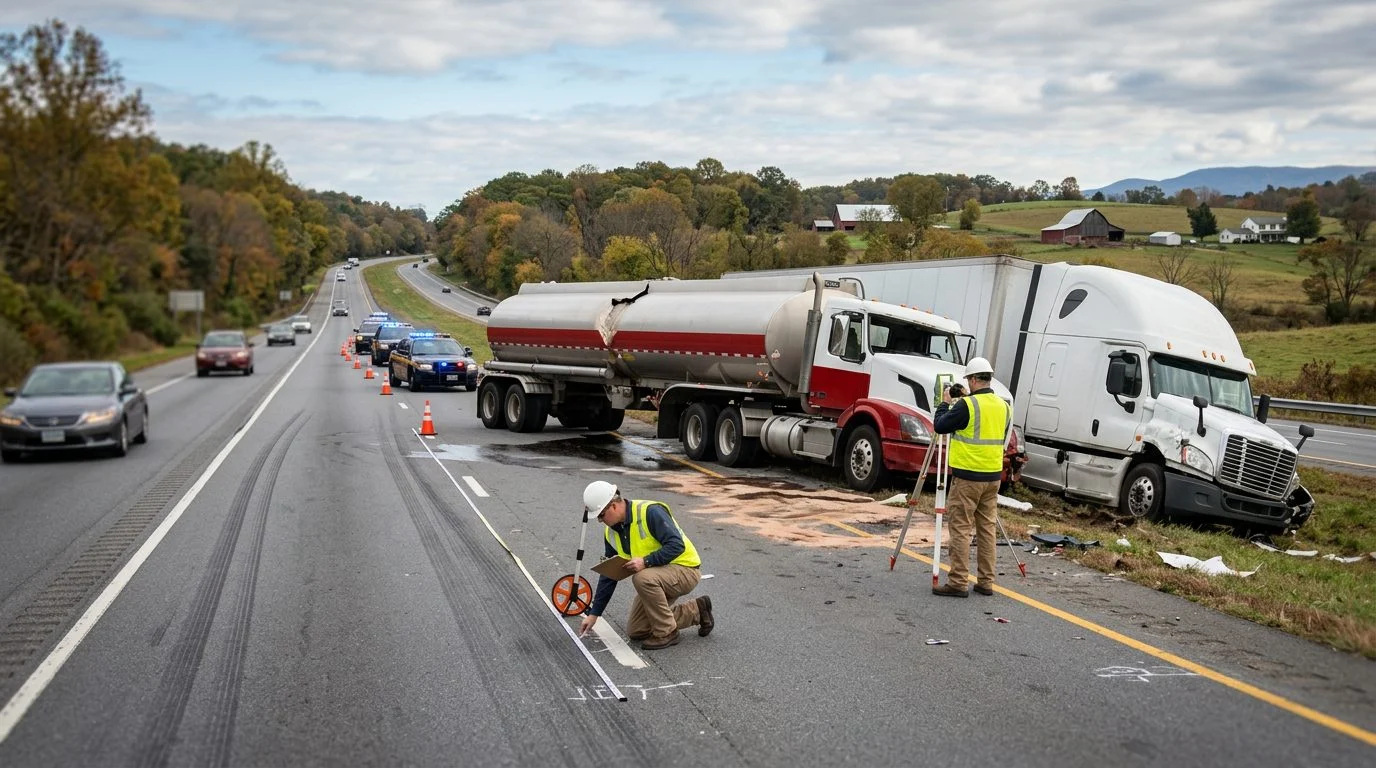
A tanker truck crash claim is an injury or wrongful death claim that arises from a crash with a truck built to haul liquids, gases, fuel or chemicals in bulk. A tanker is a truck pulling a large tank trailer. The tank can hold fuel, chemicals or other liquids and gases.
Tanker crashes can involve rollovers, spills, fires and cargo releases that force an emergency response. Liquid in a partly full tank also shifts during turns and stops. Federal rules require applicants for a tank vehicle endorsement to have knowledge of this movement, called cargo surge, and how it affects braking (49 C.F.R. § 383.119).
This guide is for people seriously hurt in a tanker crash and for families in wrongful death cases. It also serves people across the Shenandoah Valley, and in Richmond and Henrico County. For the broader picture, see commercial vehicle accidents in Virginia.
If a tanker truck crash has changed your life or your family's, you may have a claim, and the firm is ready to talk through what that could mean for you. Talk it through with Correll Law Firm — we can walk you through how a situation like yours is usually handled and what your options are.
What a Claim Can Cover
A claim can address the losses an injured person actually faces. Those often include medical bills, rehabilitation, lost income, and changes to daily life and work.
Traumatic brain injury and spinal cord injury are catastrophic injuries. They can bring long-term care needs, such as therapy, equipment, home changes and time away from work. Each person’s needs depend on the injury and the medical course.
When a crash causes a death, Virginia law sets out the damages a claim may include. Virginia wrongful death damages cover the family’s sorrow, mental anguish and loss of the decedent’s companionship, guidance and care; lost income and services; medical expenses from the injury; funeral expenses; and, for willful or wanton conduct, punitive damages (Va. Code § 8.01-52).
Who May Be Responsible After a Tanker Crash
Responsibility can reach the driver, the trucking company, and others whose conduct helped cause the crash, depending on the facts. Each party may play a different role.
Driver conduct includes speed, fatigue and distraction.
Company conduct can include maintenance. Federal rules require a motor carrier to systematically inspect, repair and maintain every vehicle under its control, including suspension systems, axles, wheels and steering (49 C.F.R. § 396.3).
The leasing company, the maintenance provider, or a maker of a defective part may also be involved.
For how driver and company claims are built, see driver and trucking company claims.
Evidence That Matters Early
Early evidence often decides how well a tanker crash can be shown. Virginia requires a driver involved in a crash with injury or death to stop and report it to police immediately (Va. Code §§ 46.2-371, 46.2-894). The two-year period discussed below is the deadline to file a lawsuit, not to report a crash.
Evidence that often matters in tanker cases includes:
- The police report and the exact crash location
- Scene and vehicle photos, including tank and trailer damage
- Cargo placards and shipping papers
- Driver logs and electronic records
- Maintenance and inspection records
- Names and contact details for witnesses
Federal rules require maintenance records to be kept for one year, and for six months after the vehicle leaves the carrier’s control (49 C.F.R. § 396.3). Records can still be overwritten or repaired, so securing them soon after the crash matters. For what to expect when an insurer calls, see insurer calls after a truck crash.
How the Process Works, Step by Step
A tanker claim usually moves through five stages, from the first facts to negotiation or a lawsuit.
- Share the basic facts. The firm reviews the crash details and whether the matter fits the practice areas it handles.
- Investigate. Requests may include the crash report, company records and medical documentation.
- Notify responsible parties. Notice goes to the parties and their insurers.
- Build the damages picture. This covers the medical course, time away from work and, in a death case, the family’s losses.
- Negotiate or file suit. Negotiation may come first. If it does not resolve the claim, a lawsuit may be filed.
Virginia generally allows two years from the date of injury to file a personal injury lawsuit (Va. Code § 8.01-243(A)); the clock runs from the date of injury, not the date of discovery, with narrow exceptions. Some claims carry notice requirements that run out sooner.
A Virginia wrongful death action is filed by the decedent’s personal representative within two years of the death (Va. Code § 8.01-50, § 8.01-244), on behalf of the family members the statute protects. Family members do not file; they share in the recovery under Va. Code § 8.01-53, which sets out who the beneficiaries are.
Virginia Fault Rules That Shape These Claims
In Virginia, the injured person’s own conduct at the scene can decide whether a claim goes forward. Virginia follows contributory negligence: if you are found even partly at fault, you may be barred from recovering, with limited exceptions. Talk to a lawyer about your facts.
Early records help show how the crash actually happened.
Not sure what your next step is?
Talk it through with Correll Law Firm — we can walk you through how a situation like yours is usually handled and what your options are.
Why the Firm Handles These Cases in the Shenandoah Valley
The firm has offices in Winchester and Harrisonburg. It handles truck accident and wrongful death claims for people across the Shenandoah Valley.
- Winchester and Harrisonburg: the firm’s two offices.
- Surrounding Shenandoah Valley communities: the firm serves people from this area.
- Richmond and Henrico County: the firm serves people here, from its Winchester and Harrisonburg offices.
The firm handles car accidents, truck accidents, commercial vehicle accidents, catastrophic injuries including traumatic brain injury and spinal cord injury, and wrongful death. It focuses on serious injury and family claims. The firm has assistants and office staff who support this work. People who want to understand their options may wish to talk with a lawyer early, while evidence is still available.
Common Questions About Tanker Truck Crash Claims
Is a tanker truck crash claim different from other truck crash claims?
It can be. Cargo, spills and fire add concerns, and federal trucking rules apply to commercial vehicles that carry property or passengers in interstate commerce (49 C.F.R. § 390.3T).
What if the tanker carried hazardous materials?
The cargo type can change which records matter and what emergency response was needed at the scene. Those details are worth preserving early.
How can a driver’s hours be checked?
Federal rules require motor carriers to have drivers record their duty status for each 24-hour period, and carriers operating commercial motor vehicles must install and require drivers to use an electronic logging device (ELD), with limited exceptions such as certain vehicles manufactured before model year 2000 (49 C.F.R. § 395.8).
Why did an insurance adjuster call so soon?
An adjuster works for the insurer and may call early to gather information. The firm’s guide on insurer calls after a truck crash explains what to expect.