
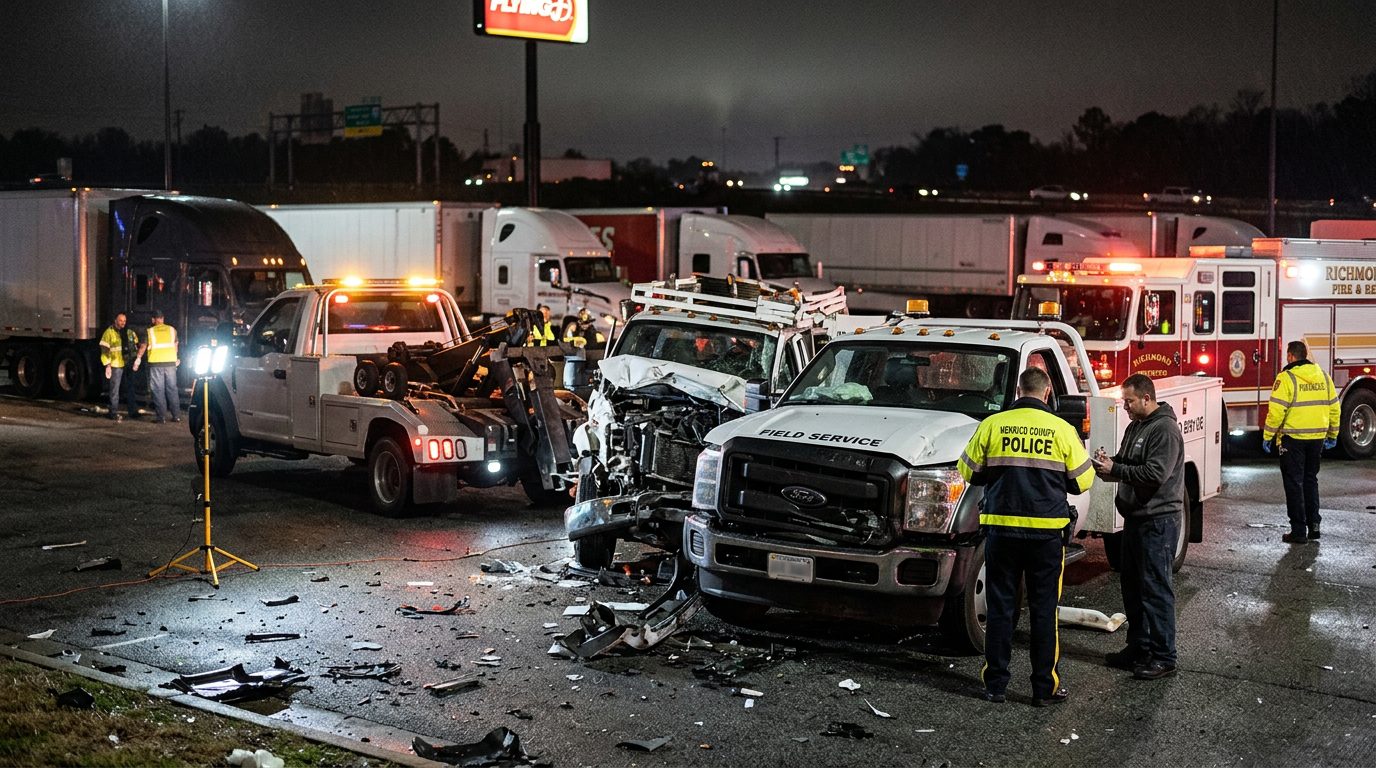
Tow Truck and Service Vehicle Accidents | Richmond and Henrico County
Hurt in a Crash With a Tow Truck or Service Vehicle?
Crashes involving these commercial vehicles can raise questions that a standard car accident does not. The firm handles these claims for people across Richmond and Henrico County.
Published November 19, 2026
A crash with a tow truck or service vehicle can leave you hurt and unsure who is responsible.
In short, a claim may involve the driver, the company that owns or runs the vehicle, and that company’s insurer. If you have been hurt in a tow truck crash in Richmond, the steps you take first can shape what comes next.
What a tow truck or service vehicle accident claim covers
A tow truck or service vehicle claim is an injury claim that arises from a crash involving one of these vehicles. Tow trucks include wreckers, flatbed carriers and roll-back carriers. Service vehicles include utility vans and work vans that a business runs on public roads.
Many of these vehicles are commercial motor vehicles. These claims can involve different facts, records and parties than a passenger-car crash.
People who may be hurt include occupants of the other vehicle, the tow or service vehicle’s own driver and passengers, roadside workers, pedestrians, and drivers near a disabled car being loaded.
If a tow truck or service vehicle hurt you or someone you love, the firm may be able to talk through who may be responsible and what your options are. Talk it through with Correll Law Firm — we can walk you through how a situation like yours is usually handled and what your options are.
Who may be responsible when a tow or service vehicle is involved
More than one person or company may be responsible when a tow or service vehicle causes a crash. The driver is one possibility. Others include the company that owns or operates the vehicle, a contractor that maintains its equipment, and anyone else whose negligence contributed.
Records help identify the right parties early. Dispatch logs, trip sheets, work orders, the company name on the vehicle and its unit number are useful starting points. Scene facts matter too: lane closures, hook-up or winch work, where the vehicle sat, and whether warning lights were on.
Under 49 C.F.R. § 392.22, when a commercial motor vehicle is stopped on the traveled portion or the shoulder of a highway for any cause other than a necessary traffic stop, the driver must immediately activate the vehicular hazard warning signal flashers and, except as paragraph (b)(2) of that section provides, place warning devices as soon as possible, and within 10 minutes.
If a county, city or town owns the service truck, an earlier notice rule can apply. A written statement of the claim, including the time and place of the injury, must be filed within six months after the claim accrues; failure to file it does not bar the claim if the locality’s attorney, chief executive or mayor, or its insurer, had actual knowledge of the claim within six months after the cause of action accrued (Va. Code § 15.2-209).
Injuries and losses these claims often involve
These crashes can cause catastrophic injuries, including traumatic brain injury and spinal cord injury. Heavy commercial vehicles can cause severe harm.
Medical records often shape these claims. Imaging, doctor visits, therapy and rehabilitation each create records. Collecting them from every provider keeps the medical picture complete.
Virginia allows punitive damages for actual malice, or for willful or wanton conduct or recklessness showing a conscious disregard for the safety of others, capped at $350,000 (Va. Code § 8.01-38.1).
For families, the filing rule is specific. A Virginia wrongful death action is filed by the decedent’s personal representative within two years of the death (Va. Code §§ 8.01-50(C), 8.01-244(B)), on behalf of the family members the statute protects. The filing rule appears in Va. Code § 8.01-244. The first class includes the surviving spouse, children of the deceased, and children of any deceased child of the deceased, and in certain circumstances the decedent’s parents (Va. Code § 8.01-53).
Steps to take after a tow truck or service vehicle crash
Getting medical care and reporting the crash come first. Virginia requires a driver involved in a crash with injury or death to stop and report it to police immediately (Va. Code §§ 46.2-371, 46.2-894). That duty appears in Va. Code § 46.2-894. The two-year period is the deadline to file a lawsuit, not to report a crash.
These steps help later:
- Keep every medical record, and note each doctor visit and therapy session.
- Photograph the scene, both vehicles, the damage and any warning signs or lights.
- Write down the company name, unit number and the driver’s name.
- Collect witness names and contact details.
An insurer for the commercial vehicle may reach out soon after the crash. Keep early statements short and factual. Don’t guess about speed, fault or injuries.
How the claim process typically unfolds
A claim usually moves from an early review to records, a demand to the insurer, and, if needed, a lawsuit.
- Initial review. The crash facts, injuries and available records are reviewed first. The review also notes whether the crash happened on a public road, a shoulder or a work zone, since each setting raises different questions.
- Investigation. Commercial records are requested.
- Damages and demand. Injuries and losses are documented, and a written demand goes to the insurer.
- Negotiation or suit. Many claims are negotiated first. If needed, a lawsuit follows. Virginia generally allows two years from the date of injury to file a personal injury lawsuit (Va. Code § 8.01-243(A)); the clock runs from the date of injury, not the date of discovery, with narrow exceptions. Some claims carry notice requirements that run out sooner.
How long each step takes depends on the facts, the injuries and how quickly records are produced.
Common questions about tow truck and service vehicle claims
These answers cover partial fault, insurer calls and the rules that apply in Virginia.
What if I was partly at fault?
Virginia follows contributory negligence: if you are found even partly at fault, you may be barred from recovering, with limited exceptions. Talk to a lawyer about your facts.
What should I say to an insurance adjuster?
Keep statements short and factual. Statements given early can be used later, so review the facts before giving detailed statements.
Does a crash outside Richmond follow different rules?
The Virginia rules in this guide apply to crashes in Virginia, including those outside Richmond and Henrico County.
Is a lawsuit the same as an insurance claim?
No. Many injury claims are resolved with an insurer without a lawsuit. A lawsuit is filed in court within the deadline described above.
Not sure what your next step is?
Talk it through with Correll Law Firm — we can walk you through how a situation like yours is usually handled and what your options are.
Practice areas these claims involve
The firm handles car accidents, truck accidents, commercial vehicle accidents, catastrophic injuries, traumatic brain injury, spinal cord injury and wrongful death matters.
Its offices are in Winchester and Harrisonburg. It represents people from the Shenandoah Valley to Richmond and Henrico County. The firm focuses on these areas of Virginia injury law. A single tow truck crash can involve more than one of them, and claims like these can name several parties.

Related guides on commercial vehicle crash claims
Several related topics build on this guide:
- Commercial vehicle accidents in Virginia: the parent guide for these claims.
- Truck driver hours of service: how to tell whether a driver was over hours in Virginia.
- Trucking insurance adjuster calls: what to say and what to avoid.
- Commercial truck crash records checklist: what to keep after a crash.