
Truck Accidents | Shenandoah Valley
When a Tanker Truck Crash Shuts Down I-81
Tanker crashes involve heavy vehicles, hazardous cargo and sometimes several companies. Here is what families in the Shenandoah Valley should know.
Where the firm works
Winchester
Office
Harrisonburg
Office
Shenandoah Valley
Area the firm serves
Published October 28, 2026
A tanker truck crash on I-81 in the Shenandoah Valley can involve fire, spilled cargo, and long road closures. If you were hurt, your first steps are getting medical care, writing down what you can, and learning the time limits that may apply. This guide explains those steps in plain language.
Why Tanker and Hazardous-Cargo Crashes Are Different
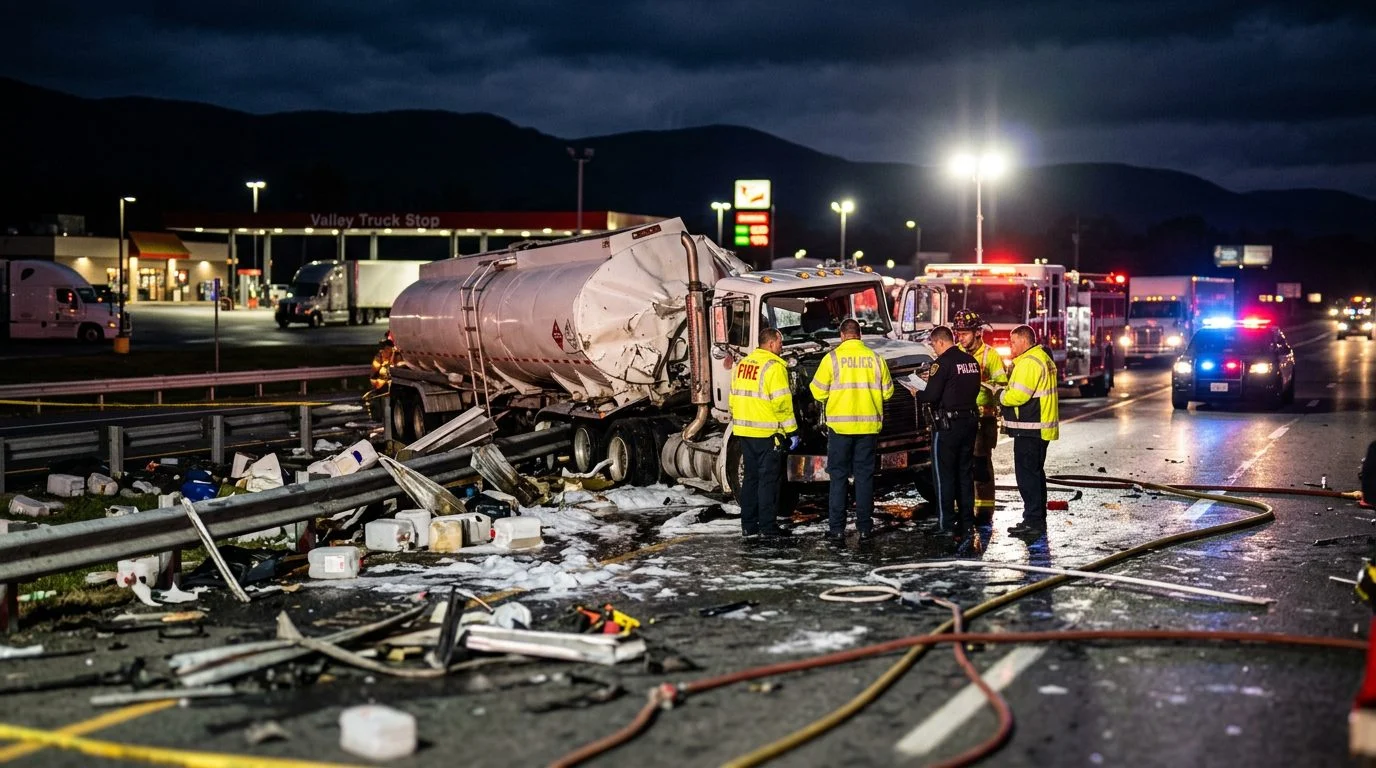
A tanker crash is different because the cargo itself can create new dangers. Fuel, chemicals, and other hazardous loads can burn, leak, or spread across lanes. The response often includes state police, local fire and rescue, and hazardous materials teams, each working its own part of the scene. Interstate lanes may stay closed for hours while crews check for leaks and clear debris.
That delay has consequences. Evidence can move or wash away before investigators reach the spot. Injured people may wait longer to be moved if the scene is unsafe. For that reason, your own notes and records should start early.
Crashes reported along I-81 often follow a few general patterns. A truck may run off the left side and strike a guardrail. A rig may overturn. A tanker may catch fire after impact. Each crash has its own facts, and these patterns are only a general guide.
If a tanker truck crash on I-81 left you or someone you love hurt, you may have a claim, and the firm is glad to talk through your situation. Talk it through with Correll Law Firm — we can walk you through how a situation like yours is usually handled and what your options are.

Getting Medical Care and Keeping Your Records
Get a medical evaluation after a tanker crash, even if you feel mostly fine at the scene. Injuries from fire, chemical exposure, or a hard impact don’t always show up right away. Some symptoms appear hours, days, or weeks later. A medical evaluation documents the injury and gives your care team a starting point.
Keep every discharge summary, imaging report, prescription receipt, and bill. Ask providers for copies. These papers show how the injury developed over time.
Start a simple symptom journal. Write the date and what you notice, such as pain, headaches, dizziness, sleep changes, memory problems, or numbness. Short notes are enough. Over time, the journal can show patterns that busy days might hide.
A family member can help when the injured person can’t keep up. A relative can track appointments, bring the journal to visits, and sort paperwork.
What to Record at the Scene and in the Days After
Write down the basic facts as soon as it is safe to do so. Note the date, the time, and the exact place on I-81. Include the direction of travel and any mile marker you can see on a nearby sign. Also record the weather, which lanes each vehicle was in, and where traffic stopped.
Record the carrier’s name and the truck’s USDOT number. Federal rules require self-propelled commercial motor vehicles subject to the subchapter to be marked with the carrier’s identification number, preceded by the letters “USDOT” (49 C.F.R. § 390.21T). Note any company name, phone number, or tank or trailer number you can see.
Take photos from a safe distance. Capture the vehicles, the road, skid marks, debris, and any placards or markings on the tank. Get names and contact details for witnesses, including anyone who stopped to help.
In the following days, save texts, emails, and letters from the carrier or any insurer. Write down the name of each person who spoke with you and what they said.
Reading the Cargo Placard and Markings
A placard is a diamond-shaped sign that shows the general hazard of the cargo.
Placards usually appear on the sides, ends, and back of a tank. They show a general hazard class, such as flammable, corrosive, or toxic. Some tankers also carry an orange panel with identification numbers.
Photograph the placard and any orange panel if you can do so safely. Those images can help investigators and medical providers understand what exposure may have happened. Tell your doctor which material you think was involved, even if you aren’t sure.
If a placard is damaged or hard to read, write down what you can see. Note colors, symbols, and any numbers. Share what you observed with the responding agency. Avoid guessing at the contents or repeating rumors from the scene.
Why the Responding Agency’s Crash Report Matters
The responding agency’s crash report is one of the first official records of what happened.
Virginia requires a driver involved in a crash with injury or death to stop and report it to police immediately (Va. Code §§ 46.2-371, 46.2-894). Under Va. Code § 46.2-371, the driver of any vehicle involved in any accident resulting in injury to or death of any person, or some person acting for him, shall immediately give notice of the accident to a law-enforcement officer, and a willful failure to make that report is a Class 4 misdemeanor. The two-year period discussed below is the deadline to file a lawsuit, not the deadline to report a crash.
The agency’s report usually records the location, the vehicles, the parties, and the officer’s observations. Ask the agency how to request a copy. The report is one record among several. Witness accounts, photos, and physical evidence also help show what happened.
Carriers keep records too. Federal rules require motor carriers to keep an accident register for 3 years after each accident. They also require carriers to make accident records and information available to authorized representatives or special agents of the Federal Motor Carrier Safety Administration, authorized state or local enforcement agency representatives, and authorized third-party representatives (49 C.F.R. § 390.15).
Reports can take time to finalize. If something looks wrong, raise the question early.
Time Limits and Fault Questions to Understand Early
Filing deadlines and fault rules shape every Virginia tanker claim, so learn them early.
Virginia generally allows two years from the date of injury to file a personal injury lawsuit (Va. Code § 8.01-243(A)); the clock runs from the date of injury, not the date of discovery, with narrow exceptions. Under Va. Code § 8.01-243, subsection A, unless otherwise provided in that section or by other statute, every action for personal injuries, whatever the theory of recovery, shall be brought within two years after the cause of action accrues.
Some claims carry shorter notice requirements. A negligence claim against a county, city, or town can be barred unless a written statement is filed within six months. The statute excuses a missed filing if the attorney, chief executive, or mayor of the locality, or any insurer or entity providing coverage or indemnification of the claim, had actual knowledge of the claim, which includes the nature of the claim and the time and place at which the injury is alleged to have occurred, within six months after the cause of action accrued (Va. Code § 15.2-209).
Virginia follows contributory negligence: if you are found even partly at fault, you may be barred from recovering, with limited exceptions. Talk to a lawyer about your facts.
Two or more people can share responsibility for one injury.
If a crash caused a death, different rules apply. A Virginia wrongful death claim is brought by the decedent’s personal representative (Va. Code § 8.01-50), and it has its own filing deadline.
Not sure what your next step is?
Talk it through with Correll Law Firm — we can walk you through how a situation like yours is usually handled and what your options are.
Catastrophic Injuries After a Truck Crash
Brain and spinal cord injuries can change a person’s daily life for a long time.
A traumatic brain injury can affect memory, mood, and focus. A spinal cord injury can affect movement and feeling. Recovery can take months or longer, and some effects may not be clear for a while.
Families often face ongoing needs. These can include rehabilitation, medical equipment, home changes, and time away from work. Early records help show that care over time.
The firm handles catastrophic injury matters, along with car accidents, truck accidents, and commercial vehicle accidents. Readers who want more detail can look at the firm’s pages on catastrophic injuries, traumatic brain injury, and spinal cord injury. Readers hurt on I-81 while traveling from the Richmond or Henrico County area can find information on the firm’s Richmond and Henrico County pages.

Next Steps for Readers in Winchester and Harrisonburg
I-81 runs through Winchester and Harrisonburg, and each area may involve different local agencies.
A crash near these towns can involve county sheriff’s offices, town police, Virginia State Police, and local fire and rescue. Knowing which agency responded helps you request the right report later.
The firm’s offices are in Winchester and Harrisonburg, and the firm serves people across the Shenandoah Valley. For a broader guide to these claims, see the firm’s page on commercial vehicle accidents in Virginia.
To sum up, record the scene, keep every medical and billing record, photograph the placard, request the crash report, and mark the filing dates on your calendar.
Can a family member keep records for an injured person?
Yes, a family member can keep the symptom journal, gather bills, and track appointments.
Does a wrongful death claim follow the same timeline?
No, it has its own filing deadline, and the decedent’s personal representative brings it.
Should I get checked if I feel fine after a tanker crash?
Yes, a medical evaluation is a good idea, because some injuries show up days or weeks later.
Related practice areas
- Commercial Vehicle Accidents in Virginia: What Injured People and Families Should Know First
- Truck Accident Hours of Service Rules in Virginia