
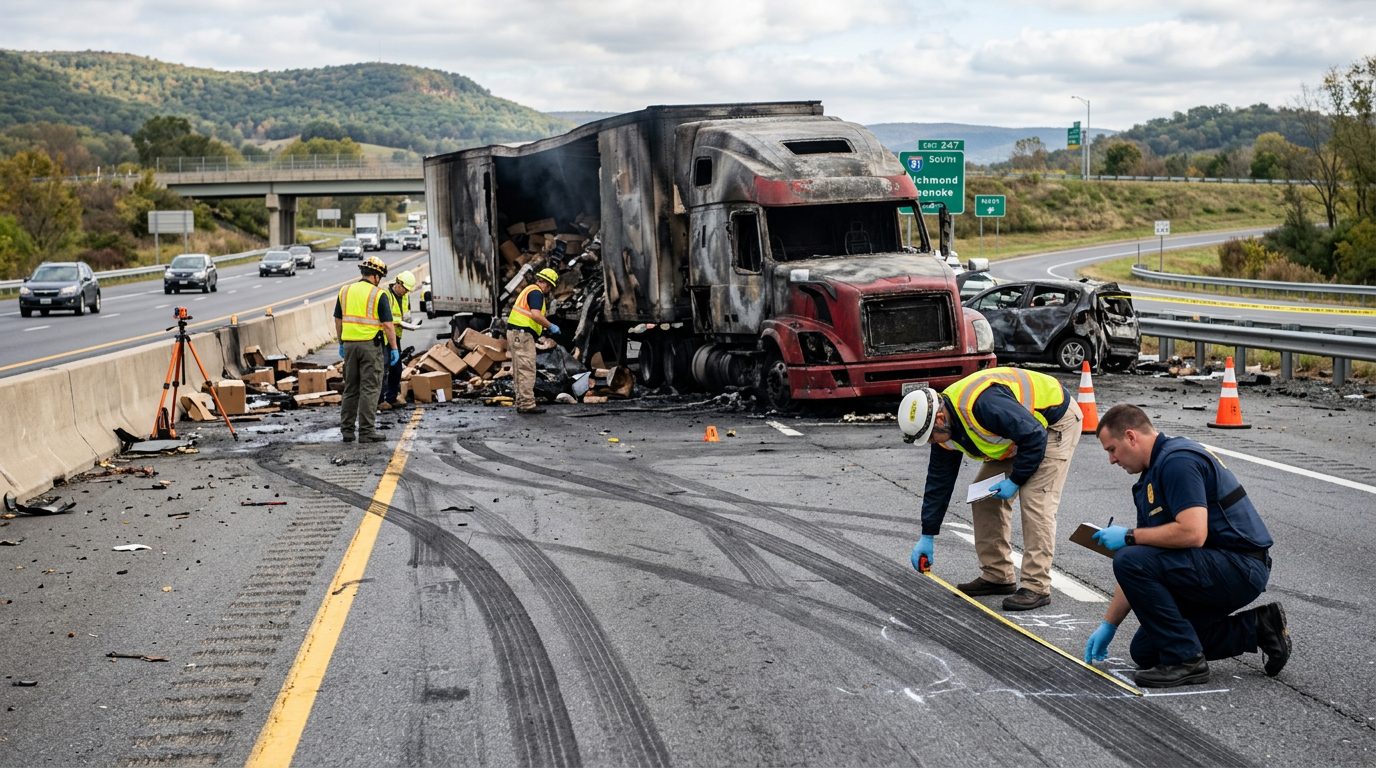
Truck Accidents · Winchester, Virginia
After a Truck Crash, Burn Injuries Raise Hard Questions
Fire can follow a commercial truck collision and change a family's life in minutes. Here is how to think through what comes next.
Published November 22, 2026
A truck crash that starts a fire can leave a person with serious burns, and the questions come fast. This page explains the medical and legal questions to raise early, in plain language.
The short answer: ask the treating team how deep the burns are and whether smoke or other injuries were checked. On the legal side, ask about deadlines and records as soon as possible.
What a truck fire burn injury involves and who this page is for
A truck fire burn injury is a burn caused by fire after a crash involving a truck or other commercial vehicle. Fuel, cargo and hot vehicle parts can all feed a fire. Burns can also happen while a person tries to get out of a vehicle.
This guide is for people burned in a truck or commercial vehicle crash. It is also for family members of a burn survivor or of someone who died. It covers questions to ask, not diagnoses. Your medical team guides treatment.
Not sure what your next step is?
Talk it through with Correll Law Firm — we can walk you through how a situation like yours is usually handled and what your options are.

Medical questions to ask in the first weeks after a truck fire burn
Start with the burn itself. Ask the treating team these questions, and write down the answers:
- How deep are the burns, and how was that depth determined? Depth shapes the treatment plan.
- Was a burn center evaluation done, or was a transfer recommended?
- What is the wound care plan, the pain plan and the follow-up schedule?
- Which signs of infection should you report right away?
- Are skin grafts or other surgeries planned, and how might they affect work and daily life?
Keep a written log of treatment dates, providers, medicines and symptoms. Take dated photos of wounds as they heal. Memory of dates and symptoms fades quickly, and a log makes later questions easier to answer.
Injuries that can occur alongside burns in a truck crash
Burns are often the most visible injury, but they are not always the only one. Ask the team about these areas before the chart is closed:
- Breathing: Was smoke or fire exposure checked for effects on the lungs?
- Head: Did the impact or the escape cause a head injury? Ask what symptoms to watch for at home and when to report them.
- Spine: Were neck or back pain, numbness or weakness checked?
Ask providers to record every injury in the chart, not only the burn. Complete medical records support later questions about the full impact of the crash.
Who may be responsible and which records matter
Early records requests help answer who was responsible and what happened. Start with these questions:
- Who was driving, who employed the driver, and was the driver on a trip or dispatch assignment?
- Do the driver’s duty status records show hours on duty and rest? Federal rules require a motor carrier subject to these rules, except a private motor carrier of passengers (nonbusiness), to require each driver to record duty status for each 24-hour period (49 C.F.R. § 395.8).
- What inspection, repair and maintenance records exist? Motor carriers must systematically inspect, repair and maintain their vehicles (49 C.F.R. § 396.3), and those records must be kept for 1 year and for 6 months after the vehicle leaves the carrier’s control. Federal fuel system rules also require fuel tanks to be securely attached (49 C.F.R. § 393.65).
- Gather the police report, any fire department report, and photos or video of the scene and the vehicle.
Some records are kept only for limited periods, so early requests matter.
Deadlines and crash reporting rules in Virginia
Virginia has separate rules for reporting a crash and for filing a lawsuit. Virginia requires a driver involved in a crash with injury or death to stop and report it to police immediately (Va. Code §§ 46.2-371, 46.2-894). The two-year period is the deadline to file a lawsuit, not to report a crash (Va. Code § 8.01-243).
Virginia generally allows two years from the date of injury to file a personal injury lawsuit (Va. Code § 8.01-243(A)); the clock runs from the date of injury, not the date of discovery, with narrow exceptions.
Some claims carry notice requirements that run out sooner. For example, a negligence claim against a county, city or town requires a written statement filed within six months after the cause of action accrued. The statute excuses that filing if the locality’s attorney, chief executive or mayor, or any insurer or other entity providing coverage or indemnification of the claim, had actual knowledge of the claim, including its nature and the time and place of the injury, within six months after it accrued (Va. Code § 15.2-209).
Fault, punitive damages and wrongful death questions
Three Virginia rules shape what an injured person or family may pursue: fault, punitive damages and wrongful death.
Fault comes first. Virginia follows contributory negligence: if you are found even partly at fault, you may be barred from recovering, with limited exceptions. Talk to a lawyer about your facts.
Virginia allows punitive damages for actual malice, or for willful or wanton conduct or recklessness showing a conscious disregard for the safety of others, capped at $350,000 (Va. Code § 8.01-38.1).
A Virginia wrongful death action is filed by the decedent’s personal representative within two years of the death (Va. Code §§ 8.01-50(C), 8.01-244(B)), on behalf of the family members the statute protects. Virginia wrongful death damages cover the family’s sorrow, mental anguish and loss of the decedent’s companionship, guidance and care; lost income and services; medical expenses from the injury; funeral expenses; and, for willful or wanton conduct, punitive damages (Va. Code § 8.01-52).
Not sure what your next step is?
Talk it through with Correll Law Firm — we can walk you through how a situation like yours is usually handled and what your options are.
How the firm handles truck fire burn and catastrophic injury matters
The firm handles car accidents, truck accidents, commercial vehicle accidents, catastrophic injuries, traumatic brain injury, spinal cord injury and wrongful death. A burn injury from a truck crash is reviewed within those practice areas. The firm has offices in Winchester and Harrisonburg. It serves people from the Shenandoah Valley, Richmond and Henrico County.
A typical first step covers the crash and injuries, gathering records and reports, identifying the parties involved, and explaining which deadlines may apply. The firm may ask you to sign records authorizations so the file is complete from the start. Every burn injury matter depends on the facts, so the firm looks at each one on its own details.
Frequently asked questions about truck fire burn injuries
Does a burn have to be severe to matter in a claim?
The full set of injuries from the crash matters, not the burn alone. Record every injury, including breathing, head and spine symptoms.
Can a family pursue a claim if a burn survivor later dies?
A wrongful death claim can be filed through the decedent’s personal representative. The section above explains who files and what the law covers.
Should I keep copies of medical records and bills?
Yes. Keep copies of records, bills and receipts, and bring them to any discussion of your matter.