

Commercial Vehicle Accidents | Virginia
Trucking Records Can Disappear Quickly. Know What to Ask For Early.
A crash involving a commercial truck leaves a trail of paper and digital data. Here is how to think about that trail, from the cab of the truck to the dispatch office.
Published November 11, 2026
After a truck crash, many people wonder what proof exists beyond the damage they can see. A trucking company may keep electronic data from the truck, driver logs, maintenance files, cargo papers, dispatch messages and crash-scene records. Some of these records are kept only for a set time, and some can be lost if no one asks for them early.
This guide goes through each category, explains why it may matter, and shows what you can keep yourself. For the wider picture, read the firm’s commercial vehicle accidents guide for Virginia.
What a trucking company may keep after a crash
A trucking company may keep records about the truck, the driver, the load and its own office. Those records can exist in several places at once.
Commercial trucks operate under federal rules that set minimum retention periods for many business and operating records. Under 49 C.F.R. § 379.3, companies subject to that part must keep records for the minimum periods listed in the regulation’s appendix A. Those periods are counted as a set number of years from the date of each document, not calendar years, under 49 C.F.R. § 379.13.
Federal carrier data is also public. The FMCSA Safety Measurement System shows a carrier’s inspection, investigation and crash-history data, and its pages note limits on how to read that data.
The firm represents people from the Shenandoah Valley to Richmond and Henrico County.
If a commercial truck crash has changed your life or your family's, you do not have to sort out the evidence questions alone, and the firm is glad to talk. Talk it through with Correll Law Firm — we can walk you through how a situation like yours is usually handled and what your options are.

Electronic data from the truck itself
The truck’s own systems can store data about how it moved before and during a crash. That data is often the most direct record of speed and braking.
Many heavy trucks have an engine control module and an event data recorder, often called a black box. These devices may save speed, braking and throttle information around a sudden event. Not every truck saves the same data, and what is saved depends on the make and settings.
Many commercial trucks carry an electronic logging device, or ELD. Under 49 C.F.R. § 395.26, an ELD automatically records the date, time, the truck’s location, engine hours, vehicle miles, driver and vehicle identification, and motor carrier identification data. It also records an intermediate entry when the truck is in motion and there has been no duty status change or other intermediate recording in the previous hour.
This data may exist only on the truck or on the company’s system. If no one saves it, it can be lost. That is one reason early requests for preservation matter.
Driver logs, hours of service and driver files
Driver logs show when a driver was driving, on duty or resting in the period before a crash. They are one of the first places to check the driver’s timeline.
Under 49 C.F.R. § 395.8, a motor carrier subject to that part (except a private motor carrier of passengers, nonbusiness) must require each driver it uses to record the driver’s duty status for each 24-hour period using the method the regulation prescribes, as applicable. That method is generally an electronic logging device (ELD), although paragraph (a)(1)(ii) allows a carrier to require manual recording instead in certain circumstances, such as limited log days or older vehicles.
The driver qualification file is a separate record. Under 49 C.F.R. § 391.51, a motor carrier must keep one for each driver it employs. Where the driver obtained the medical certification based on a medical variance from FMCSA, the file must also include a copy of the medical variance documentation.
Checking whether these papers match the crash report and witness accounts can show if the times line up. You may wish to speak with a lawyer about what those comparisons mean in your case.
Maintenance, inspection and repair records
Maintenance and inspection records show what was checked on the truck and whether a known problem was fixed before the trip. They can be as important as the driver’s own paperwork.
Under 49 C.F.R. § 396.11, a driver’s written report must list any defect that affects safe operation of the vehicle, but these rules do not apply to a private motor carrier of passengers (nonbusiness), a driveaway-towaway operation, or any motor carrier operating only one commercial motor vehicle. The carrier must certify repairs on that report. The carrier must keep the report, the repair certification and the driver’s review for three months from the date the report was written.
Periodic inspection reports are different. Under 49 C.F.R. § 396.21, the report must name the inspector, the carrier, the date, the vehicle and the parts checked, describe the results of the inspection including the identification of those components not meeting the minimum standards, and certify the accuracy and completeness of the inspection as complying with the section’s requirements. The carrier must keep it for fourteen months from the date of the inspection report.
Maintenance may be done by the carrier, a repair shop or a contractor. Each may hold part of the record, so the file may be spread across more than one place.
Cargo, loading and bill of lading records
Cargo papers show what the truck carried, where the load started and where it was headed. They can also show who arranged the trip.
A bill of lading is the shipping document for a load. It must also link those records to the driver’s record of duty status.
Load records matter because the way a load was secured or weighed can be part of how a crash happened. The papers may show what was on the truck and how it was loaded. Cargo records are often kept in company offices or with brokers, not only in the cab.
Cargo records can also name the shipper, broker or loading company. Those names can point to other parties who handled the load.
Dispatch, phone and internal company communications
Dispatch messages and phone records can show schedules and instructions given to the driver before the crash. They can reveal pressure to keep a timeline that may not have been safe.
Federal rules treat several of these as supporting documents. Under 49 C.F.R. § 395.11, that includes dispatch and trip records, expense receipts related to any on-duty not driving time, electronic mobile communication records, and payroll records that show payment to a driver.
The same section bars destruction of existing information. No motor carrier or driver may obscure, deface, destroy, mutilate or alter existing information in a supporting document.
These messages can sit on company systems, on a company phone or on the driver’s personal phone. Because the company controls most of them, asking early which messages are kept is a practical first step.
Not sure what your next step is?
Talk it through with Correll Law Firm — we can walk you through how a situation like yours is usually handled and what your options are.
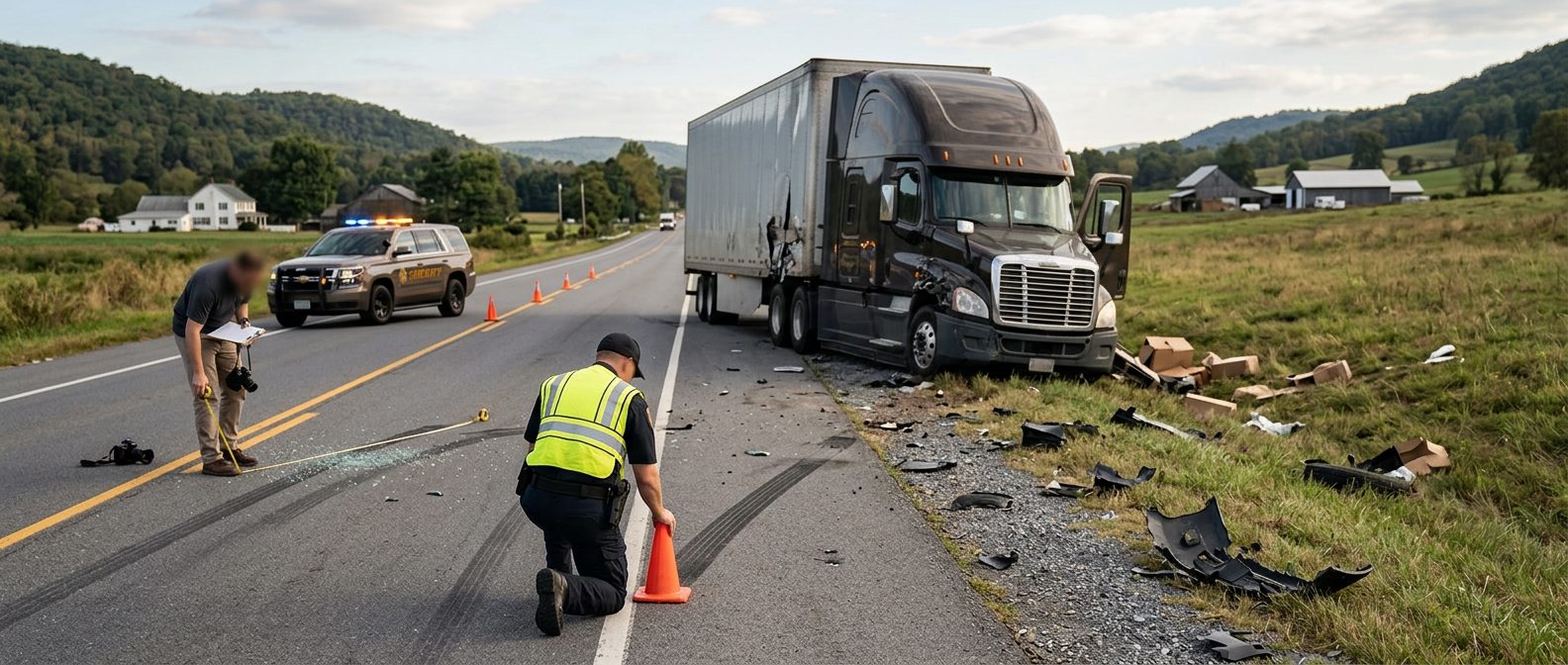
Crash-scene records, police reports and photos
The police crash report is an official record of what the officer found at the scene. It can include a diagram, citations and officer notes. It may differ from the company’s own account, so the two should be compared.
Virginia requires a driver involved in a crash with injury or death to stop and report it to police immediately (Va. Code §§ 46.2-371, 46.2-894). The driver’s duty to stop and report statute also requires reasonable help for an injured person.
Photos and video from the scene, traffic cameras and nearby businesses can show positions and conditions. The Bureau of Justice Assistance video evidence primer explains that video evidence should be identified, recovered, managed and handled appropriately for evidentiary use.
A garbage truck uses different equipment than a long-haul tractor-trailer, so its records and crash-scene evidence can differ. See the firm’s garbage truck injury guide for how vehicle type changes the picture.
Timing, medical records and the evidence you can keep
Your own medical records, bills, photos and timeline are evidence you control. You can start gathering them now, even while the company’s records are still out of reach.
Medical records show what injuries were treated, when treatment began, and how the injuries affected daily life and work. Keep bills, treatment notes and records of missed work.
Take photos of injuries and vehicle damage, and write a timeline while memory is fresh. Save the names and contact details of any witnesses.
Virginia generally allows two years from the date of injury to file a personal injury lawsuit (Va. Code § 8.01-243(A)); the clock runs from the date of injury, not the date of discovery, with narrow exceptions. The personal injury filing statute sets out the rule. Some claims carry notice requirements that run out sooner.
How long does a trucking company keep records?
Retention periods depend on the record type. They run for a set number of years from each document’s date, under 49 C.F.R. § 379.13.
Can a trucking company delete records after a crash?
Minimum federal retention periods apply: under 49 C.F.R. § 395.8(k)(1), a motor carrier must keep records of duty status and supporting documents for at least six months from the date of receipt, and under 49 C.F.R. § 395.11(d)(1), subject to paragraphs (d)(3) and (4) of that section, it need not retain more than eight supporting documents for an individual driver’s 24-hour period, while paragraph (d)(4), notwithstanding that maximum, requires a motor carrier that requires a driver to complete a paper record of duty status under § 395.8(a)(1)(iii) to maintain toll receipts for any period when the driver kept paper records of duty status. Under 49 C.F.R. § 379.3, records may be destroyed at the discretion of each company’s management after the required retention periods, but that section does not excuse compliance with longer retention periods set by other governmental bodies. Under 49 C.F.R. § 395.11, no motor carrier or driver may obscure, deface, destroy, mutilate, or alter existing information contained in a supporting document.
What is a black box on a semi truck?
It is an event data recorder that may save speed, braking and throttle information around a sudden event.
You may wish to speak with a lawyer about which records matter in your own case, since the facts differ from crash to crash.