
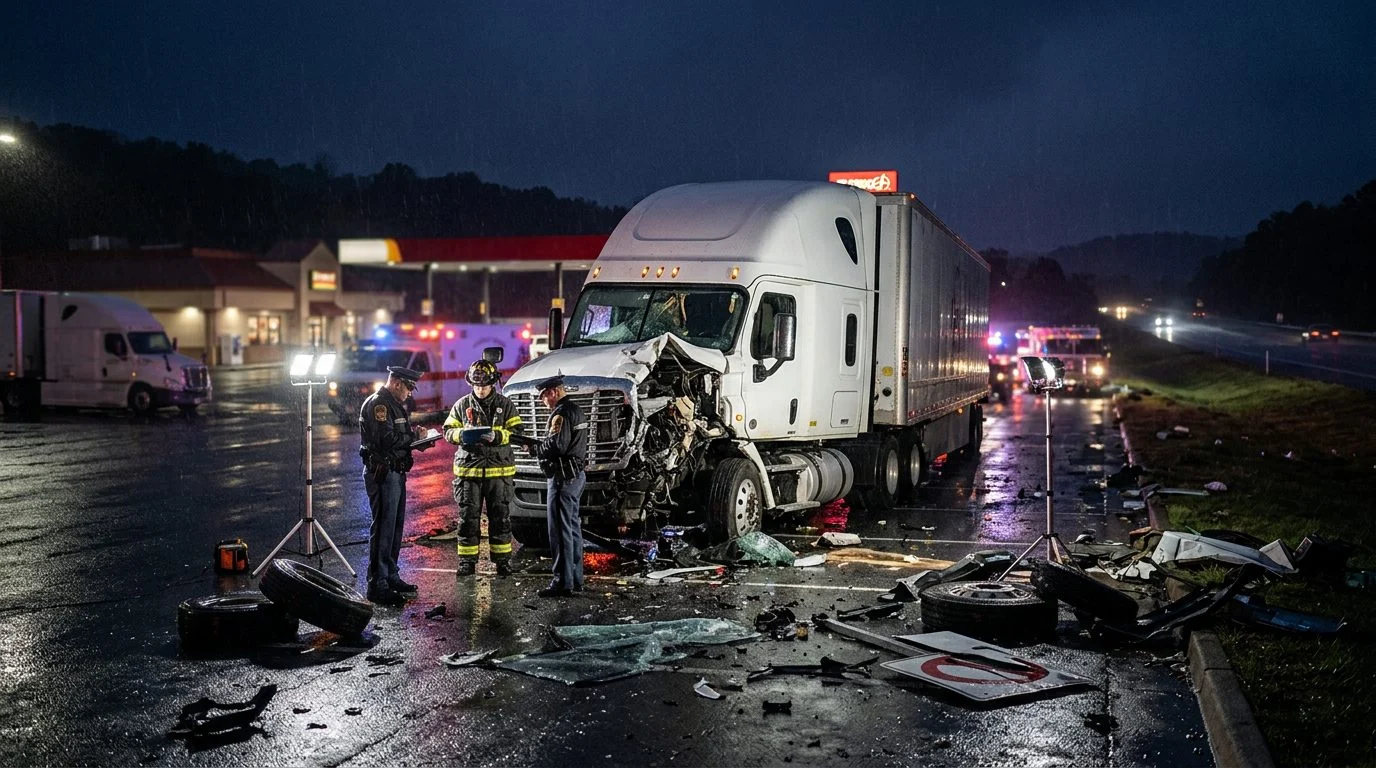
Truck Accidents | Virginia
Who Can Be Responsible After a Virginia Truck Crash?
A commercial truck crash can involve the driver, the company that runs the truck and the company that owns or leases it. Each one leaves its own records.
Published November 15, 2026
If a commercial truck hurt you or someone you love, you may wonder which company is responsible. In a Virginia truck crash, the driver, the company that operates the truck, and the company that owns or leases it can each be relevant to a claim, depending on the facts.
This page explains truck owner and driver liability after a crash, which records can show who controlled the truck, and which Virginia rules apply. Each role leaves a different paper trail.
Why a Leased or Company-Owned Truck Raises More Than One Question
A commercial truck often has three roles, and they can belong to three different businesses. The driver operates the vehicle. The operating carrier, sometimes called a motor carrier, runs the trip and assigns the load. The owner or lessor holds the title or the lease.
One crash can involve all three roles, and the facts decide how much each role matters. The firm’s offices are in Winchester and Harrisonburg. It handles truck and commercial vehicle crash claims for people from the Shenandoah Valley to Richmond and Henrico County. For an overview, read the commercial vehicle accidents guide for Virginia.
If a truck crash left you or someone you love hurt, the firm offers a free case evaluation to talk through who may be responsible. Talk it through with Correll Law Firm — we can walk you through how a situation like yours is usually handled and what your options are.
The Driver: What the Driver’s Conduct and Records Can Show
The driver’s conduct is often the first thing examined after a crash. Investigators and attorneys look at the route, the speed, the time spent driving and any citations. Each fact can bear on how the crash happened.
Federal rules require motor carriers, except private motor carriers of passengers (nonbusiness) as defined in 49 C.F.R. § 390.5, to make drivers record their duty status for each 24-hour period. Under 49 C.F.R. § 395.8, a driver must also show the carrier’s name and the truck’s number on that record. These logs can show when the driver was working and driving.
Virginia requires a driver involved in a crash with injury or death to stop and report it to police immediately (Va. Code §§ 46.2-371, 46.2-894). The two-year period discussed below is the deadline to file a lawsuit, not the deadline to report a crash (Va. Code § 8.01-243).
The Operating Carrier: Who Controlled the Trip and the Driver’s Work
The operating company often controls the driver’s schedule, dispatch and paperwork. That control can matter when a crash is traced back to how the trip was planned or how long the driver had been on the road.
Federal rules place duties on the carrier. Under 49 C.F.R. § 390.11, when the rules impose a duty on a driver, the motor carrier must require the driver to follow it. Records that can help show what the carrier required include:
- Dispatch messages and delivery schedules, which can show who assigned the load and set the timing.
- Bills of lading, which show what was hauled and where it was headed.
- The driver qualification file. Under 49 C.F.R. § 391.51, each motor carrier keeps one for every driver it employs. It holds the driver’s application, motor vehicle records and medical examiner’s certificate.
- Maintenance histories for the truck and its equipment.
Whether the operating company is legally responsible turns on the facts of each crash. The records above help show what the company knew and controlled, so they matter early.
The Owner or Lessor: What Lease and Registration Papers Can Show
The company listed on the title or registration may not be the company that runs the truck day to day. Some trucks are owned by one business and leased to another.
Federal rules set what a written equipment lease must say. Under 49 C.F.R. § 376.12, the lease must clearly state which party pays for fuel, fuel taxes, permits, tolls and detention. It must also say who loads and unloads the freight. The lease must set the conditions for deducting cargo or property damage from the lessor’s pay, and the carrier must give a written itemization before any deduction is made.
Registration papers and lease agreements can show which businesses are named for the truck and how they divided its costs and duties. Those papers help show who held control over the equipment at the time of the crash.
Electronic and Maintenance Records That Help Trace Responsibility
Electronic and written records often show what the truck was doing in the moments before a crash. A crash data recorder can store information such as speed and braking, which may be useful to a claim. For more detail, see the truck black box crash data guide for Virginia.
Records also have retention periods. Under 49 C.F.R. § 379.3, companies keep records for the minimum periods listed in appendix A. After those periods, a company may destroy the records at its own discretion. A driver qualification file must be kept while the driver is employed and for three years after, except that certain records, such as the medical examiner’s certificate, may be removed three years after execution, under the same driver file rule in 49 C.F.R. § 391.51.
Inspection and maintenance records show whether the truck was serviced. More than one company can hold these records, so they may be spread across several businesses.
Federal safety data can also help. The FMCSA Safety Measurement System Vehicle Maintenance page shows an example of a carrier’s inspection and crash history. A listed crash, however, does not by itself establish the fault of the carrier or the driver.
Because records are kept only for set periods, early steps matter. The fatal commercial truck crash checklist for families lists steps families can take.
How Fault and Filing Deadlines Work in Virginia
Fault and deadlines are separate questions, and both can shape a claim. Fault is decided on the facts of each crash, and the timing rules apply no matter how the facts turn out.
Virginia follows contributory negligence: if you are found even partly at fault, you may be barred from recovering, with limited exceptions. Talk to a lawyer about your facts.
Virginia generally allows two years from the date of injury to file a personal injury lawsuit (Va. Code § 8.01-243(A)); the clock runs from the date of injury, not the date of discovery, with narrow exceptions. Under Va. Code § 8.01-243(A), unless otherwise provided in that section or by other statute, an action for personal injuries, whatever the theory of recovery, must be brought within two years after the cause of action accrues.
Some claims carry notice requirements that run out sooner, so timing is worth checking early.
Not sure what your next step is?
Talk it through with Correll Law Firm — we can walk you through how a situation like yours is usually handled and what your options are.

When a Fatal Crash Involves a Leased or Company-Owned Truck
A fatal truck crash can lead to a wrongful death claim, and the same questions about the driver, carrier and owner still apply.
A Virginia wrongful death action is filed by the decedent’s personal representative within two years of the death (Va. Code §§ 8.01-50(C), 8.01-244(B)), on behalf of the family members the statute protects. Family members do not file the case themselves; they share in the recovery. Va. Code § 8.01-50 allows an action for damages when a death is caused by the wrongful act, neglect, or default of another person or corporation, and that action is brought by and in the name of the personal representative of the deceased person. Va. Code § 8.01-244(B) requires that action to be brought by the personal representative within two years after the death of the injured person.
Virginia wrongful death damages cover the family’s sorrow, mental anguish and loss of the decedent’s companionship, guidance and care; lost income and services; medical expenses from the injury; funeral expenses; and, for willful or wanton conduct, punitive damages (Va. Code § 8.01-52). Those damages are listed in Va. Code § 8.01-52, which says the verdict or judgment shall include, but may not be limited to, those categories.
Virginia allows punitive damages for actual malice, or for willful or wanton conduct or recklessness showing a conscious disregard for the safety of others, capped at $350,000 (Va. Code § 8.01-38.1).
For the order of steps after a fatal crash, see the commercial vehicle wrongful death timeline.