
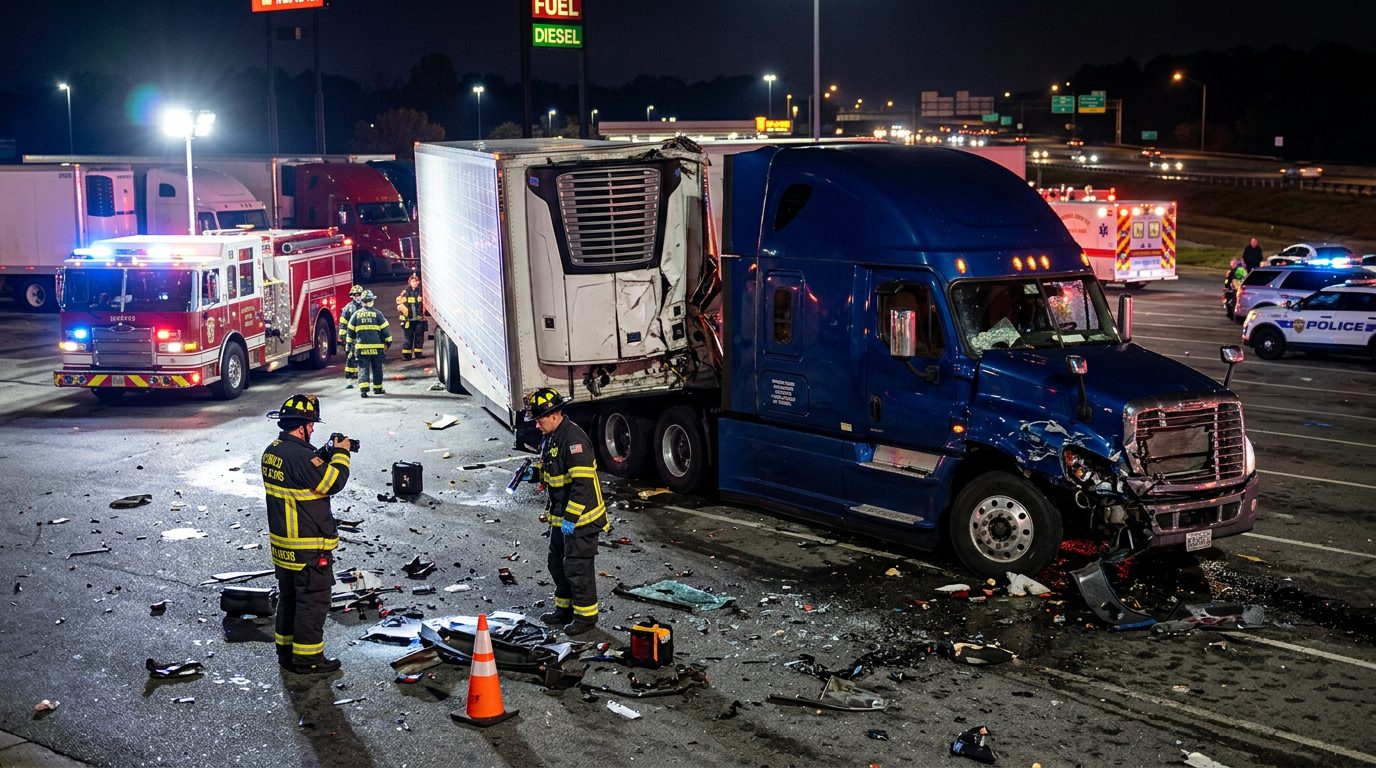
Truck Accidents | Richmond and Henrico County
Hurt in a Truck Rear-End Crash? Start With the Facts That Matter Most
A rear-end collision with a large truck can change your life in seconds. Here is what to understand about these crashes and the steps that can protect your claim.
Published November 21, 2026
Being hit from behind by a large truck is frightening, and the questions come fast. People hurt in a truck rear-end collision in Richmond or Henrico County often ask who is responsible and what deadlines apply. In short, an injured person may have a claim against the truck driver and, in some cases, the company that employs or dispatches the driver.
What a Truck Rear-End Collision Is and Why It Can Be Serious
A truck rear-end collision happens when a commercial truck hits the back of a car, or a vehicle hits the back of a truck. The size gap is the core problem. A loaded tractor-trailer weighs far more than a passenger car, so the force lands on the smaller vehicle and the people inside it.
Drivers and passengers can suffer neck and back injuries, broken bones, head injuries or spinal damage. Heavy traffic on busy corridors such as Interstate 95 and Interstate 64 adds risk. A sudden slowdown can leave a large truck little room to stop.
Not every injury shows at the scene. Some symptoms appear hours, days or weeks later. Getting checked by a medical provider soon after the crash creates a clear record of what happened and when.
If a truck struck you from behind in Richmond or Henrico County, you may have a claim, and the firm is glad to talk through what happened. Talk it through with Correll Law Firm — we can walk you through how a situation like yours is usually handled and what your options are.

Who May Be Responsible After a Truck Rear-End Crash?
The truck driver may be responsible, and so may the motor carrier that employed or dispatched the driver. Other parties may also be involved, depending on who owned, leased, loaded or maintained the truck.
Records often show who controlled the truck. Federal rules require a motor carrier to keep a driver qualification file for each driver it employs. That file can include the driver’s application, motor vehicle records and road test or medical certificate (49 C.F.R. § 391.51).
What Evidence Often Matters in a Truck Rear-End Case?
Early evidence usually includes the police report, photos of both vehicles and the roadway, witness names, and damage to each vehicle. Truck records matter too. These can include maintenance and inspection files, dispatch messages and driver logs.
Federal rules require drivers to record their duty status. They also bar any driver or motor carrier from making a false report in connection with a duty status (49 C.F.R. § 395.8).
Under 49 C.F.R. § 382.303, an employer is required to test each surviving commercial motor vehicle driver for alcohol and controlled substances after a crash involving a loss of human life if the driver was performing safety-sensitive functions with respect to the vehicle. When no one died, testing is required if the driver receives a citation for a moving traffic violation arising from the crash within the required window (8 hours for alcohol, 32 hours for controlled substances) and the crash involves either bodily injury that requires immediate medical treatment away from the scene or disabling damage that requires a motor vehicle to be transported away from the scene by a tow truck or other motor vehicle (49 C.F.R. § 382.303).
Some records and footage are not kept forever. Early requests can matter.
What Injuries Are Common in Rear-End Truck Crashes?
Traumatic brain injury and spinal cord injury are among the most serious injuries these crashes can cause. A brain injury happens when a blow or jolt disrupts how the brain works. A spinal cord injury damages the nerves that carry signals between the brain and the body.
Catastrophic injuries can need long-term medical care, therapy and changes at home or work. The full effect may take time to understand. That can affect when a claim is ready to evaluate.
Some injuries are harder to document than others. Clear medical records, consistent treatment and testimony from treating providers can help explain what happened. Outside medical reviewers may also play a role when the facts call for it.
Reporting the Crash and Virginia’s Filing Deadline
Virginia requires a driver involved in a crash with injury or death to stop and report it to police immediately (Va. Code §§ 46.2-371, 46.2-894). The two-year period below is a deadline to file a lawsuit, not a deadline to report a crash (Va. Code § 8.01-243).
Virginia generally allows two years from the date of injury to file a personal injury lawsuit (Va. Code § 8.01-243(A)); the clock runs from the date of injury, not the date of discovery, with narrow exceptions.
Some claims carry notice requirements that run out sooner.
When a Rear-End Truck Crash Is Fatal: Wrongful Death Claims
Under Va. Code § 8.01-50(C), every action under subsection A of § 8.01-50 shall be brought by the personal representative of the decedent, within the time limits in § 8.01-244, which is two years after the death of the injured person.
Virginia wrongful death damages cover the family’s sorrow, mental anguish and loss of the decedent’s companionship, guidance and care; lost income and services; medical expenses from the injury; funeral expenses; and, for willful or wanton conduct, punitive damages (Va. Code § 8.01-52).
The statute sets an order of who shares, starting with a surviving spouse and children, with parents included in defined situations (Va. Code § 8.01-53).
Not sure what your next step is?
Talk it through with Correll Law Firm — we can walk you through how a situation like yours is usually handled and what your options are.
What to Expect From the First Steps Through the Claim
- Records review. The firm looks at the crash facts, medical treatment and available records. It may send requests to preserve evidence.
- Investigation. This may include outside accident reconstruction or medical review when the facts call for it.
- Resolution. The firm may negotiate with insurers or file a lawsuit. Timing depends on the facts, and no timeline is promised.
The firm’s offices are in Winchester and Harrisonburg. It handles car accidents, truck accidents, commercial vehicle accidents, catastrophic injuries and wrongful death claims. It represents people in Richmond, Henrico County and across Virginia.
What Not to Say to an Insurance Adjuster or Other Party After a Crash
Be careful with statements about speed, fault and injuries, because a short remark can be quoted later and misread.
- Don’t guess about speed, distance or what the other driver did. Say what you saw, and say when you are not sure.
- Don’t admit fault. You can politely say you need time to understand what happened.
- Don’t minimize symptoms. Saying you are fine can be recorded as a statement about your health.
- Keep medical records and a daily symptom journal.
- Tell a medical provider about new symptoms, even minor ones.
Full and accurate information helps a lawyer evaluate the facts.

Frequently Asked Questions About Truck Rear-End Collision Claims
Can I still bring a claim if I was partly at fault?
Virginia follows contributory negligence: if you are found even partly at fault, you may be barred from recovering, with limited exceptions. Talk to a lawyer about your facts.
Will the truck company’s insurer be involved?
A claim may involve the insurer for the truck or its company, but coverage and liability are fact-specific.
What should I do first after a truck crash?
Get medical care, report the crash to police, and keep your records.
Should I speak with a lawyer before giving a recorded statement?
You may wish to speak with a lawyer about your own facts before you give any recorded statement.
Do truck crash claims always go to court?
Some claims are resolved without a trial, and others are filed in court. The path varies.