
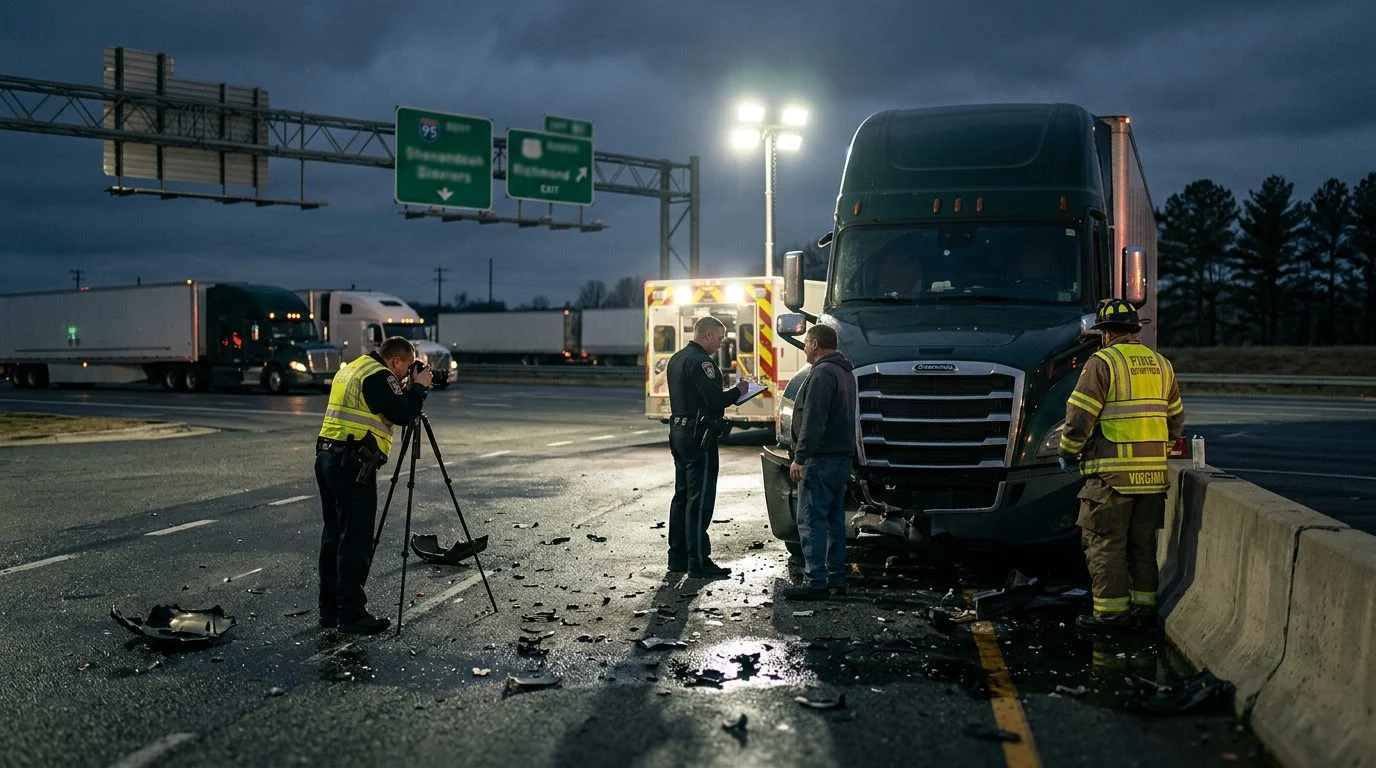
Truck Accidents | Shenandoah Valley and Richmond, Virginia
Was the Truck Driver Working When the Crash Happened?
A driver's work status can shape how a truck crash is investigated. Here is how logs, dispatch papers and other records help answer that question.
Published November 20, 2026
After a crash with a commercial truck in Virginia, one early question is whether the driver was working when the crash happened. To answer it, compare the crash time with several trucking records and read them together.
Those records can include the driver’s duty-status logs, electronic logging device data, dispatch and load papers, and fuel, toll and GPS trails. Each one shows a different part of the day. A police report is one piece of that picture, not the final answer.
Why Whether the Driver Was Working Often Matters After a Truck Crash
Whether the driver was working can affect which companies and insurers may be asked to respond to a claim. The question is factual first: what the driver was doing, for which company, and under what assignment.
Those facts matter because more than one party can be involved in a truck crash. The trucking company and the driver can both be possible parties, depending on the facts.
Three simple questions guide the early work: who employed the driver, what the truck was carrying, and where it was headed. The answers point to which records to request first, and that is why timing matters. For background on these claims, read the commercial vehicle claims guide.
If you are unsure whether the driver was on the job, you do not have to work through those records alone. The firm is ready to talk through what your situation may show. Talk it through with Correll Law Firm — we can walk you through how a situation like yours is usually handled and what your options are.

Driver Logs and Electronic Logging Device Records
A driver’s logs show whether the driver was driving, on duty, off duty or resting in the sleeper berth. Federal rules require motor carriers, except private motor carriers of passengers (nonbusiness), to have each driver record duty status for each 24-hour period (49 C.F.R. § 395.8).
An electronic logging device, or ELD, records data automatically. An electronic logging device (ELD) automatically records the date, time, commercial motor vehicle geographic location, engine hours, vehicle miles, and driver or authenticated user identification (49 C.F.R. § 395.26), except that for an intermediate recording made while the driver indicates authorized personal use, engine hours and vehicle miles are left blank and location is recorded with a single decimal point resolution (approximately within a 10-mile radius). If the truck is moving and nothing else has been logged for an hour, the ELD records an entry on its own.
Compare the crash time with the entry at that moment. Was the driver driving, on duty but not driving, or off duty? The FMCSA hours-of-service rules explain the driving limits and rest periods behind those entries.
Logs can contain errors. A driver must review and correct inaccurate entries and annotate each change, and a carrier may not alter or erase the original records (49 C.F.R. § 395.30). A log is a strong starting point, but it should be checked against other records.
Dispatch, Load, and Trip Paperwork
Dispatch and load papers show what the driver was assigned to do and when. Supporting documents such as bills of lading and dispatch or trip records help verify on-duty time that is not driving (49 C.F.R. § 395.11).
A bill of lading shows where a load starts and where it is going. Dispatch messages sent through a company system can also show what the driver was told to do and when.
Put those times next to the crash location. If the crash happened on the assigned route, near the scheduled window, that is a fact to note. If it happened far off the route, that gap raises questions.
A common mistake is to assume the paperwork is complete. Missing times or cities are a reason to ask why.
Location, Fuel, Toll, and Electronic Data Trails
GPS, fuel, and toll records can place a truck on a road at a specific time. The ELD location data described above is one trail. Fuel card purchases add a place and time, and toll transponders and scale or weigh station entries add more points along the route.
Put these points in order. A fuel stop, a toll point and the crash location can show whether the truck stayed on the expected route.
One record alone can be incomplete, so cross-checking matters. These records can confirm or challenge the driver’s account of the trip. A mismatch between records is worth examining, but it is not proof on its own.
Some of these records sit with the company or an outside provider, so they may need a formal request. That makes early action useful.
Employment, Pay, and Driver File Records
Wage records and the driver’s file can show who employed the driver and what work was assigned. Federal rules require a motor carrier to keep a driver qualification file for each driver it employs. The file is kept while the driver works there and for three years afterward. It includes the driver’s application and motor vehicle record (49 C.F.R. § 391.51).
Wage records can show when a driver was paid for driving or other on-duty work. Trip sheets and inspection reports can add dates, routes and equipment details.
Federal rules can also require a motor carrier that uses leased trucks to have a written arrangement and to be responsible for operating them safely (49 U.S.C. § 14102).
Company written policies on on-duty work, personal use of a truck and off-duty time can also be relevant. A driver on a personal errand raises different facts than a driver on a delivery, and those facts need careful review.
What the Police Crash Report Can and Cannot Show
A police crash report records what the officer saw and learned at the scene. It usually lists the vehicles, the location, the time and any citations issued. It may also name the truck’s company.
Virginia requires a driver involved in a crash with injury or death to stop and report it to police immediately (Va. Code §§ 46.2-371, 46.2-894).
A report records the officer’s view of the scene, not the truck’s full schedule. Witness statements, photographs and scene notes can add detail the report leaves out. A driver’s own account at the scene is one statement among several, and it should be compared with the records.
If your memory of the crash is limited, read about remembering a commercial vehicle crash after a head injury.
Not sure what your next step is?
Talk it through with Correll Law Firm — we can walk you through how a situation like yours is usually handled and what your options are.

Why Timing Matters for Trucking Records and Next Steps
Trucking records do not all last the same amount of time, so timing affects what remains available. Federal retention periods run from each document’s date, not from the crash date (49 C.F.R. § 379.13). Records not on the federal schedule are kept as each company’s management decides.
Alcohol testing rules also run on a clock. After certain commercial vehicle crashes, the employer must test surviving drivers as soon as practicable. If a test is not given within two hours, the employer must record the reasons (49 C.F.R. § 382.303).
Virginia generally allows two years from the date of injury to file a personal injury lawsuit (Va. Code § 8.01-243(A)); the clock runs from the date of injury, not the date of discovery, with narrow exceptions. That two-year period is the deadline to file a lawsuit, not to report a crash (Va. Code § 8.01-243).
A company or insurer may reach out soon after a crash. Background on those early contacts is in the quick insurance offer guide. If the truck belongs to a company based outside Virginia, the steps can differ. See out-of-state trucking company claims.
Does a police report show whether the truck driver was working?
Not by itself. It is usually read together with the driver’s logs and dispatch papers.
How long do trucking companies keep driver logs?
Federal retention periods run from each document’s date.