
Truck Accidents | Virginia
Hit by a Truck in Virginia? Here's What Comes Next
A collision with a large truck can change a family's life in an instant. This guide walks through the practical steps that often follow, from the scene to the medical and insurance questions that come later.
Where the firm works
2
Offices, in Winchester and Harrisonburg
Virginia
Serving the Shenandoah Valley, Richmond and Henrico County
Published November 11, 2026
If someone you care about gets hit by a truck, the first hours can feel chaotic, and the questions come fast. In short, emergency help comes first, the crash is reported to police, medical care follows, and investigators look at what caused the crash.
Truck crashes often differ from car crashes in how hard the impact hits and how serious the injuries can be. Here is what usually happens, step by step, and what Virginia law says about reporting, responsibility and time limits.
Why a truck crash can cause more serious injuries than a car crash
A truck crash often causes more serious injuries because a loaded commercial truck weighs far more than a passenger car.
Force depends on weight and speed. When a heavy truck strikes a car, the people inside absorb much of that force, and a smaller vehicle offers less protection.
Pedestrians, cyclists and people on motorcycles have even less protection. A person on foot or on a bicycle can be struck with force a passenger car would not typically produce.
The point of impact also matters. A truck’s bulk can strike a car’s doors, roof or rear seats, and each contact point can cause different injuries.
Injury severity depends on speed, the angle of impact and the body’s position at the moment of contact. Two crashes that look alike on the road can produce very different injuries.
For a broader overview of these crashes, read the commercial vehicle accidents guide.
Not sure what your next step is?
Talk it through with Correll Law Firm — we can walk you through how a situation like yours is usually handled and what your options are.

What happens at the scene in the first minutes and hours
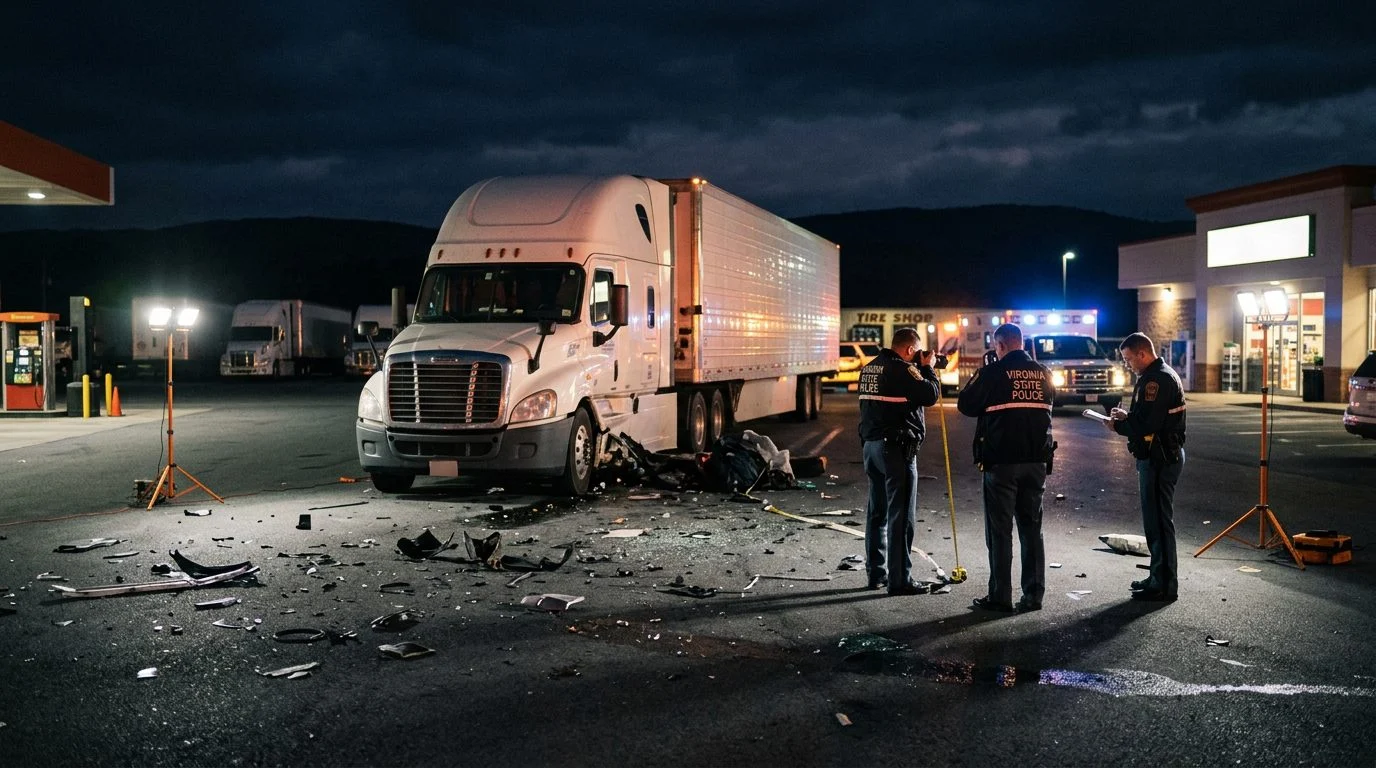
At the scene, someone calls 911, injured people are checked, traffic may be blocked, and police begin an investigation.
Virginia requires a driver involved in a crash with injury or death to stop and report it to police immediately (Va. Code §§ 46.2-371, 46.2-894).
The duty to stop at the scene, report your name, address, driver’s license number and vehicle registration number, and render reasonable assistance to anyone injured is set out in Va. Code § 46.2-894.
Others at the scene can help document what happened. Useful details include photos of vehicle positions, names of witnesses, the truck’s company name and the police report number.
Some injuries are not obvious right away. A medical check is worth making even when the pain seems mild.
One point often gets mixed up. The two-year period discussed later on this page is the deadline to file a lawsuit, not the deadline to report a crash (Va. Code § 8.01-243).
Common injuries after being hit by a truck
Common injuries after a truck crash include broken bones, internal bleeding, organ injury, deep tissue damage and burns or road rash.
Broken bones often happen at the moment of impact or when the body hits the interior or the road. Internal bleeding and organ injuries can be hidden, which is why early medical care matters.
Soft tissue injuries, such as torn muscles and deep bruising, can cause pain that lasts well after the crash.
Some injuries appear days or weeks later. How long recovery takes depends on the injury, the treatment and the person, and medical providers guide that process.
Disfigurement and scarring can be part of the picture too. Burns, lacerations and nerve damage can leave lasting marks, and the emotional effects can continue after the wounds heal.
A related discussion of large-vehicle injuries appears in the bus accident injury guide.
Traumatic brain injury and spinal cord injury after a truck crash
A traumatic brain injury or spinal cord injury is a catastrophic injury, and it can change a person’s life over the long term.
A traumatic brain injury happens when a blow or jolt to the head disrupts how the brain works. Headaches, memory problems, confusion and mood changes can develop after a crash.
A spinal cord injury damages the nerves that carry signals between the brain and the body. It can affect movement, feeling and bodily functions, and some effects may be permanent.
Medical providers decide diagnosis, treatment and the long-term outlook for each person. Rehabilitation and daily-life challenges vary widely from one person to the next.
These injuries can also reshape work, family roles and daily routines. More on catastrophic injuries appears in the commercial vehicle accidents guide.
Who may be responsible when a truck hits someone
More than one party may share responsibility for a truck crash, depending on the facts.
Responsibility can reach the truck driver, the trucking company, a vehicle owner, a maintenance provider or a cargo loader. Who is responsible depends on what caused the crash.
Federal rules also require motor carriers to inspect, repair and maintain their vehicles. Under 49 C.F.R. § 396.3, maintenance records are kept for one year where the vehicle is housed, and for six months after it leaves the carrier’s control.
Investigators often look at the police report, driver logs, maintenance records, vehicle data and any dashcam or surveillance footage. Video can be overwritten, so early requests matter. The footage guide covers that step.
Because several parties can be involved, the investigation can be more detailed than in a typical car crash.
When a truck crash is fatal: wrongful death in Virginia
When a truck crash causes a death, the claim is brought as a wrongful death action, and it follows different rules from an injury claim.
A Virginia wrongful death action is filed by the decedent’s personal representative within two years of the death (Va. Code §§ 8.01-50(C), 8.01-244(B)), on behalf of the family members the statute protects.
The distribution rules appear in Va. Code § 8.01-53.
Virginia wrongful death damages cover the family’s sorrow, mental anguish and loss of the decedent’s companionship, guidance and care; lost income and services; medical expenses from the injury; funeral expenses; and, for willful or wanton conduct, punitive damages (Va. Code § 8.01-52).
A jury must find that the conduct met the punitive damages standard, which covers willful or wanton conduct and recklessness showing a conscious disregard for others’ safety, under Va. Code § 8.01-52.
Commercial crashes in the Richmond area are discussed in the work van accident guide.
Not sure what your next step is?
Talk it through with Correll Law Firm — we can walk you through how a situation like yours is usually handled and what your options are.

Deadlines and fault rules that affect a Virginia truck accident claim
Virginia sets a deadline for filing most injury lawsuits, and fault can decide whether a claim can move forward.
Virginia generally allows two years from the date of injury to file a personal injury lawsuit (Va. Code § 8.01-243(A)); the clock runs from the date of injury, not the date of discovery, with narrow exceptions. Va. Code § 8.01-243 sets out this rule.
Some claims carry notice requirements that run out sooner than the filing deadline.
Virginia follows contributory negligence: if you are found even partly at fault, you may be barred from recovering, with limited exceptions. Talk to a lawyer about your facts.
Scene reporting, medical care, injuries, responsibility, fatal cases and deadlines each shape what happens next. Read the commercial vehicle accidents guide for the wider picture.
Can a head injury from a truck crash show up later?
Yes. Some head injury symptoms can appear after a crash, so report any change to a medical provider.
Does every truck crash lead to a lawsuit?
Not every crash leads to a lawsuit. Whether a claim exists depends on the facts and on the time limits.