
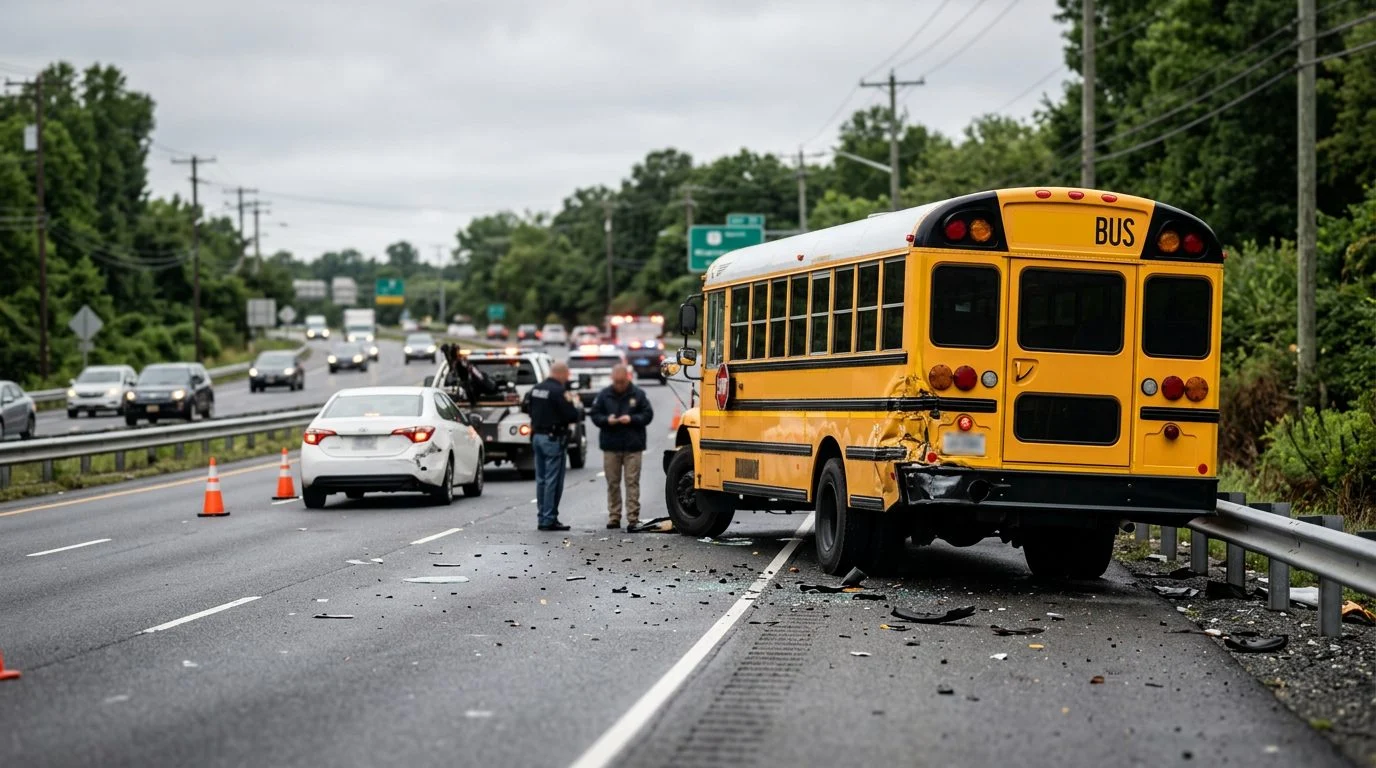
Commercial Vehicle Accidents | Winchester, Virginia
Bus Crash Liability in Virginia: Who Can Be Held Responsible
A bus crash often involves more than one company, vehicle or person. Understanding who may share responsibility is a useful first step.
Published November 9, 2026
A crash involving a bus can leave passengers, drivers and families facing serious injuries and hard questions. If you were hurt in a bus crash, the driver is not necessarily the only party who may be responsible: the company that operates the bus, a maintenance contractor, and a vehicle manufacturer may also be liable.
Which Parties Can Be Held Liable After a Bus Crash, Such as the Driver, the Operating Company, a Maintenance Contractor, or the Vehicle Manufacturer?
Several parties can be held liable after a bus crash, and the list is often longer than in a car crash. A bus involves more people and companies in its operation. A driver, a company that runs the trip, mechanics who service the brakes and steering, and manufacturers who build its parts each control a different piece of the vehicle or the trip.
Which parties get named depends on the facts. Identifying them early helps a reviewer decide which records to request first. For the wider picture of commercial vehicle crashes, see the firm’s truck accident guide.
If a bus crash hurt you or someone you love, you may have a claim, and the firm is ready to talk through the facts with you. Talk it through with Correll Law Firm — we can walk you through how a situation like yours is usually handled and what your options are.

Can the Bus Driver Be Held Responsible for a Crash?
Yes, the driver can be named when the driver’s own conduct helped cause the crash. The driver is the party most people think of first. Reviewers look at how the driver handled the bus, including speed for road and weather conditions, following distance, distraction, impairment, and how the driver yielded or stopped.
Bus drivers often carry many passengers over long hours, so their schedule can matter. Federal rules limit driving time for passenger-carrying commercial vehicles. A driver may not drive more than 10 hours after 8 consecutive hours off duty, or drive after 15 hours on duty following 8 consecutive hours off, and may not drive after being on duty 60 hours in any 7 consecutive days if the carrier does not operate commercial vehicles every day of the week (or 70 hours in any 8 consecutive days if it does) (49 C.F.R. § 395.5). Driver logs can show whether those limits were followed.
Punitive damages are a separate question. Virginia allows punitive damages for actual malice, or for willful or wanton conduct or recklessness showing a conscious disregard for the safety of others, capped at $350,000 (Va. Code § 8.01-38.1).
When Can the Company That Operates the Bus Be Named?
A bus company can be named when its own decisions helped cause the crash. The operating company may be a charter service, a tour operator, a school or transit contractor, or an employer that controls the bus, the route and the schedule.
Reviewers look at company decisions. These include how it hired drivers, what background checks it ran, what training it gave, how dispatch set schedules, and how it responded to earlier safety problems. A claim against the company is separate from a claim against the driver, so each party is judged on its own conduct.
Federal rules also set requirements for passenger carriers.
Can a Maintenance Contractor Be Held Responsible for a Bus Crash?
Yes, a maintenance contractor can be named if its work, or a failure to do work, helped cause the crash. Many bus companies send brakes, tires, steering and required inspections to outside shops.
Federal rules require motor carriers to systematically inspect, repair and maintain every vehicle under their control, including steering systems, suspension, axles, wheels and rims (49 C.F.R. § 396.3). Repair records show the date and nature of each service. They can also show whether a reported defect was fixed before the trip.
A maintenance claim usually depends on a clear link to the crash. Poor brake work is not automatically responsible for every crash. The question is whether the work, or the lack of it, contributed to what happened. Virginia law also provides that a contractor cannot escape a negligence claim just because it finished the work or the owner accepted it (Va. Code § 8.01-39).
Can the Vehicle Manufacturer Be Part of a Bus Crash Claim?
Parts that may be examined include brakes, tires, steering, seats, restraints and the body structure.
A defect claim often turns on the part itself. The part is preserved, examined, and compared with its design, its warnings and how it was maintained. Because that work is technical, reviewers often use outside engineers and accident reconstruction engineers. The results depend on the evidence.
A crash caused only by driver behavior does not automatically point to the manufacturer. Maintenance history matters here too. A defect that was reported and never repaired may point to the maintenance party instead.
Can Another Driver Share Responsibility for a Bus Crash?
Yes, another driver can share responsibility when that driver’s conduct helped cause the crash. A car, a truck or another vehicle may cut off the bus, change lanes unsafely, or run a signal.
Virginia follows contributory negligence: if you are found even partly at fault, you may be barred from recovering, with limited exceptions. Talk to a lawyer about your facts.
Police reports, witness statements and vehicle damage patterns help show how each vehicle moved before impact. Those sources can show the order of events, which is often the key question in a multi-vehicle crash.
Not sure what your next step is?
Talk it through with Correll Law Firm — we can walk you through how a situation like yours is usually handled and what your options are.
What Evidence Helps Identify the Responsible Parties in a Bus Crash?
Records usually show who did what before a bus crash. Start with the police crash report, photographs and witness contact information. Onboard or dashcam video, electronic data from the bus, driver logs, maintenance and inspection records, and dispatch and training files may also matter.
The Virginia State Police Motor Carrier Safety Unit inspects commercial trucks and buses for safety compliance. Its examination reports can be requested for a crash investigation.
Virginia requires a driver involved in a crash with injury or death to stop and report it to police immediately (Va. Code §§ 46.2-371, 46.2-894). Early evidence matters because video, data and parts can be overwritten, repaired or discarded. A person who was hurt may wish to speak with a lawyer about which records to preserve.
What Time Limits and Family Rights Apply After a Fatal Bus Crash?
The deadline depends on whether the injured person survived. A family’s wrongful death claim follows its own rules. For an injured person, Virginia generally allows two years from the date of injury to file a personal injury lawsuit (Va. Code § 8.01-243(A)); the clock runs from the date of injury, not the date of discovery, with narrow exceptions.
Do not treat two years as the only deadline.
A Virginia wrongful death action is filed by the decedent’s personal representative within two years of the death (Va. Code §§ 8.01-50(C), 8.01-244(B)), on behalf of the family members the statute protects.
Virginia wrongful death damages cover the family’s sorrow, mental anguish and loss of the decedent’s companionship, guidance and care; lost income and services; medical expenses from the injury; funeral expenses; and, for willful or wanton conduct, punitive damages (Va. Code § 8.01-52).
For vehicle and property losses after a crash, see how much you can sue for property damage.
Frequently Asked Questions
What does Virginia require after a crash with injury?
How long must bus maintenance records be kept?
Required records must be kept where the vehicle is housed or maintained for 1 year, and for 6 months after it leaves the carrier’s control, for motor carriers other than a private motor carrier of passengers (nonbusiness) (49 C.F.R. § 396.3).