Wrongful Death | Virginia
Wrongful Death Car Accident Lawyer in Virginia
When a loved one is killed in a crash, you need a law firm that understands your loss and will fight for fair compensation. Correll Law Firm represents families throughout the Shenandoah Valley, Richmond, and beyond.
Published October 01, 2026
Wrongful Death Claims from Car and Truck Accidents in Virginia
When a loved one dies in a car or truck accident caused by someone else’s negligence, a wrongful death claim may be available in Virginia, brought by and in the name of your loved one’s personal representative. This civil lawsuit seeks compensation for the losses your family has suffered—both the financial costs and the profound emotional toll of losing someone you depended on.
Wrongful death claims are distinct from criminal cases. While a criminal prosecution holds a defendant accountable through the justice system, a wrongful death claim is a civil action that focuses on recovering damages for your family. Under Virginia law, these claims are brought by and in the name of the personal representative of the person who died.
The process is complex, the emotions are raw, and the stakes are high. This guide explains what wrongful death claims are, who can file them, what compensation may be available, and how we help families navigate this difficult path.

If your family has lost a loved one in a car or truck accident caused by someone else's negligence, you don't have to navigate this alone. Talk it through with our team — the first case evaluation is free, confidential, and carries no obligation.
Understanding Wrongful Death Claims in Virginia
A wrongful death claim is a civil lawsuit that may be brought when a person’s death is caused by another’s wrongful act, neglect, or default. Unlike a criminal case—where the state prosecutes the at-fault party for breaking the law—a wrongful death claim is brought by the personal representative of the person who died to recover financial compensation.
In Virginia, wrongful death claims arise from many types of accidents: car collisions, truck crashes, commercial vehicle accidents, and other incidents where negligence causes death. The claim recognizes that the deceased had a life with earning potential, relationships, and value to those who depended on them. When that life is cut short by someone else’s failure to exercise reasonable care, the family deserves compensation.
Wrongful death claims are separate from any criminal proceedings. A defendant might face both a criminal prosecution and a civil wrongful death lawsuit. The criminal case seeks punishment; the civil case seeks to make the family whole financially.
Who Can File a Wrongful Death Claim in Virginia?
Not everyone can file a wrongful death claim. Virginia law specifies who has the legal right—called “standing”—to bring this type of lawsuit.
Primary beneficiaries include: – The surviving spouse of the deceased – The deceased’s children (biological or legally adopted) – The deceased’s parents (if the deceased had no spouse or children)
In some circumstances, other dependents or heirs may also have standing, but the spouse, children, and parents are the primary beneficiaries under Virginia law.
The claim is typically filed by the personal representative or executor of the deceased’s estate. This person is appointed by the court or named in a will to handle the estate’s affairs. The personal representative acts on behalf of the estate and all eligible family members.
Time matters. Virginia has a statute of limitations—a legal deadline—for filing wrongful death claims. Families should consult with an attorney as soon as possible after a fatal accident to ensure the claim is filed within the required timeframe and to preserve critical evidence.
What Are the Types of Damages That Can Be Awarded in Virginia for Wrongful Death?
Damages in a wrongful death case fall into two main categories: economic and non-economic.
Economic damages are financial losses that can be calculated with relative precision: – Medical expenses incurred before the death – Funeral and burial costs – Lost wages and salary the deceased would have earned – Lost earning capacity (the income the deceased would have earned over their lifetime) – Loss of benefits (such as health insurance or retirement contributions)
Non-economic damages address the emotional and relational harm your family has suffered: – Loss of companionship and society with the deceased – Emotional pain and suffering of surviving family members – Loss of parental guidance, instruction, and support (if the deceased was a parent) – Loss of spousal comfort and consortium (if the deceased was married)
In rare cases where the defendant’s conduct was willful or wanton, punitive damages may also be awarded. These are intended to punish the defendant and deter similar conduct in the future, rather than to compensate the family.
Each family’s circumstances are unique. The amount of damages depends on the deceased’s age, earning potential, health, and the strength of family relationships. A young professional with decades of earning potential and young children will have different damages than a retired person. An attorney evaluates all these factors to calculate a fair and complete claim.
Proving Negligence in a Fatal Car or Truck Accident
To succeed in a wrongful death claim, your family must prove that the other party was negligent and that negligence caused the death. This requires establishing four elements:
-
Duty of care: The defendant owed a legal duty to the deceased. Every driver on the road owes a duty to operate their vehicle safely and follow traffic laws.
-
Breach of duty: The defendant failed to meet that standard. Common breaches in fatal accidents include speeding, distracted driving (texting, phone use), impaired driving (alcohol or drugs), reckless driving, failure to yield, or ignoring traffic signals.
-
Causation: The breach directly caused the accident and, ultimately, the death. The defendant’s negligent conduct must be the direct cause, not merely a contributing factor.
-
Damages: The family suffered measurable losses—financial, emotional, or both.
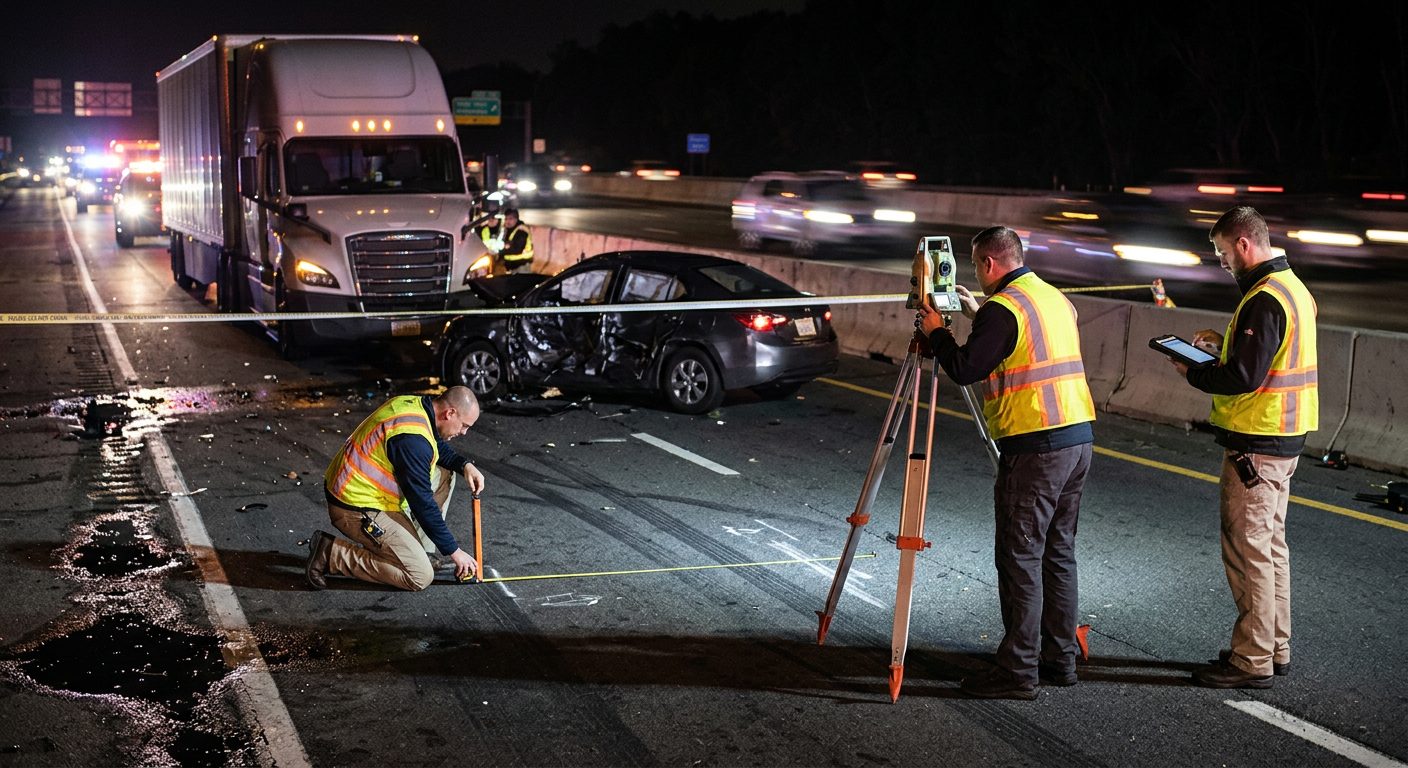
Evidence used to prove negligence includes: – Police accident reports – Witness statements and testimony – Accident reconstruction by engineers or accident specialists – Vehicle data (from event data recorders, commonly called “black boxes”) – Medical records and autopsy reports – Photos and video from the scene – Cell phone records (to establish distracted driving) – Toxicology reports (to establish impairment) – Traffic camera footage
In truck accidents, evidence also includes the driver’s logbook (Hours of Service records), vehicle maintenance records, company safety policies, and federal transportation regulations. Trucking companies are subject to strict federal rules, and a violation of those rules can be evidence of negligence, although a violation does not by itself automatically establish negligence.
Who Pays the Money in a Wrongful Death Lawsuit?
When you file a wrongful death claim, you’re seeking compensation from the at-fault party. But who actually pays depends on several factors.
Auto insurance is typically the first source of recovery. The at-fault driver’s liability insurance policy covers damages up to the policy limits. In Virginia, drivers are required to carry minimum liability coverage, but many carry higher limits.
Commercial truck accidents often involve higher insurance limits because trucking companies carry substantial liability policies. However, liability may extend beyond just the driver to include the trucking company itself, the vehicle’s owner, maintenance contractors, or even manufacturers if a defect contributed to the crash.
If insurance limits are insufficient, the at-fault party’s personal assets may be pursued. This could include bank accounts, property, or other valuables. However, Virginia law protects certain assets (such as a primary residence, up to a certain value) from collection.
Multiple parties may share liability. In some cases, more than one party bears responsibility. For example, a truck accident might involve liability from the driver, the trucking company, a maintenance contractor who failed to service the brakes, and even a government entity if poor road maintenance contributed to the crash—though claims against a county, city, or town are barred unless a written statement of the claim is filed within six months after the claim accrued. An experienced attorney investigates all potential sources of recovery to maximize compensation for your family.
Not sure what your next step is?
Talk it through with our team — the first case evaluation is free, confidential, and carries no obligation.
The Wrongful Death Claim Process in Virginia
The process of pursuing a wrongful death claim typically unfolds in these stages:
Investigation and evidence gathering: We obtain the police report, interview witnesses, collect medical records, and preserve evidence from the accident scene. In truck cases, we request logbooks, maintenance records, and company safety documentation.
Determining liability: We analyze the evidence to identify all parties who bear responsibility for the accident and death.
Calculating damages: We work with financial experts, medical professionals, and vocational specialists to assess the full extent of your family’s losses—both economic and non-economic.
Demand and negotiation: We present the claim to the at-fault party’s insurance company with a detailed demand for compensation. We negotiate on your family’s behalf, and a claim may be resolved through settlement without the need for trial.
Litigation: If settlement negotiations don’t result in fair compensation, we file a lawsuit and prepare the case for trial. This includes discovery (exchanging evidence), expert testimony, and presenting your family’s case to a judge or jury.
Timeline: Some wrongful death cases settle within months; others take longer, particularly if litigation is necessary. We keep your family informed at every step and work toward resolution as efficiently as possible.
Fatal Car Accidents vs. Fatal Truck Accidents
While all fatal accidents are tragic, truck accidents often involve greater complexity and higher stakes.
Truck accidents frequently result in death because of the size and weight disparity. A commercial truck weighing 80,000 pounds creates forces that a passenger vehicle cannot withstand. The injuries are often catastrophic and frequently fatal.
Liability is more complex in truck cases. Beyond the driver, liability may extend to: – The trucking company (for its driver’s negligence on the job, and for hiring, keeping, or entrusting a truck to an unsafe driver) – The vehicle owner (if different from the operating company) – Maintenance contractors (for failure to maintain brakes, tires, or other critical systems) – Shippers or loaders (for improper cargo loading that caused instability) – Manufacturers (for defects in the truck or its components)
Federal regulations govern commercial trucking. Violations of Hours of Service rules (which limit how long a driver can operate without rest), improper maintenance, or falsified logbooks can all establish negligence. We investigate these regulatory violations thoroughly.
Evidence in truck cases includes the driver’s electronic logbook, vehicle maintenance records, company safety policies, training documentation, and communications between the driver and the company. Federal regulations require trucking companies to maintain these records, and we know how to obtain and interpret them.
What Happens After a Fatal Car Accident: Immediate Steps
If a loved one has been killed in a car or truck accident, the immediate aftermath is overwhelming. Here are the steps your family should take:
Contact emergency services if not already done. Even if death occurred at the scene, emergency responders will document the incident.
Preserve evidence. Take photos of the accident scene, vehicle damage, road conditions, and traffic signals or signs. Collect contact information from witnesses. This evidence may be critical later.
Obtain the police report. Request a copy from the police department that responded. The report documents the officer’s observations and may establish fault.
Document all expenses and losses. Keep records of medical bills, funeral costs, lost wages, and other financial impacts.
Do not sign settlement offers or speak with insurance adjusters without legal counsel. Insurance companies are motivated to minimize payouts. An attorney protects your family’s interests.
Consult a wrongful death attorney as soon as possible. Early legal guidance helps preserve evidence and meet important deadlines.
Catastrophic Injuries That Become Wrongful Death
Some accident victims survive the initial crash but succumb to severe injuries days, weeks, or even months later. This scenario is common in serious accidents and doesn’t diminish your family’s right to recover.
Traumatic brain injuries (TBI) can be fatal even if the victim initially survives. Swelling, bleeding, or infection in the brain can cause death long after the accident.
Spinal cord injuries (SCI) may result in complications—respiratory failure, infection, or organ damage—that prove fatal over time.
Internal injuries such as organ damage or internal bleeding may not be immediately apparent but can lead to death as complications develop.
Medical complications such as blood clots, pneumonia, or sepsis can arise during recovery and become fatal.
Virginia law recognizes wrongful death claims regardless of whether death occurs immediately or after a delay. The at-fault party remains liable. The statute of limitations typically begins from the date of death, not the date of the accident, so families have time to pursue their claim even if death occurs months later.
Have questions about what happened?
Ask our team directly. The first conversation is free, confidential, and there is no obligation to continue.
Correll Law Firm’s Approach to Wrongful Death Claims
We represent families throughout Virginia who have lost loved ones in car and truck accidents. Our offices in Winchester and Harrisonburg serve the Shenandoah Valley, Richmond, Henrico County, and communities across the Commonwealth.
We understand that wrongful death cases are deeply personal. We approach each case with empathy, respect, and a commitment to holding negligent parties accountable.
Our process includes: – Thorough investigation to identify all liable parties and sources of recovery – Expert analysis of accident causation and negligence – Detailed calculation of economic and non-economic damages – Skilled negotiation with insurance companies – Preparation for trial if settlement is not achieved – Clear communication with your family throughout the process
We offer free case evaluations to discuss your family’s situation, answer your questions, and explain your legal options. There’s no obligation, and we’re here to help you understand what comes next.

Frequently Asked Questions About Wrongful Death Claims
What is the average settlement for a car accident in Virginia?
Every case is unique. Settlement amounts depend on liability strength, the extent of damages, insurance coverage, and other factors. We evaluate each claim individually to determine fair compensation for your family.
What are the odds of winning a wrongful death lawsuit?
We cannot predict outcomes, but we build strong cases based on solid evidence, expert testimony, and thorough investigation. Our goal is to pursue fair compensation for your family’s losses.
How long does a wrongful death lawsuit take?
Timelines vary significantly. Some cases settle within months; others proceed to trial over a longer period. We keep your family informed and work toward resolution as efficiently as possible.
What if the at-fault driver dies in the accident?
Wrongful death claims can still proceed against the deceased’s estate, their insurance policy, or other liable parties (such as a trucking company if a truck was involved).
Can I file a wrongful death claim if the victim was partially at fault?
Virginia follows a pure contributory negligence rule (Contributory negligence bars recovery in Virginia). Fault is a central question in these cases, and an attorney can evaluate how Virginia’s rule applies to the facts of your family’s case.
If your family has lost a loved one in a car or truck accident caused by someone else’s negligence, you don’t have to navigate this alone. The legal process is complex, but your family’s right to compensation is real. Contact Correll Law Firm for a free case evaluation to discuss your situation and learn what your family may be entitled to recover.
Time Matters in Wrongful Death Cases
Virginia law imposes strict deadlines for filing a wrongful death claim. The sooner you contact us, the sooner we can investigate the crash, preserve evidence, and protect your family's right to compensation.
Why Families Choose Correll Law Firm
Focused on Serious Injury & Loss
We handle catastrophic injury, traumatic brain injury, spinal cord injury, and wrongful death cases. Your case gets the full attention it deserves.
Local Presence, Regional Reach
With offices in Winchester and Harrisonburg, we serve families across the Shenandoah Valley, Richmond, Henrico County, and throughout Virginia.
Compassionate Representation
We understand the devastating impact of losing a family member. We listen, we care, and we advocate for the compensation your family deserves.
No Fees Unless There Is a Recovery
We work on contingency—you pay no attorney fees unless we recover compensation for your family. You may still owe case costs.
What We Handle in Wrongful Death Cases
Car Accidents
When negligent driving causes a fatal crash, we investigate liability, gather evidence, and pursue compensation for your family's loss.
Truck Accidents
Commercial truck crashes often involve complex liability. We examine driver logs, maintenance records, and company practices to hold responsible parties accountable.
Commercial Vehicle Accidents
Accidents involving delivery vehicles, buses, and other commercial vehicles require careful investigation and knowledge of industry regulations.
Catastrophic Injury Deaths
When traumatic brain injury, spinal cord injury, or other catastrophic injuries result in death, we fight for full compensation reflecting your loved one's loss.
Common Questions About Wrongful Death Cases
What is the average settlement for a wrongful death case?
Every case is unique. Settlement amounts depend on liability strength, the extent of damages, insurance coverage, and other factors. We evaluate each claim individually to determine fair compensation for your family.
What can we recover in a wrongful death claim?
Compensation may include funeral and medical expenses, lost income and benefits, loss of companionship, and other damages. We'll explain what your family may be entitled to pursue.
How long does a wrongful death case take?
Timeline varies based on case complexity, investigation needs, and whether settlement is reached or litigation is necessary. We'll keep you informed every step of the way.
Who can file a wrongful death claim?
Virginia law specifies who may bring a wrongful death action. We'll explain your family's rights and who has standing to pursue the claim.