
Truck Accidents | Winchester, Harrisonburg and the Shenandoah Valley
When a Truck Driver Is Distracted, the Proof Is in the Details
How the firm approaches the records, data and witness accounts that can show what happened behind the wheel.
Published November 25, 2026
A truck crash can leave you or a family member facing serious injuries and hard questions. If you suspect the truck driver was distracted, the proof usually comes from records and recordings made at the time of the crash. These include electronic logs, camera footage, phone activity and dispatch messages. Many of these sources are easy to lose, so knowing what exists and when to ask for it matters.
Why Distraction Is Hard to Prove After a Truck Crash
Distraction is hard to prove because a crash scene usually shows the result, not the driver’s attention. A truck that drifts out of its lane or misses a merge leaves damage and marks, but those do not show where the driver was looking. Distraction can also be a brief moment, like a glance at a screen. That means the evidence has to show a specific moment, not a general habit.
The strongest proof tends to come from records made at the time of the crash, often by machines or phones. Those sources can be overwritten or lost if no one asks for them early. Some of the proof sits on the truck, some sits with the carrier, and some sits with a phone company or a camera owner.
For the broader picture of commercial vehicle crash claims in Virginia, see the commercial vehicle accident guide.
If you believe a truck driver's distraction played a part in your crash, you may have a claim, and the firm is glad to talk through your situation. Talk it through with Correll Law Firm — we can walk you through how a situation like yours is usually handled and what your options are.

Electronic Data From the Truck
Electronic data can show how a truck was moving in the minutes and seconds before a crash. Many commercial trucks carry an electronic logging device (ELD), which records the date, time, location, engine hours and vehicle miles. Under federal rules, the device also records an entry when the truck is moving and no other status change has been logged in the previous hour (49 C.F.R. § 395.26). That can help place the truck on the road at a specific time.
Duty-status records matter for another reason. A motor carrier must not alter or erase, or permit or require alteration or erasure of, the original information about a driver’s hours of service (49 C.F.R. § 395.30). A missing or changed log can itself be a question worth raising.
Some trucks also store speed or braking information, depending on their equipment. That data may sit on the truck or on the carrier’s systems, so an early written preservation request is important. Each record should be compared with the crash time from other sources.
Cell Phone and Device Records
Phone records can show whether a driver was using a phone near the time of a crash. They list calls, texts and data activity with timestamps. A record of activity is not the same as proof the driver was holding or reading the phone, so the details matter.
Federal rules limit phone use for commercial drivers. No driver may use a hand-held mobile telephone while driving a commercial motor vehicle, and no driver may engage in texting while driving (49 C.F.R. § 392.82; 49 C.F.R. § 392.80). The rules allow an exception for communicating with law enforcement or emergency services. They also treat driving as including brief stops in traffic, so a hand-held call at a red light can still fall under the rule.
Timing is the next problem. A phone’s clock and the truck’s clock may not agree, and a few minutes’ difference can change the story. Each timestamp should be matched to the crash time from the truck’s data and from the scene. Getting phone or company device records usually takes a formal request or subpoena, not just a question to the driver.
Dashcam, In-Cab and Outside Video
Video is often the most direct evidence of where a driver was looking. A forward-facing or in-cab camera can show whether the driver watched the road, looked down or held a device. Not every truck has these cameras, so it helps to ask early whether one was installed.
Video from other places can also help. A passing driver’s dashcam, a nearby business, a traffic camera or a bystander’s phone may show the truck’s lane position and speed. Footage like this can capture the moments before a rollover, a cut-off or a multicar crash. It can show the order of events in a way memory cannot.
Video can be recorded over, so a written preservation request sent soon after the crash gives footage the best chance of being kept. Footage may not show a driver’s eyes or hands clearly, so video works best alongside other evidence.
Scene Details and Witness Accounts
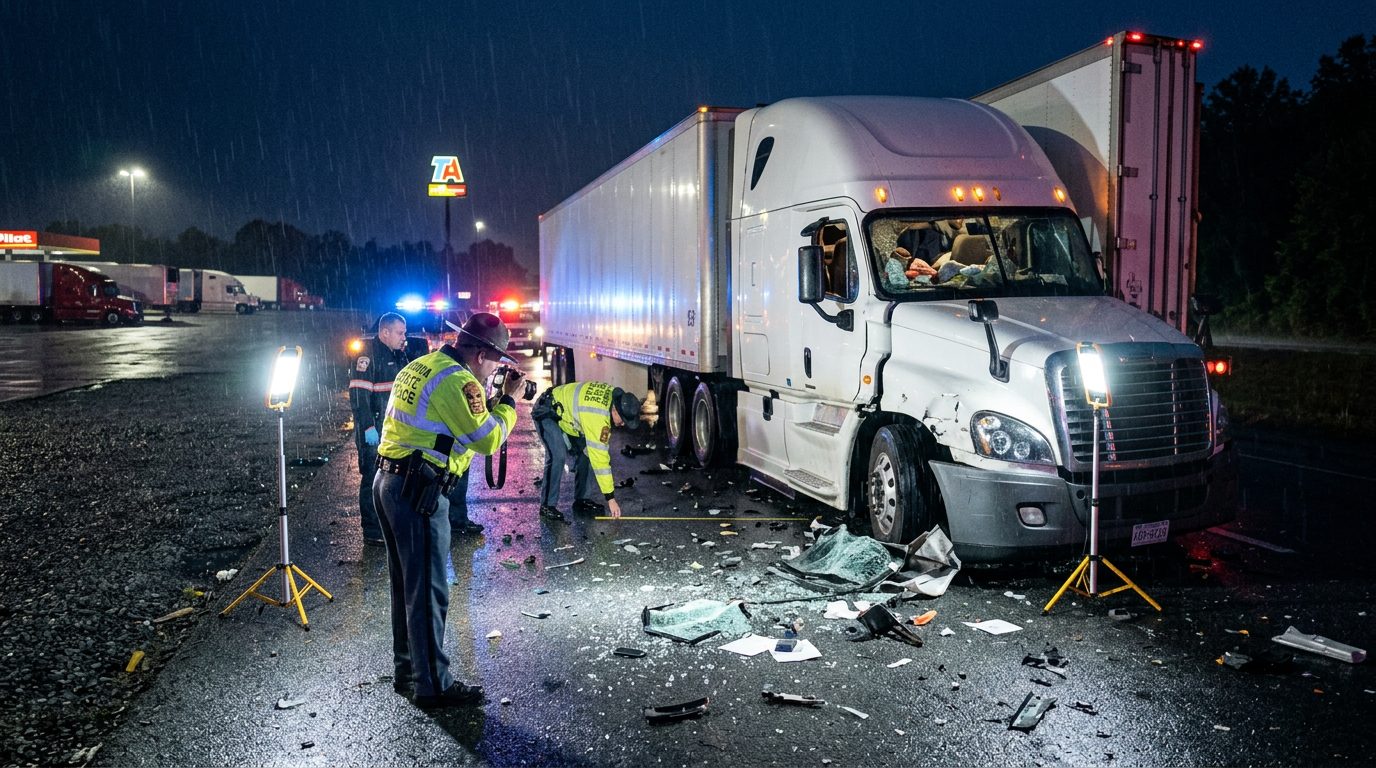
Scene details and witness accounts can show inattention even when nobody saw a device. Physical evidence includes skid marks or the lack of them, debris, the final rest position of each vehicle and the order of impacts. In a multicar crash, that sequence can show which vehicle reacted first. Investigators weigh each clue against the others.
Witnesses can describe what they saw before the crash. A driver who drifted, weaved, cut off a pickup or failed to yield at a merge may be described by other drivers, passengers or bystanders. Their accounts are most useful when recorded while memories are fresh. Write down what each person saw, where they were, and how to reach them.
Hit-and-run crashes raise a different problem. When a truck driver leaves the scene, investigators often rely on plate numbers, camera images and witness descriptions to identify the vehicle. Leaving the scene of an injury crash is a serious offense in Virginia, and a conviction can be a Class 5 felony (Va. Code § 46.2-894).
Police Reports, Crash Reporting and Driver History
A police crash report is usually the first official record of a crash. It typically includes the officer’s observations, statements from those involved, any citations and a diagram of the scene. It is a starting point, not the final word on what happened. An officer may note a device in the cab, but a report does not show what the driver was doing in the seconds before impact.
Virginia requires a driver involved in a crash with injury or death to stop and report it to police immediately (Va. Code §§ 46.2-371, 46.2-894). A willful failure to make that report is a Class 4 misdemeanor (Va. Code § 46.2-371).
Keep two deadlines apart. The reporting duty applies right after a crash that results in injury or death: the driver, or some person acting for the driver, must immediately give notice of the accident to a law-enforcement officer. The two-year period discussed later is the deadline to file a lawsuit, not the deadline to report a crash (Va. Code § 8.01-243). Crash reports and driver records can be requested and reviewed as part of building a case.
Not sure what your next step is?
Talk it through with Correll Law Firm — we can walk you through how a situation like yours is usually handled and what your options are.
Company Records, Training and Negligent Hiring
Company records can show the pressures a driver may have faced on the day of a crash. Dispatch messages, delivery schedules and trip records are common examples. Tight schedules can help explain why a driver rushed or reached for a phone, but schedule records alone do not prove what a driver was thinking.
Driver training files, prior safety complaints and inspection history can also be relevant. These records help show what the carrier knew about a driver’s habits and how it responded. Use them carefully, because a complaint on file is not proof the complaint was true.
Hours-of-service records are part of this picture too. No driver or carrier may make a false report about duty status (49 C.F.R. § 395.8). Records that look edited, missing or inconsistent with the crash timeline deserve a close look.
When Distraction May Support Punitive Damages
Punitive damages in Virginia depend on a specific standard, and a distracted driver does not automatically meet it.
Virginia allows punitive damages for actual malice, or for willful or wanton conduct or recklessness showing a conscious disregard for the safety of others, capped at $350,000 (Va. Code § 8.01-38.1).
The evidence described above, such as phone use while driving or warnings a driver ignored, is what a jury would weigh. The jury must find that the conduct met this standard. Whether it does depends on the facts of the crash.

Deadlines and Fault Questions to Keep in Mind
Virginia generally allows two years from the date of injury to file a personal injury lawsuit (Va. Code § 8.01-243(A)); the clock runs from the date of injury, not the date of discovery, with narrow exceptions. Some claims carry notice requirements that run out sooner, so the two-year period is not the only date to watch.
A Virginia wrongful death action is filed by the decedent’s personal representative within two years of the death (Va. Code §§ 8.01-50(C), 8.01-244(B)), on behalf of the family members the statute protects. Family members do not file; they share in the recovery.
Virginia follows contributory negligence: if you are found even partly at fault, you may be barred from recovering, with limited exceptions. Talk to a lawyer about your facts.
For a fuller explanation of how fault questions arise in these crashes, see partial fault in commercial vehicle crashes.
Can a phone record prove a truck driver was distracted?
A phone record works best when it is compared with the truck’s data, video and the crash timeline. Timing matters more than the record alone.
What should someone do first after a truck crash?
Get medical care, even if injuries seem minor. If you can, write down the truck number, the carrier’s name and the names of witnesses.