
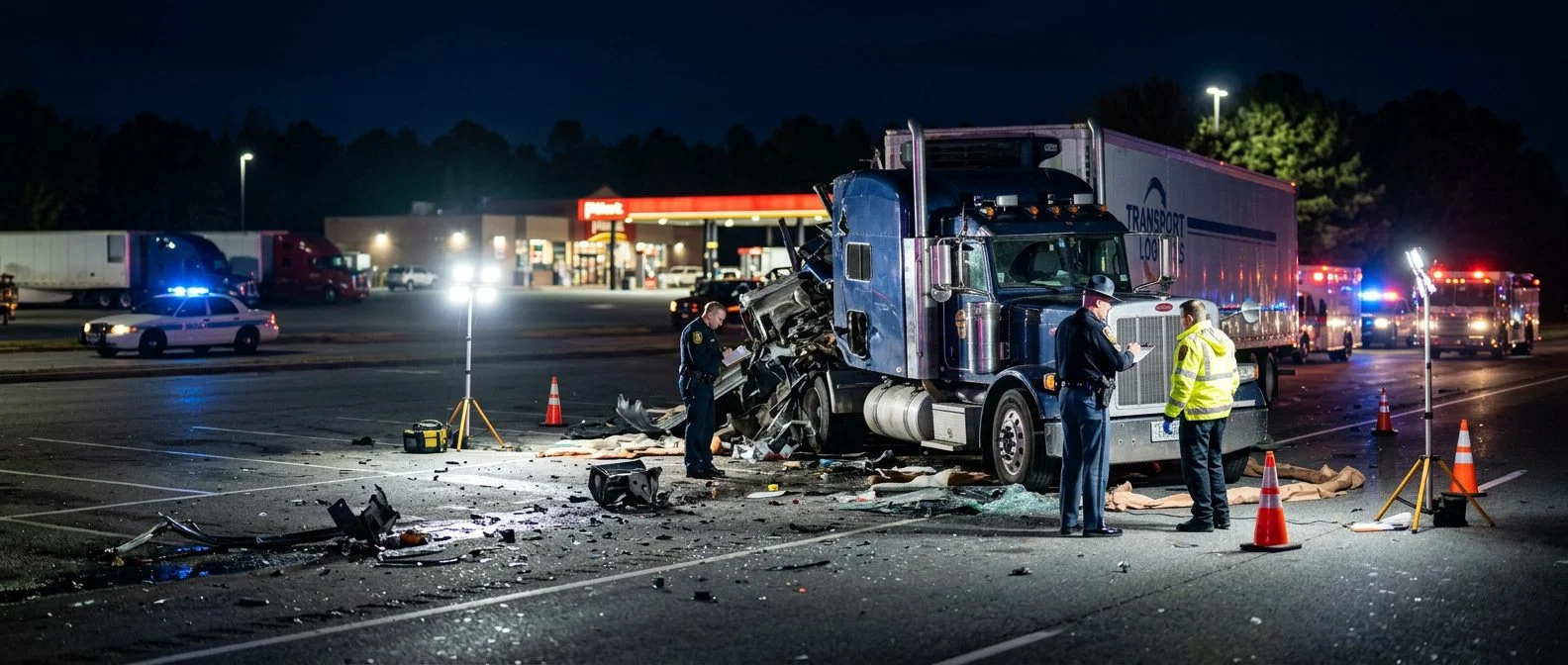
Commercial Truck Accidents | Shenandoah Valley, Virginia
Drug and Alcohol Testing After a Commercial Truck Crash
What the testing rules mean for injured people and families, and why the details of a crash can shape what comes next.
Published November 21, 2026
If a large truck just hit your car, or someone you love, you may wonder whether the driver was tested. In many serious crashes, federal rules require testing, and whether they apply turns on how the crash happened.
The core rule is short. After certain crashes, the employer must test each surviving driver for alcohol and for controlled substances. This page explains which crashes count, how fast testing must happen, and how the records can matter in a Virginia claim.
Are Commercial Truck Drivers Tested for Drugs and Alcohol After a Crash?
Yes, in qualifying crashes, federal rules require the employer to test each surviving driver for alcohol and controlled substances. The rule is 49 CFR 382.303, and it covers commercial motor vehicles operating on public roads in commerce.
The duty falls on the employer. The employer must run the tests “as soon as practicable” after the crash. Drivers have obligations too. A driver who is subject to post-accident testing must stay readily available for it, or the employer may treat the driver as having refused.
The rule also says it does not require delaying necessary medical care for injured people. Law enforcement or public safety officials with independent authority can conduct breath or blood tests for alcohol, or urine tests for controlled substances, and those results can count, as long as the tests conform to the applicable testing requirements and the employer obtains the results.
This page covers post-accident testing only. Random testing and reasonable-suspicion testing follow separate rules, explained below.
If you were hurt in a truck crash and have questions about which tests may apply, you do not have to sort it out alone. The firm is glad to talk through your situation. Talk it through with Correll Law Firm — we can walk you through how a situation like yours is usually handled and what your options are.
Which Crashes Trigger Post-Accident Testing?
Post-accident testing is required for each surviving driver who was performing safety-sensitive functions with respect to the vehicle after a crash that results in a loss of human life, whether or not a citation is issued. After a crash in which someone is injured and, as a result, immediately receives medical treatment away from the scene, or a vehicle has disabling damage that requires it to be towed away from the scene by a tow truck or other motor vehicle, testing applies only if the driver is cited within 8 hours for alcohol testing or 32 hours for controlled substances testing, per 49 CFR 382.303. Both triggers appear in the rule for alcohol and for controlled substances.
The first trigger is bodily injury to any person who, because of the injury, immediately receives medical treatment away from the scene, and it applies to a driver who receives a citation within 8 hours (alcohol) or 32 hours (controlled substances) of the occurrence under State or local law for a moving traffic violation arising from the accident. The second is one or more motor vehicles with disabling damage that must be transported away by a tow truck or other vehicle.
The rule also has exclusions. It does not apply to an occurrence involving only loading or unloading cargo. It also does not apply to a passenger car or multipurpose passenger vehicle, unless that vehicle carries passengers for hire or hazardous materials that require marking or placarding. These details can decide whether the rule applies to a given crash.
How Quickly Must Testing Happen?
Testing must happen “as soon as practicable” after the crash. For alcohol, the rule sets two checkpoints that keep the timing on paper.
If an alcohol test is not given within two hours of the crash, the employer must keep a record stating why it was not promptly given. If it is not given within eight hours, the employer must stop trying to administer it and keep the same record.
Why does timing matter? A test taken close to the crash says more about the driver’s condition at that time than one taken much later. Delay weakens that link. Keeping a written note of the reasons for any delay can help a person keep track of their own timeline.
How Post-Accident Testing Differs From Random and Reasonable-Suspicion Testing
Post-accident testing is triggered by a crash. Random testing is a separate category that does not depend on any crash. Under 49 CFR 382.305, every driver must submit to random alcohol and controlled substances testing, and selection must use a scientifically valid method.
Reasonable-suspicion testing is different again.
The federal government also lists which substances DOT testing covers. The FMCSA page on which substances are tested explains that list.
Keeping the categories apart helps. A test given after a crash follows different rules than a random test or a test based on suspicion.
Crash Reporting and Preserving Evidence Early
Early evidence matters because testing paperwork and trip records are easiest to gather in the days after a crash. Virginia requires a driver involved in a crash with injury or death to stop and report it to police immediately (Va. Code §§ 46.2-371, 46.2-894).
Virginia generally allows two years from the date of injury to file a personal injury lawsuit (Va. Code § 8.01-243(A)); the clock runs from the date of injury, not the date of discovery, with narrow exceptions.
A truck accident claim may involve several kinds of records. These include the crash report, the testing records, driver duty-status logs, dispatch records, and maintenance records. Under 49 CFR 395.8, motor carriers must require drivers to record their duty status for each 24-hour period.
The retention rules also matter. Under 49 CFR 382.401, some collection-process records must be kept for at least two years, and some negative test results for at least one year. Most of these minimums are fixed, but records related to the education and training of breath alcohol technicians, screening test technicians, supervisors, and drivers have no fixed end: they must be kept by the employer while the individual performs the functions which require the training and for two years after ceasing to perform those functions, so the records you need may be easier to reach early.

How Test Results Can Fit Into a Truck Accident Claim
Test results are one kind of evidence. They are reviewed alongside the crash report, the records above, and the other facts of the crash. The firm cannot predict what any test will show, and no result is assumed in advance.
Virginia law can involve more than one party.
How a test result is used depends on the facts. The testing records, how they were kept, and what they show together all shape how much weight they carry.
For a wider view of these cases, see commercial vehicle accidents in Virginia.
Frequently Asked Questions
Are truck drivers tested after every crash?
No. Post-accident testing applies only to certain crashes under 49 CFR 382.303: any crash involving a death, or a crash with an injury that requires immediate medical treatment away from the scene or disabling damage that requires a tow-away, if the CMV driver is also cited.
Is a random test the same as a post-accident test?
No. Random testing follows 49 CFR 382.305, while post-accident testing follows 49 CFR 382.303.