
Truck Accident Investigation | Virginia
What Investigators Look for in the Days and Months After a Fatal Truck Crash
A plain-language walk through the evidence that is gathered, and when, following a serious commercial truck collision on Virginia roads.
Published November 13, 2026
After a loved one dies in a truck crash, the questions come fast, and many of them are about timing. In Virginia, a fatal truck crash investigation moves in stages: the scene and the reporting duties, early records and evidence, official findings and reconstruction, and then the filing deadlines.
Each stage has its own clock. Some evidence is kept only for limited periods, so the early steps matter. This page walks through that timeline in plain language.
What Happens at the Scene of a Fatal Truck Crash
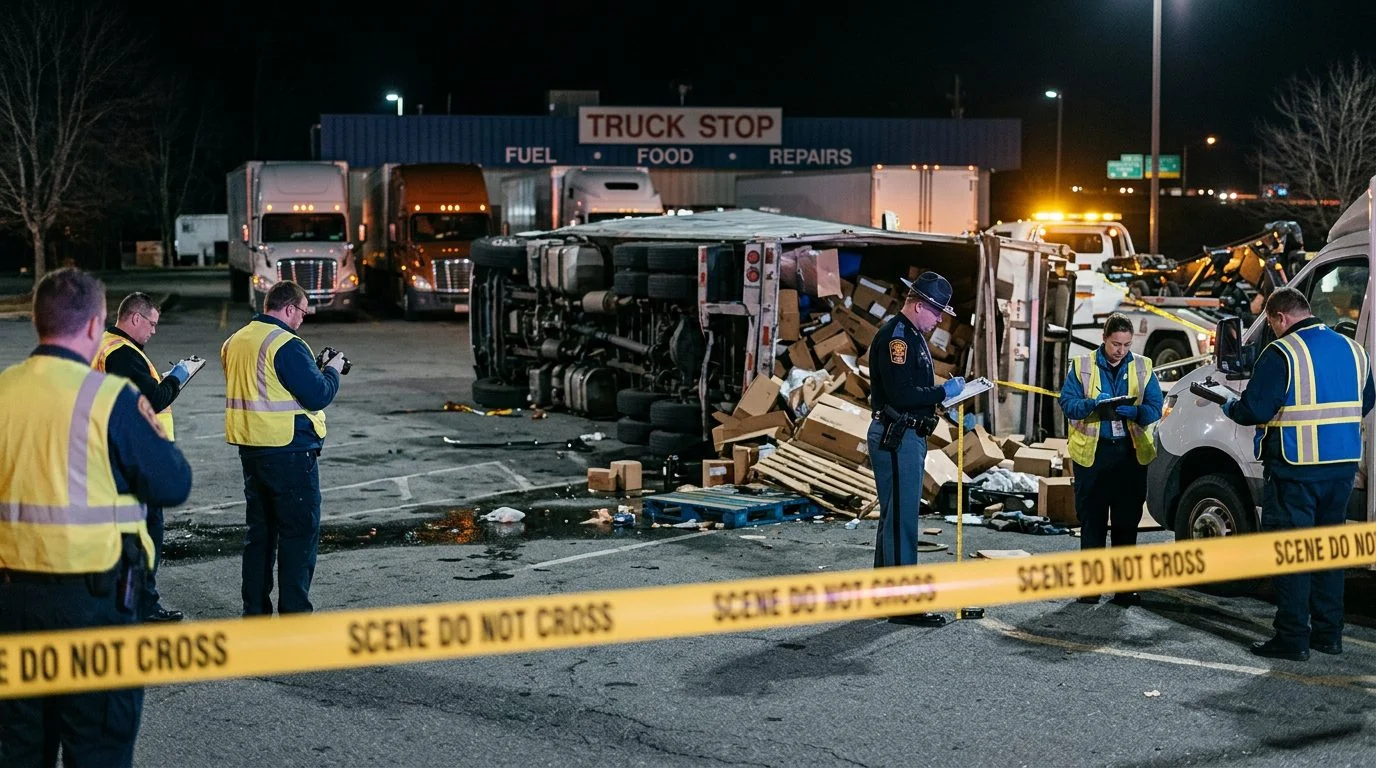
Law enforcement responds to the scene, and officers typically document what they find, including vehicle positions and road conditions. They may also speak with drivers and witnesses. Families often learn the details later, so the first hours can feel confusing.
Virginia requires a driver involved in a crash with injury or death to stop and report it to police immediately (Va. Code §§ 46.2-371, 46.2-894). The driver must also stop as close to the scene as possible without blocking traffic, and give reasonable help to anyone who is hurt (Va. Code § 46.2-894).
It is separate from the two-year period to file a lawsuit, which comes later on the timeline. Reporting is due now; the lawsuit deadline is much later.
Not sure what your next step is?
Talk it through with Correll Law Firm — we can walk you through how a situation like yours is usually handled and what your options are.

The First 72 Hours: Why Early Evidence Matters
Early evidence matters because a commercial truck creates records that can be lost. Many of the answers in a fatal crash sit in the carrier’s paperwork and electronic data.
Commercial drivers record their duty status, which shows hours on and off duty. Carriers must keep those records and supporting documents for not less than six months from the date of receipt (49 C.F.R. § 395.8). That is a minimum, so waiting can put key records at risk.
Other proof can change quickly. Dispatch messages, GPS data, phone records and dashcam footage may exist for a short time. Trucks may be towed, repaired or returned to service. After a fatal crash involving a commercial motor vehicle operating on a public road in commerce, federal rules also require the employer to test each surviving driver who was performing safety-sensitive functions with respect to the vehicle for alcohol and controlled substances, as soon as practicable (49 C.F.R. § 382.303).
A common mistake is waiting for the official report before asking about these items. By then, some records may be near or past their minimum keeping period.
Weeks One Through Four: The Official Crash Report and Medical Examiner Findings
During the first month, the official crash report and the medical examiner’s findings often begin to shape the timeline. The crash report records what investigating officers learned at the time. It is a starting point, not a final word.
Officers may update their work as they gather more information, such as statements, measurements and witness accounts. Families may ask the investigating agency where its report stands.
In a fatal case, the medical examiner determines the cause of death. The examiner may order an autopsy and toxicology testing. Those results can take time, and they can change the picture of what happened. Read the report’s facts and any conclusions about fault separately, because they are not always the same thing.
Months Two to Six: Reconstruction, Maintenance Records and Driver Qualification Files
Over the following months, the work shifts to reconstruction and carrier records. Reconstruction analysts review speed, braking, lane position and vehicle data to build a picture of how the crash unfolded. That work often depends on data collected early.
Carriers must keep a driver qualification file for each driver. It includes the driver’s application, motor vehicle records from the licensing authority and a medical examiner’s certificate (49 C.F.R. § 391.51). Maintenance records matter too. Carriers must keep inspection, repair and maintenance records for one year where the vehicle is housed or maintained, and for six months after the vehicle leaves their control (49 C.F.R. § 396.3).
Braking and stopping distance often matter in these reviews. The Insurance Institute for Highway Safety reports that loaded tractor-trailers need a longer stopping distance than passenger vehicles.
The insurer and the carrier often run their own investigations at the same time. Their findings do not replace the official ones, and they may arrive on a different schedule.
Who May Bring a Wrongful Death Claim in Virginia
In Virginia, a wrongful death case is filed by one person, not by each family member. A Virginia wrongful death action is filed by the decedent’s personal representative within two years of the death (Va. Code §§ 8.01-50(C), 8.01-244(B)), on behalf of the family members the statute protects.
The action is brought by and in the name of the personal representative of the deceased person, not by family members as such. For a fetal death action, the natural mother brings it (Va. Code § 8.01-50). They share in the recovery, if there is one. Under § 8.01-50, every such action must be brought within the time limits specified in § 8.01-244, which runs two years after the death of the injured person.
Because the personal representative brings the case, knowing early who holds that role can help a family follow the timeline. It also helps families understand who makes decisions on the case’s behalf.
The Two-Year Clock for Personal Injury Claims
Virginia generally allows two years from the date of injury to file a personal injury lawsuit (Va. Code § 8.01-243(A)); the clock runs from the date of injury, not the date of discovery, with narrow exceptions.
The investigation does not pause this clock. Waiting for the official report, the reconstruction or the carrier’s records does not stop time from running.
Some claims carry notice requirements that run out sooner.
Not sure what your next step is?
Talk it through with Correll Law Firm — we can walk you through how a situation like yours is usually handled and what your options are.
What a Wrongful Death Claim May Cover
Virginia law lists the losses a wrongful death claim may cover. Virginia wrongful death damages cover the family’s sorrow, mental anguish and loss of the decedent’s companionship, guidance and care; lost income and services; medical expenses from the injury; funeral expenses; and, for willful or wanton conduct, punitive damages (Va. Code § 8.01-52).
The list describes the family’s losses.
Records from the early weeks can help document each category. Families often keep bills, pay stubs, funeral home paperwork and notes on the decedent’s role in the household.
When Punitive Damages May Be Considered
Punitive damages depend on how the driver or carrier acted, not only on the fact that a crash happened. In a Virginia wrongful death action, punitive damages may be recovered for willful or wanton conduct, or such recklessness as evinces a conscious disregard for the safety of others (Va. Code § 8.01-52), and in no event may the total amount awarded for punitive damages against all defendants found to be liable exceed $350,000 (Va. Code § 8.01-38.1).
The jury must find that the conduct met this standard.
Findings about driver hours, testing, maintenance and braking can bear on whether this standard is at issue. Those findings come from the steps described above.

Putting the Timeline Together for a Virginia Family
A fatal truck crash timeline runs from the scene to early records, then to official reports and reconstruction. Filing deadlines run alongside each stage, so it helps to track them from the start.
Keeping a dated log can help. Record each document received, each officer or agency contact and each insurer communication. A simple record makes it easier to see what has been requested and when.
Correll Law Firm is based in Winchester, with an office in Harrisonburg. The firm serves people from the Shenandoah Valley to Richmond and Henrico County.
Common questions after a fatal truck crash
What do the post-accident test time limits mean?
If an alcohol test required by this section after an accident is not given within two hours, the employer must prepare and maintain a record stating the reasons. Under 49 C.F.R. § 382.303, after an occurrence involving a commercial motor vehicle operating on a public road in commerce, an employer that cannot give an alcohol test within eight hours must stop trying, and for controlled substance tests the cutoff is 32 hours (49 C.F.R. § 382.303).