
Truck and Car Accidents | Winchester, Harrisonburg and the Shenandoah Valley
Semi Truck Crash on Snowy or Icy I-81: Steps to Take Next
Winter roads turn a routine drive into a dangerous one, and a crash involving a commercial truck brings its own set of questions. Here is how to protect your health and your options in the days that follow.
Published November 28, 2026
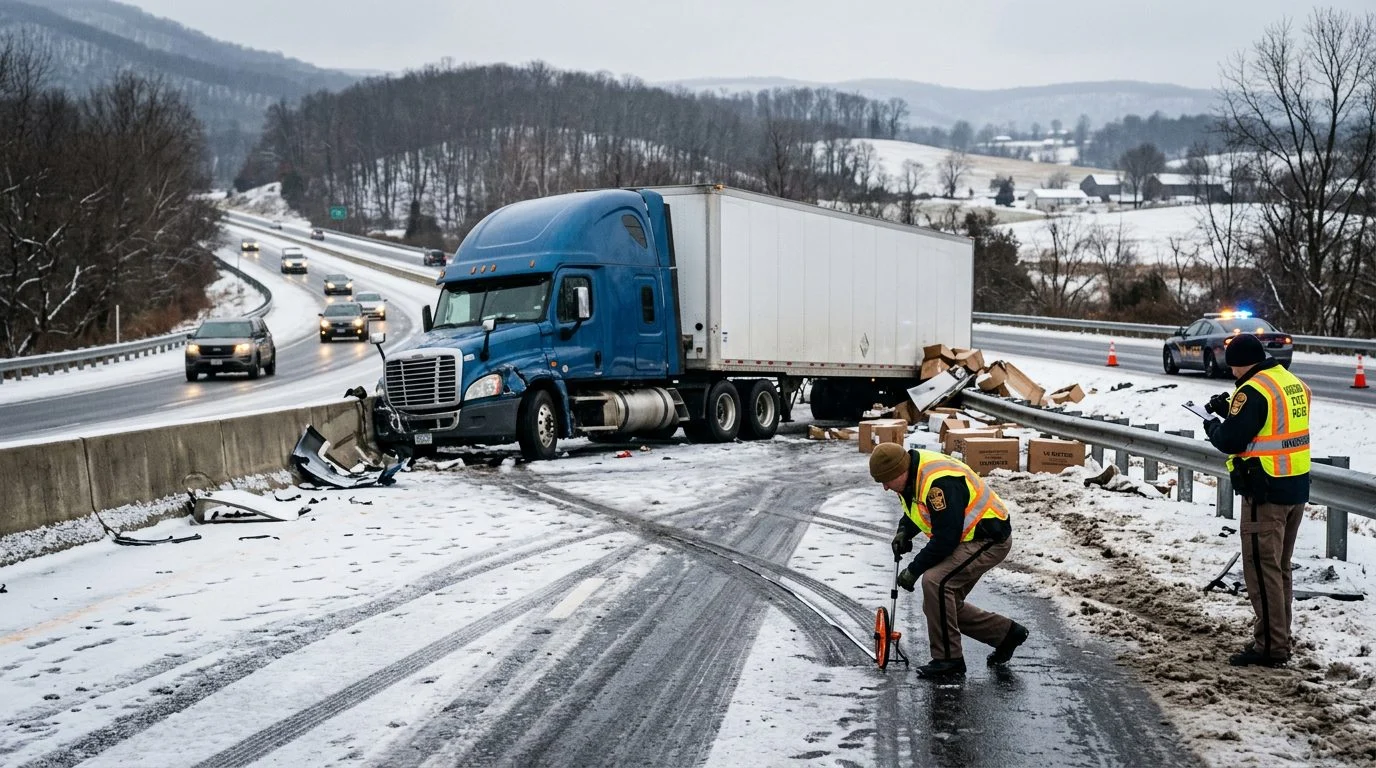
A semi truck crash in snow near Winchester, Virginia, can leave people hurt and facing many decisions at once. After a crash, getting to a safe place and calling 911 can help make sure injured people get medical attention and that police are notified. The steps that follow matter just as much.
This guide walks through what to do after a semi truck crash in snow or ice on Interstate 81, from the scene to the time limits that may apply.
Why Snow and Ice Change How Semi Trucks Crash on I-81
Snow and ice make it much harder for a loaded tractor-trailer to stop, so a crash can start in seconds. A heavy truck needs far more distance to stop on a slick road than a passenger car does. Trailer weight and lower traction raise the chance of a jackknife, where the trailer swings out of line with the cab.
Federal rules for commercial drivers call for extreme caution when snow, ice or sleet affect traction or visibility. Speed must be reduced when those conditions exist. If conditions become sufficiently dangerous, driving must stop and shall not be resumed until the commercial motor vehicle can be safely operated (49 C.F.R. § 392.14).
Interstate 81 runs through Winchester, Frederick County and Harrisonburg. Bridges and overpasses often freeze before the road around them does. A shaded curve can stay icy after the open road has thawed, so a driver may not notice the change until the truck is already sliding.
Winter does not affect only trucks. Passenger cars and other drivers face the same roads, so fault depends on the facts of each crash, not on the weather alone. The firm’s guide to commercial vehicle accidents in Virginia covers the wider picture.
If a semi truck crash on a snowy or icy road left you or a loved one hurt, you may have a claim, and the firm offers a free case evaluation to talk through the facts. Talk it through with Correll Law Firm — we can walk you through how a situation like yours is usually handled and what your options are.
Common Crash Patterns in Winter Weather on I-81
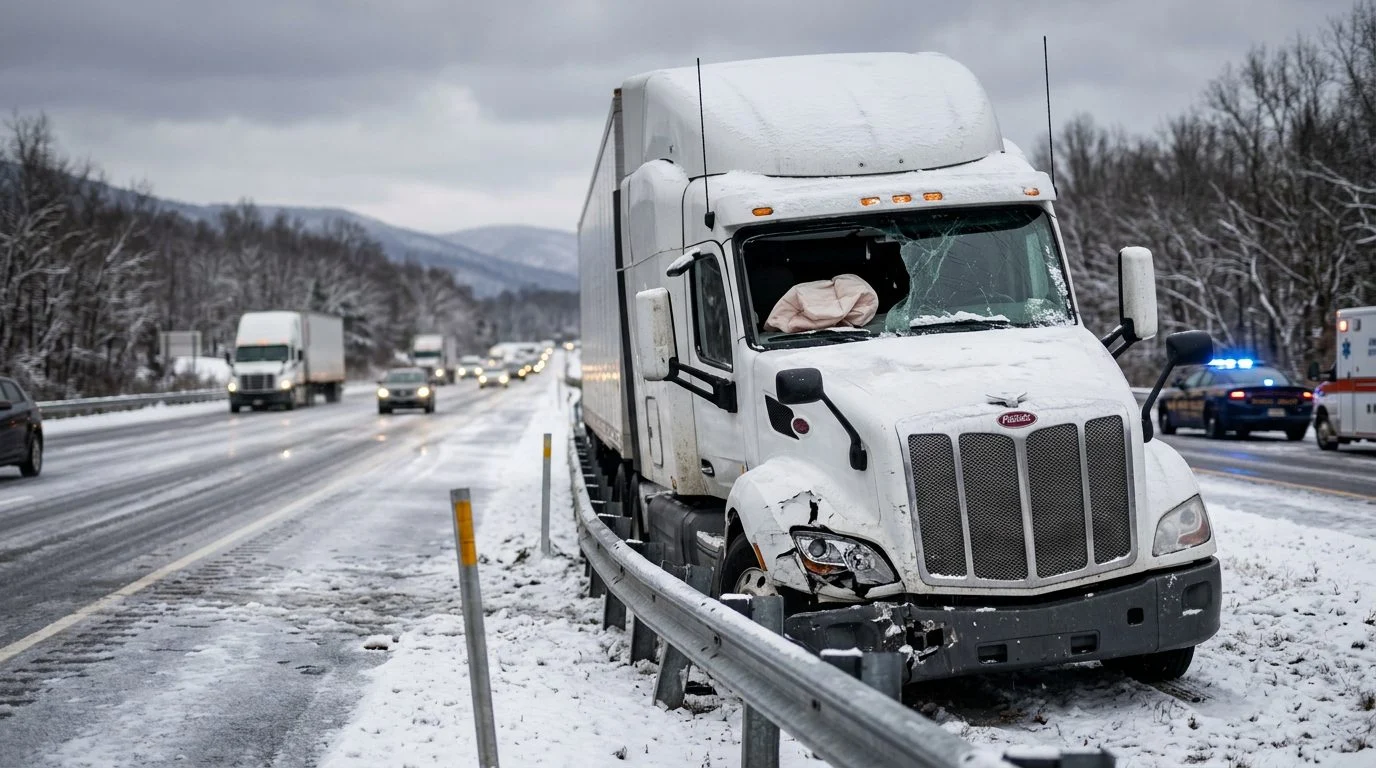
Winter truck crashes on I-81 tend to fall into a few patterns, and each one raises different questions. Local news reports about I-81 have described tractor-trailers that jackknifed, ran off the road, or overturned on a ramp.
A jackknife happens when the trailer folds toward the cab and the driver loses steering control. Another pattern is a truck that leaves the road or crosses into a median. A third is a truck that overturns and blocks lanes, which can cause secondary crashes behind it. Drivers approaching a blocked lane may not have time to stop on ice.
Each pattern raises questions about speed for conditions, following distance, lane changes and the truck’s equipment. These are factual questions. The answers come from the scene, the records and the witnesses.
What to Do Right Away at the Scene
Your first priority is safety. Move out of traffic if you can, turn on your hazard lights, and stay clear of sliding or downed vehicles. Call 911 and ask for medical help, even if injuries seem mild. Responders and state police can then reach the scene.
Virginia requires a driver involved in a crash with injury or death to stop and report it to police immediately (Va. Code §§ 46.2-371, 46.2-894).
Under Va. Code § 46.2-894, the driver must also give reasonable help to an injured person. That includes taking the person to a hospital when medical treatment appears necessary or is requested. If injuries keep a driver from making the report right away, the report must be made as soon as reasonably possible.
That reporting duty is separate from the lawsuit deadline. The two-year period discussed later limits when a lawsuit must be filed. It does not set when a crash must be reported.
Evidence and Records to Keep After a Winter Truck Crash
The most useful evidence is usually what you can gather while the scene is still fresh. Photos and video can show the road surface, the positions of the trucks and vehicles, skid marks, ice and the weather. If it is safe, write down the names and contact details of drivers and witnesses.
Note the truck’s company name and any USDOT number on its door or cab. Federal rules require self-propelled commercial vehicles subject to this subchapter to be marked on both sides, which can help identify the carrier (49 C.F.R. § 390.21T).
Keep the crash report from the investigating agency. It records what officers documented at the scene. It is one record among several, and it does not settle fault by itself.
FMCSA hours-of-service rules address federal driving-time limits and required rest breaks for commercial drivers. These records can matter to the facts of a claim.
Medical Care and Why a Prompt Evaluation Matters
A medical evaluation soon after a crash is a sensible step, even when pain seems mild. Some injuries do not show symptoms right away, including some head and spine injuries. Symptoms can also grow over days, so an early check creates a clear record of how you felt.
Keep a written list of symptoms with dates. Follow medical advice, and keep copies of bills, prescriptions and discharge instructions. The firm’s guide on keeping medical records after a truck crash explains how to organize this information.
The firm handles catastrophic injuries, including traumatic brain injury and spinal cord injury. These injuries can affect work, family life and daily tasks over a long period.
Fault, Partial Fault and Punitive Damages in Virginia
Fault after a winter crash is worked out from the evidence, and a partial-fault rule can limit recovery. Virginia follows contributory negligence: if you are found even partly at fault, you may be barred from recovering, with limited exceptions. Talk to a lawyer about your facts.
Fault can also rest with more than one party.
Virginia allows punitive damages for actual malice, or for willful or wanton conduct or recklessness showing a conscious disregard for the safety of others, capped at $350,000 (Va. Code § 8.01-38.1). The cap is set out in Va. Code § 8.01-38.1. The jury must find that the conduct met this standard.
Not sure what your next step is?
Talk it through with Correll Law Firm — we can walk you through how a situation like yours is usually handled and what your options are.
Time Limits and Wrongful Death When a Crash Is Fatal
Two deadlines matter most here: the lawsuit deadline for injuries, and the wrongful death deadline after a death. Virginia generally allows two years from the date of injury to file a personal injury lawsuit (Va. Code § 8.01-243(A)); the clock runs from the date of injury, not the date of discovery, with narrow exceptions.
When a crash causes a death, the rules change. A Virginia wrongful death action is filed by the decedent’s personal representative within two years of the death (Va. Code §§ 8.01-50(C), 8.01-244(B)), on behalf of the family members the statute protects. Virginia wrongful death damages cover the family’s sorrow, mental anguish and loss of the decedent’s companionship, guidance and care; lost income and services; medical expenses from the injury; funeral expenses; and, for willful or wanton conduct, punitive damages (Va. Code § 8.01-52).
Family members do not file the action. Family members share in the recovery, but damages for medical care and funeral expenses are apportioned among the creditors who rendered such services (Va. Code § 8.01-52).
Understanding the Next Steps After a Winter Semi Truck Crash
The next steps follow a clear order: safety and 911, the reporting duty, medical care, records, and then the time limits. Each step protects a different part of your situation, so none of them should be skipped.
The facts of each crash decide which legal questions apply. Weather, the driver’s conduct and the injuries all shape the picture. General information cannot predict how one crash will turn out.
Does the crash report decide who was at fault?
No. The report records what officers documented at the scene, and it is one record among several.
Does bad weather mean no one was at fault?
No. Weather can be part of the facts, but fault still depends on how each driver acted, including speed and following distance.