
Car and Truck Accidents | Virginia
Company Vehicle Crashes in Virginia: Who May Be Responsible
Published November 2, 2026
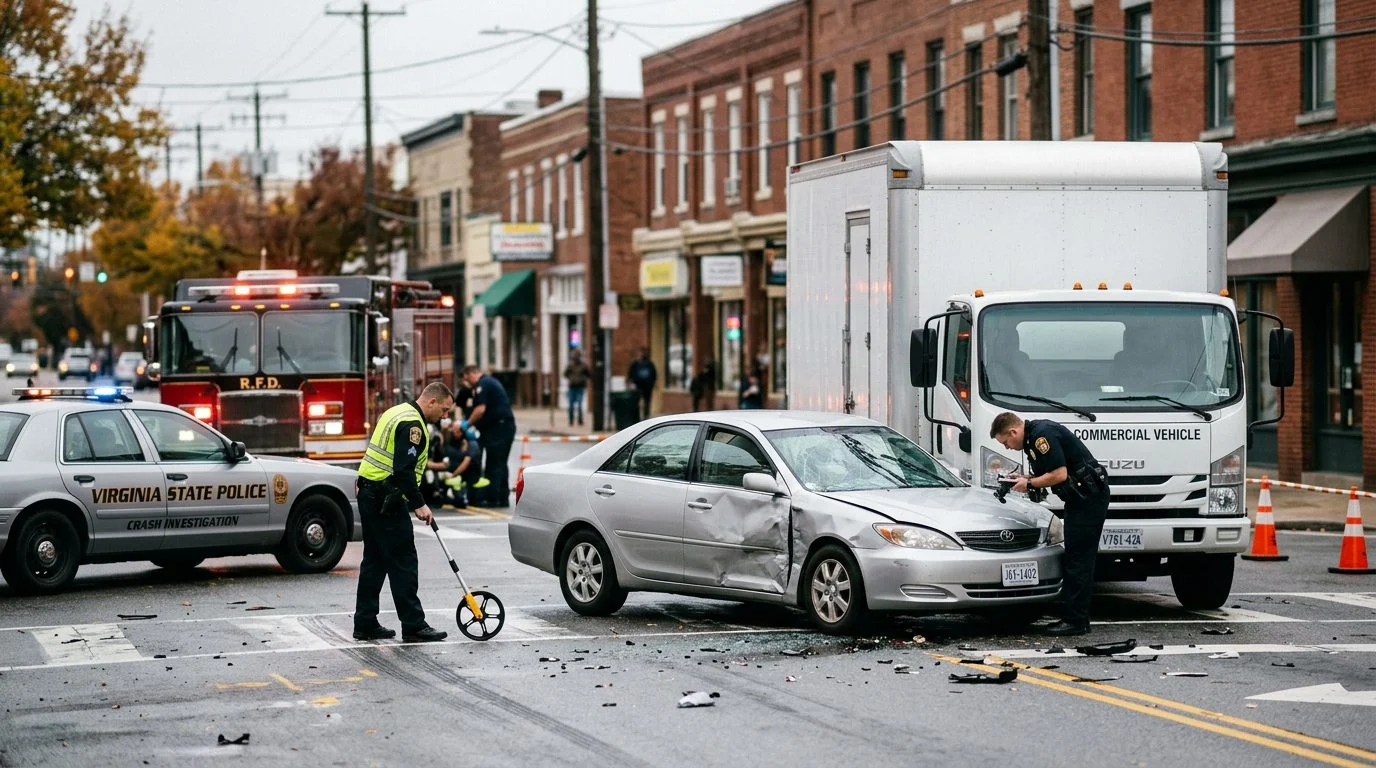
A company vehicle crash can involve more than one party. Many people ask who is responsible when a company vehicle crashes in Virginia. The short answer is that it can be several businesses and people, not just the driver. The vehicle owner, the employer, and companies tied to the cargo or equipment may all be part of the picture. Identifying each party is a normal step in the investigation. The firm represents people from the Shenandoah Valley to Richmond and Henrico County, so this guide explains how that step works under Virginia rules.
More Than One Party May Be Involved in a Company Vehicle Crash
A company vehicle crash may involve the driver, the vehicle owner, the employer, and other companies. Several businesses can own, operate, load, or maintain the same vehicle, and each may keep its own records.
Picture a delivery van that crashes on a Shenandoah Valley road. The driver works for a contractor. A leasing company owns the van. A warehouse loaded the cargo. Each of those businesses may hold papers that shed light on the trip. That is why the investigation looks at every party, not only the person behind the wheel.
For the wider picture of these claims, read the firm’s commercial vehicle accidents guide.
Not sure what your next step is?
Talk it through with Correll Law Firm — we can walk you through how a situation like yours is usually handled and what your options are.

The Driver
The driver is the person whose conduct at the time of the crash is examined first. Driver conduct can be shown through records. Electronic data from the vehicle can show what happened before impact, and driver logs show hours and duty status. You can read about these records in the truck black box data guide and the driver logbook guide.
Carriers operating commercial motor vehicles must install and require drivers to use an electronic logging device (ELD) to record duty status, subject to limited exceptions, including manual recording in certain cases, under 49 C.F.R. § 395.8. Federal rules also place a duty on the motor carrier to require that drivers observe their duties, under 49 C.F.R. § 390.11.
A driver-only view can leave out the companies that set the rules, schedules, and equipment.
The Vehicle Owner and the Employer
The vehicle’s owner and the company that employs or directs the driver are often examined together. Registration, dispatch records, and employment papers can show who had control of the vehicle at the time of the crash. Whether a given relationship matters in a claim turns on the facts and the records that show them.
Ownership and employment are questions to investigate. Keeping that distinction clear helps the investigation stay accurate from the start.
Cargo, Equipment, and Maintenance Companies
Companies that load cargo, supply equipment, or maintain the vehicle can hold records tied to how a crash happened. Loading papers show what was carried and how it was secured. Maintenance files show repairs and inspections.
Federal rules set detail for some of these records. Under 49 C.F.R. § 396.21, an inspection report must be kept for fourteen months from the date of the report, where the vehicle is housed or maintained. A written equipment lease must also say who handles loading and unloading and who is responsible for items such as fuel and tolls, under 49 C.F.R. § 376.12.
A bus or van carrying passengers can raise its own questions about which companies are involved. The page on injured bus passengers covers that situation.
Why Identifying Every Party Is Part of the Investigation
Identifying every party early helps preserve records that can be lost or discarded. Under 49 C.F.R. § 379.3, companies subject to these federal recordkeeping rules must keep records for the minimum retention periods the rules set. After the required retention periods, the records may be destroyed at the discretion of each company’s management, and 49 C.F.R. § 379.3 states that its provisions do not excuse compliance with the lawful requirements of any other governmental body prescribing longer retention periods for any category of records.
Knowing which company holds which record helps the investigation reach the right source while the records still exist. A police report from the scene is another record that can point to the vehicles involved.
Partial fault can change the picture, so it matters here. Virginia follows contributory negligence: if you are found even partly at fault, you may be barred from recovering, with limited exceptions. Talk to a lawyer about your facts.
Timing: Reporting the Crash and Filing a Lawsuit
The reporting duty and the lawsuit deadline run on two different clocks. Virginia requires a driver involved in a crash with injury or death to stop and report it to police immediately (Va. Code §§ 46.2-371, 46.2-894). Va. Code § 46.2-894 requires the driver of a vehicle involved in an accident in which a person is killed or injured to stop immediately as close to the scene as possible without obstructing traffic, and to report his name, address, driver’s license number, and vehicle registration number to the State Police or local law-enforcement agency. The driver is also to render reasonable assistance to an injured person (Va. Code § 46.2-894). Va. Code § 46.2-371 requires the driver to give notice of the accident to a law-enforcement officer immediately (Va. Code § 46.2-371).
The two-year period is the deadline to file a lawsuit, not to report a crash (Va. Code § 8.01-243). Virginia generally allows two years from the date of injury to file a personal injury lawsuit (Va. Code § 8.01-243(A)); the clock runs from the date of injury, not the date of discovery, with narrow exceptions. Some claims carry notice requirements that run out sooner.
Not sure what your next step is?
Talk it through with Correll Law Firm — we can walk you through how a situation like yours is usually handled and what your options are.
When a Company Vehicle Crash Is Fatal
When a crash caused by the wrongful act, neglect, or default of a person or company results in a death, the family’s claim runs through a wrongful death action. A Virginia wrongful death action is filed by the decedent’s personal representative within two years of the death (Va. Code §§ 8.01-50(C), 8.01-244(B)), on behalf of the family members the statute protects. The statutes are at Va. Code § 8.01-50 and Va. Code § 8.01-244.
Virginia wrongful death damages cover the family’s sorrow, mental anguish and loss of the decedent’s companionship, guidance and care; lost income and services; medical expenses from the injury; funeral expenses; and, for willful or wanton conduct, punitive damages (Va. Code § 8.01-52).
Punitive damages are available only if the conduct meets the standard set by statute: Virginia allows punitive damages for actual malice, or for willful or wanton conduct or recklessness showing a conscious disregard for the safety of others, capped at $350,000 (Va. Code § 8.01-38.1).
Each party in this guide is part of the picture: the driver, the vehicle owner, the employer, and any company tied to the cargo or equipment. Keeping every one of them in view is where the investigation starts.
Frequently asked questions
Can more than one company be sued after a company vehicle crash?
Is the employer always responsible when its driver causes a crash?
Not automatically. The employment relationship is a fact to examine, and the records and facts of the case show what it means.
Related practice areas
- What Is Delayed Shock After a Virginia Car Crash?