
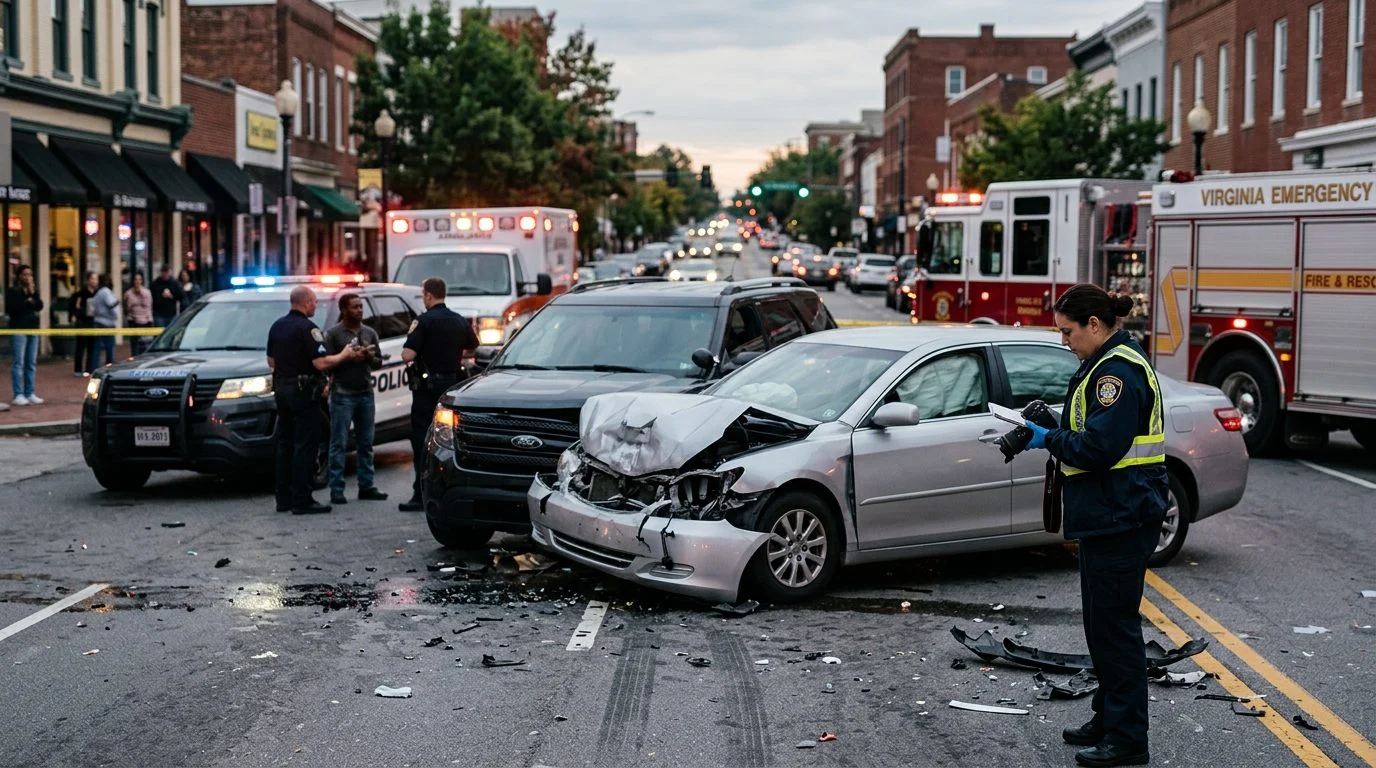
Impaired driving crashes in Virginia
Drunk Driving Crash Timeline: What Happens in Virginia, Step by Step
A crash caused by an impaired driver brings a sequence of police, medical, insurance and court steps. Here is how that sequence usually unfolds, and how a firm can help you keep track of it.
Published November 9, 2026
If a drunk driver hurt you or someone you love, you may be asking how long the claim will take. In Virginia, a drunk driving accident case has no single length. Its timing depends on how serious the injuries are, how fault is disputed, and whether the case settles or goes to court.
The sections below explain each stage, the factors that speed a claim up or slow it down, and the filing deadlines that run in the background. Knowing the stages early can make the process easier to follow.
Why a Drunk Driving Case Has No Single Length
The length of a claim depends on four main things. Those are the injuries, the fault dispute, the number of insurers and parties, and whether the case resolves before trial. Each one can move the timeline in either direction.
Serious injuries usually take longer. A claim can’t be valued fully until the medical picture is clear. A drunk driving crash can add work on top of that. Toxicology results, arrest records, and the officer’s report may need to be gathered and reviewed. An impaired driver may also deny fault, which can lead to more back-and-forth between the sides.
The firm handles these matters for people across the Shenandoah Valley, Richmond and Henrico County from its Winchester and Harrisonburg offices, and the same stages apply to crashes across Virginia. Understanding how time gets spent is more useful than a guessed number of months.
If a drunk driver hurt you or someone you love, you may have a claim, and you do not have to face the process alone. Talk it through with Correll Law Firm — we can walk you through how a situation like yours is usually handled and what your options are.

Immediate Steps After a Crash That Shape the Timeline
The first few days after a crash often shape how smoothly the claim moves later. Getting medical care right away protects health and creates the record the claim is built on. Keep every appointment, test result, and treatment note. Missing records are hard to rebuild months later.
Virginia requires a driver involved in a crash with injury or death to stop and report it to police immediately (Va. Code §§ 46.2-371, 46.2-894). The two-year period is the deadline to file a lawsuit, not to report a crash. You can read the duties in Va. Code § 46.2-371 and Va. Code § 46.2-894.
Write down the police report number, the names of any witnesses, and the other driver’s vehicle information. Take photos of the scene, the vehicles, and your injuries. These details fade quickly, and they are hard to rebuild later.
The Stages of a Virginia Drunk Driving Accident Claim
A claim usually moves through investigation, treatment, demand and negotiation, and then a lawsuit only if the case does not resolve. Each stage can take a different amount of time.
In the investigation stage, the firm gathers the police report, medical information, insurance details, and facts about how the crash happened. This stage shows who may be responsible and which insurers are involved. It often runs alongside treatment.
Treatment comes next, and it often sets the pace. A claim usually can’t be valued fully until the injured person’s medical condition is known. For serious injuries, including brain and spinal cord injuries, recovery can take many months, and sometimes longer.
Once the picture is clearer, the firm may send a demand to the insurer and negotiate. Many claims resolve at this stage. Others need more work before they do.
If the case does not resolve, a lawsuit is filed. Discovery follows, which is the exchange of records and sworn testimony. Pretrial motions, mediation, and trial come after that, if they are needed. A lawsuit usually takes longer than a negotiated claim.
How the Drunk Driving Element Can Change the Work
A drunk driving arrest and a civil injury claim are different matters. The criminal case moves on its own schedule, and the civil claim has its own timeline.
Drunk driving charges rest on Va. Code § 18.2-266. That law makes it unlawful to drive with a blood alcohol concentration of 0.08 percent or more, or while under the influence of alcohol. A civil claim often needs the driver’s test results, arrest records, and the officer’s reports. Getting those records can take time.
Virginia allows punitive damages for actual malice, or for willful or wanton conduct or recklessness showing a conscious disregard for the safety of others, capped at $350,000 (Va. Code § 8.01-38.1). You can read the cap in Va. Code § 8.01-38.1.
In motor vehicle injury cases, Va. Code § 8.01-44.5 lets the finder of fact decide, in its discretion, whether to award punitive damages. Under Va. Code § 8.01-44.5, in a case for personal injury or death arising from the operation of a motor vehicle, the finder of fact may, in its discretion, award punitive damages if the evidence proves that the defendant acted with malice toward the plaintiff or that the defendant’s conduct was so willful or wanton as to show a conscious disregard for the rights of others. Under Va. Code § 8.01-44.5, a defendant’s conduct is deemed sufficiently willful or wanton to show a conscious disregard for the rights of others when the evidence proves that (i) when the incident causing the injury or death occurred, the defendant had a blood alcohol concentration of 0.15 percent or more; (ii) the defendant knew or should have known that his ability to operate a motor vehicle would be impaired by alcohol, or knew or should have known that his ability was impaired while he was operating the vehicle; and (iii) the defendant’s intoxication was a proximate cause of the injury or death.
Filing Deadlines That Run From the Date of Injury
Virginia generally allows two years from the date of injury to file a personal injury lawsuit (Va. Code § 8.01-243(A)); the clock runs from the date of injury, not the date of discovery, with narrow exceptions. The statute is at Va. Code § 8.01-243.
Some claims carry notice requirements that run out sooner than the lawsuit deadline. A lawyer can review which requirements may apply to the facts, and you may wish to raise that question early.
The two-year period is a deadline to file, not a schedule for the claim (Va. Code § 8.01-243). Many claims resolve well before a lawsuit is needed. Others take longer once a lawsuit is filed.
Factors That Speed Up or Slow Down a Claim
Clear evidence, complete records, and stable injuries tend to speed a claim. Disputed fault and changing injuries tend to slow it.
Speed usually comes from clear proof of how the crash happened, complete medical records, and insurers that respond on time. A claim also moves faster once the injuries have stabilized and the medical picture is settled.
Slower cases often involve serious or still-changing injuries, a dispute over who was at fault, several parties or insurers, and records that must be requested through a court order. Drunk driving cases can raise fault questions, because the other driver may argue that you contributed to the crash.
Virginia follows contributory negligence: if you are found even partly at fault, you may be barred from recovering, with limited exceptions. Talk to a lawyer about your facts.
If the impaired driver was operating a commercial truck, the claim can add parties, such as the trucking company. It can also add records under federal hours-of-service rules for commercial drivers. The FMCSA hours-of-service summary describes those standards.
Not sure what your next step is?
Talk it through with Correll Law Firm — we can walk you through how a situation like yours is usually handled and what your options are.
Wrongful Death Cases Involving a Drunk Driver
A Virginia wrongful death action is filed by the decedent’s personal representative within two years of the death (Va. Code §§ 8.01-50(C), 8.01-244(B)), on behalf of the family members the statute protects. Here, the decedent means the person who died. The statutes are at Va. Code § 8.01-244 and Va. Code § 8.01-50.
Virginia law sets out who shares in the damages awarded under Va. Code § 8.01-53, which distributes them to specified surviving beneficiaries.
Virginia wrongful death damages cover the family’s sorrow, mental anguish and loss of the decedent’s companionship, guidance and care; lost income and services; medical expenses from the injury; funeral expenses; and, for willful or wanton conduct, punitive damages (Va. Code § 8.01-52). The damages list is in Va. Code § 8.01-52.
Wrongful death cases often need the same investigation and records steps as injury claims. Coordinating with the personal representative and the family can add time, especially when several relatives have questions.
Common Questions About Timing
Does the criminal case have to end first?
The criminal case and the civil claim are separate, and they may run on different schedules. The filing deadline still applies while the criminal case is pending.
Why can’t a claim be valued while treatment continues?
A claim usually can’t be valued fully until the medical condition is known. Serious injuries often need time before their long-term effects are clear.
Does a commercial truck change how long a claim takes?
It can. A commercial vehicle claim can add parties and records, which can lengthen the work.

Connecting the Timeline to Your Situation
The stages and deadlines in this article are general. The order and length of each step depends on the facts of the crash, the injuries, and the parties involved.
Every crash has its own facts. These include where it happened, who was hurt, how the injuries are healing, and who may share fault. The firm’s car, truck, and wrongful death work is described on its practice pages.
With the stages in view, a person can better understand what to expect and when. Knowing the deadlines early keeps the options open.