
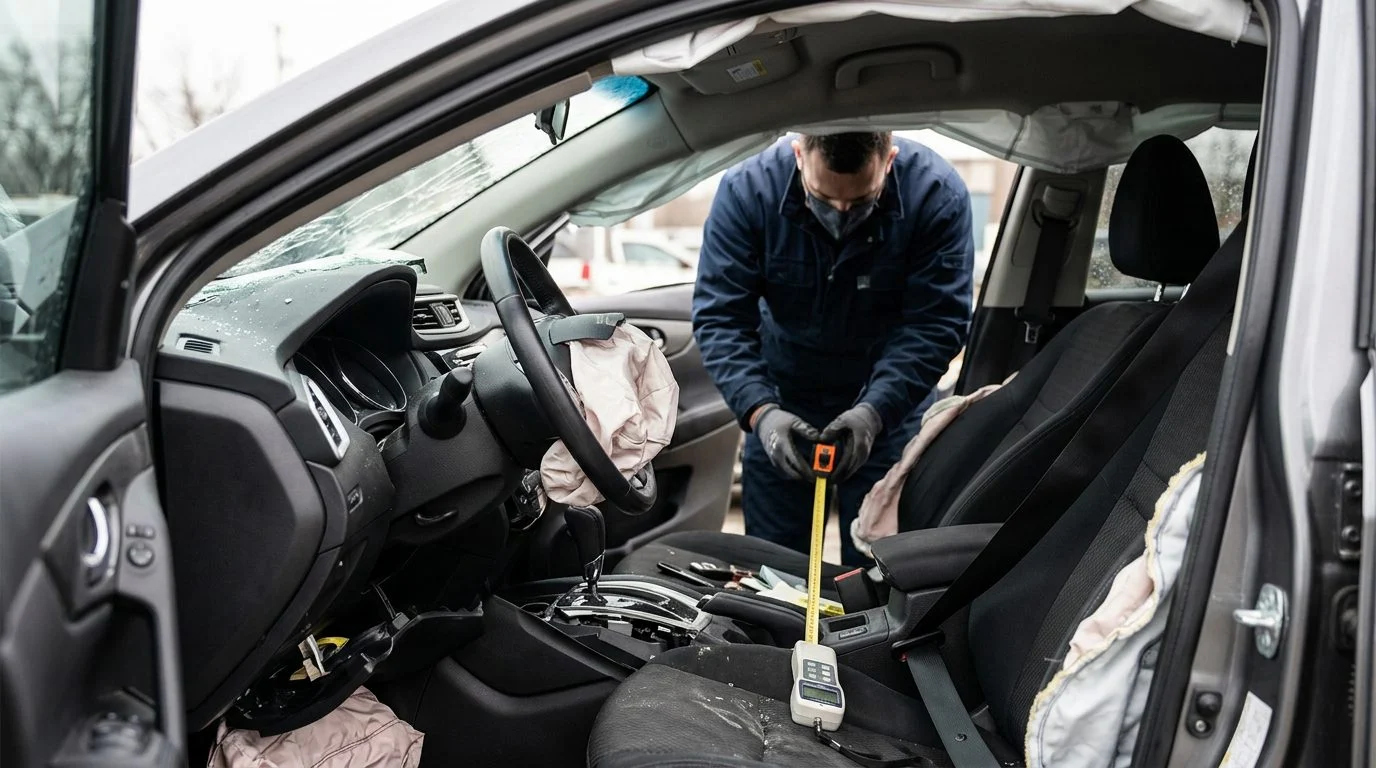
Can a Low-Speed Crash Cause a Catastrophic Injury?
Brain and spinal cord injuries can follow lower-speed impacts. Here is what to know about these injuries and why a medical evaluation matters after any crash.
Published November 3, 2026
Short Answer: Can a Low Speed Crash Cause a Catastrophic Injury?
Can a low speed crash cause a catastrophic injury? Yes. A low speed crash can cause a serious, lasting injury, such as a traumatic brain injury or a spinal cord injury. These injuries are not the usual result of every low-speed impact, and most minor crashes do not lead to them.
Speed is only one factor. The direction of the impact matters. So does the person’s position in the vehicle, whether the head and neck were supported, and the person’s age and prior health.
This page explains those factors in plain language. It is general educational information, not a prediction about any particular crash. Only a medical evaluation can show what injury a person has. If you were hurt in a crash that seemed minor, it makes sense to ask whether it mattered.
Talk it through with Correll Law Firm — we can walk you through how a situation like yours is usually handled and what your options are.

What Is Considered a Low-Speed Crash?
There is no single legal or universal speed cutoff for a low-speed crash. People usually use the term for collisions where the vehicles were moving slowly or where visible damage looks limited.
Visible damage is an imperfect guide to injury. Damage shows how a vehicle was built and how its parts absorbed force. It does not show what the occupant’s body absorbed. A bumper can look fine while a neck has been forced well beyond its normal range.
That is why questions like “How bad is a 30 mph crash?” and “At what speed can a crash be fatal?” have no simple answer. The outcome depends on the facts of each crash, including the direction of impact and the people involved. No speed figure tells you what happened to any one person.
Speed can help describe a crash, but it should not decide whether an injury is real. Anyone who feels hurt should describe the symptoms to a medical provider, whatever the speed.
What Counts as a Catastrophic Injury?
A catastrophic injury causes long-term or permanent serious impairment. The term describes what the injury does to a person’s life, such as losing the ability to walk, think clearly, work or care for oneself. It does not describe how fast the crash was.
Traumatic brain injury and spinal cord injury are two common examples. Both can change how a person moves, speaks, remembers and works. Both can require long medical care and changes at home.
The speed of the crash does not decide whether an injury is catastrophic. Medical findings and how the injury affects daily life determine that. A slower crash can still produce a serious injury, and a faster one can produce a minor one.
For more on these injury categories, read the firm’s page on catastrophic injuries.
How Injuries Happen in Low-Speed Collisions
The body can move quickly in a crash, even when the car barely seems to move. Forces act on the person, not only on the vehicle. In a rear-end collision, the head and neck can be pushed back and then forward before muscles react.
Position matters. A person who is turning to look at a child, reaching for something or leaning forward may not be braced when impact comes. The same force can then affect the head and neck differently.
Safety equipment helps. Seat belts, head restraints and airbags are designed to reduce harm, and they work as designed. They do not prevent every type of injury, though. A belted person can still be hurt when the head or neck moves past what the restraints allow.
Clear details help a medical team understand what happened. Describe the direction of impact, where you were sitting, and whether your head struck anything. Those details can guide which tests a doctor orders.
Brain and Spinal Cord Injuries After Lower-Speed Impacts
A traumatic brain injury can follow a blow to the head or a sudden stop of the head, even without hitting the windshield. A person may not lose consciousness. A concussion is one form of brain injury, and it can still be serious.
The NINDS overview of traumatic brain injury states that severe cases can result in permanent disability or death.
Spinal cord injury can occur when the neck or back is forced beyond its normal range of motion. Watch for numbness, tingling, weakness or changes in feeling in the arms or legs. Those symptoms need prompt medical evaluation.
These injuries can have lasting effects, which is why they fall within the catastrophic category. Recovery looks different for each person.
Whiplash and Soft Tissue Injuries: Not Always Minor
Yes, neck and back soft tissue injuries, including whiplash, are common after lower-speed impacts. Whiplash is a neck injury caused by a sudden back-and-forth movement of the head.
Soft tissue injuries are often called minor. Yet persistent neck pain, headaches, dizziness or reduced range of motion can last for months. Those symptoms can affect sleep, work and daily life. Some people stop treatment once the sharp pain eases, and stiffness returns later.
A soft tissue injury alone does not automatically mean a catastrophic injury. Imaging and medical findings determine the diagnosis, and testing can reveal a more serious problem than first suspected.
Keep the doctor informed as symptoms change, so the medical record shows the full picture.
Not sure what your next step is?
Talk it through with Correll Law Firm — we can walk you through how a situation like yours is usually handled and what your options are.
Why Symptoms Can Be Delayed
Some symptoms can appear hours or days after a crash. Headache, trouble concentrating, memory problems, sleep changes and mood shifts can follow a brain injury. They may not show up right away.
Many people feel shaken or sore at the scene and assume the injury is minor. The rush of the moment can dull pain. A person may feel fine on the drive home and wake up stiff the next morning.
When new symptoms appear, a medical evaluation is the right next step. Keep a written daily log. Note symptoms, pain levels, activities you could not do, and any work you missed.
Medical records that link symptoms to the crash are important evidence in any later claim. A written log can also help a doctor understand the history.
Documenting a Low-Speed Crash
Start by making a record while the details are fresh. Take photos of the vehicles, the road, the scene and any visible injuries. Write down the exact time and location of the crash.
Virginia requires a driver involved in a crash with injury or death to stop and report it to police immediately (Va. Code §§ 46.2-371, 46.2-894). The statutes are Va. Code § 46.2-371 and Va. Code § 46.2-894. The two-year period is the deadline to file a lawsuit, not to report a crash.
Collect witness names and contact details. Get the police report number, and the other driver’s name, license number and plate number.
Keep all medical bills, appointment notes, prescriptions and records of time missed from work. Those records show how the crash affected daily life.
How Fault Can Affect a Claim After a Low-Speed Crash
Fault is often disputed after a low-speed crash. The other driver’s insurer may argue that minor damage means minor injury. A claim can be questioned even when the crash looks simple.
Virginia follows contributory negligence: if you are found even partly at fault, you may be barred from recovering, with limited exceptions. Talk to a lawyer about your facts.
Evidence helps answer these questions. Photos, witness names and the police report help show how the crash happened.
Time Limits and the Special Case of a Fatal Low-Speed Crash
Virginia generally allows two years from the date of injury to file a personal injury lawsuit (Va. Code § 8.01-243(A)); the clock runs from the date of injury, not the date of discovery, with narrow exceptions. The statute is Va. Code § 8.01-243.
Some claims carry notice requirements that run out sooner than the lawsuit deadline. Do not assume the two-year period is the only clock that matters.
When a crash is fatal, the question becomes whether the family has a wrongful death claim. No fixed speed answers that.
A Virginia wrongful death action is filed by the decedent’s personal representative within two years of the death (Va. Code §§ 8.01-50(C), 8.01-244(B)), on behalf of the family members the statute protects. The statutes are Va. Code § 8.01-50 and Va. Code § 8.01-244.
Virginia wrongful death damages cover the family’s sorrow, mental anguish and loss of the decedent’s companionship, guidance and care; lost income and services; medical expenses from the injury; funeral expenses; and, for willful or wanton conduct, punitive damages (Va. Code § 8.01-52).

Local Context for Shenandoah Valley and Richmond-Area Readers
Correll Law Firm operates from Winchester and Harrisonburg. The firm represents people injured in car and commercial truck crashes from the Shenandoah Valley to Richmond and Henrico County.
The firm handles car accidents, truck and commercial vehicle accidents, catastrophic injuries, traumatic brain injury, spinal cord injury and wrongful death matters. Readers in Winchester, Harrisonburg, Richmond and Henrico County can apply the same steps described here.
Crashes on busy highways and local roads raise the same medical and documentation questions. Commercial truck crashes can add questions about the driver and the company that operated the truck.
Frequently Asked Questions
Can a low speed crash cause a catastrophic injury?
Yes. Brain and spinal cord injuries can follow lower-speed impacts, though not every crash causes them.
What is a catastrophic injury?
It is an injury with long-term or permanent serious impairment, judged by its effect on a person’s life.