
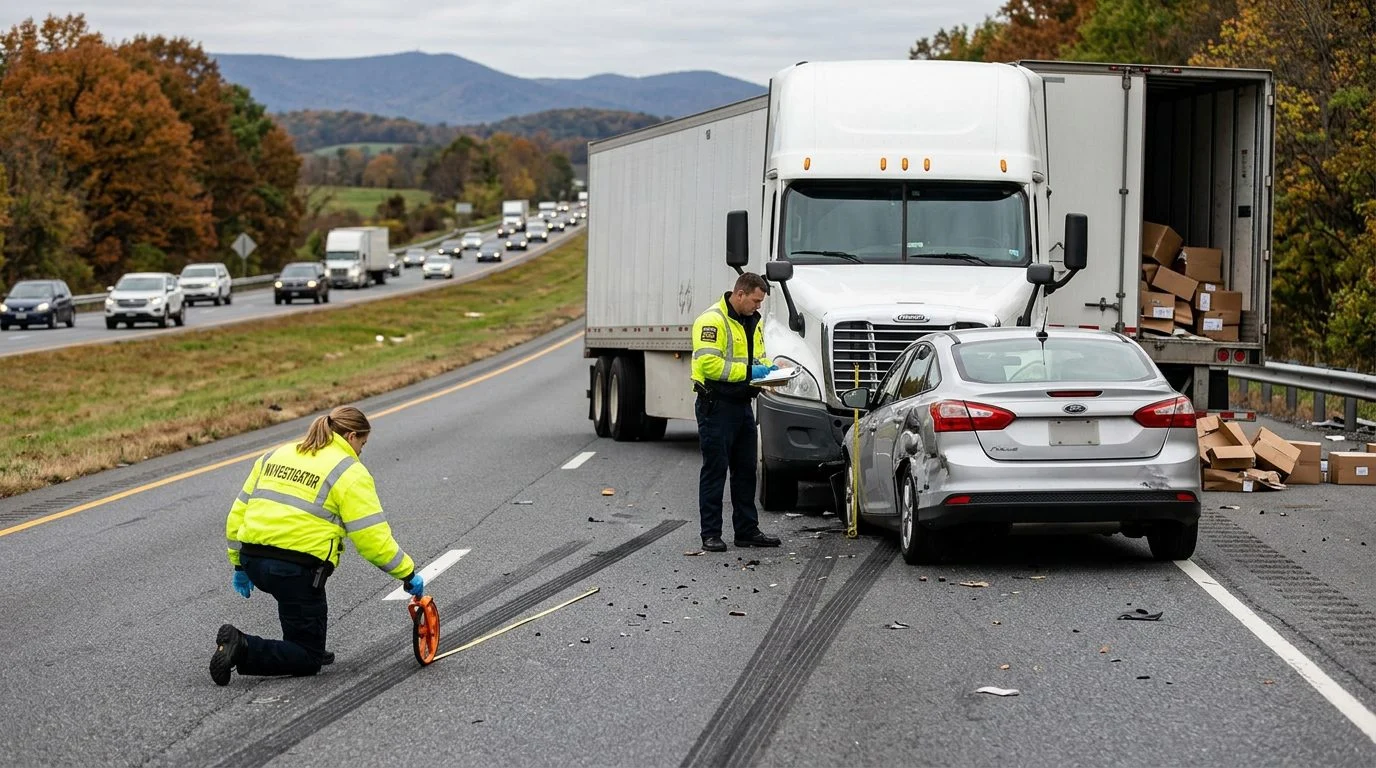
Truck Accidents | Virginia
Hurt in a Rear-End Semi Truck Crash? Understand Your Options in Virginia
Correll Law Firm represents people injured in car and commercial truck crashes, from Winchester and Harrisonburg to Richmond and Henrico County.
Published November 13, 2026
A semi truck hitting you from behind can leave you hurt, shaken and unsure what comes next. Yes, you may be able to sue after a rear-end crash with a semi truck in Virginia, if another driver’s negligence caused the crash and your injuries. Whether a claim is possible depends on the facts of the crash, your injuries and the deadlines that apply.
Short answer: you may be able to sue after a rear-end semi truck crash
A person hurt when a semi truck strikes their vehicle from behind may be able to bring a claim in Virginia. A claim is a legal question about fault and damages. It is not a promise of any result, and no outcome can be promised in advance.
In a crash case, that means showing the driver breached a duty and that the breach caused the harm.
The firm has offices in Winchester and Harrisonburg. It serves people across the Shenandoah Valley, Richmond and Henrico County. It handles car accidents, truck accidents, commercial vehicle accidents, catastrophic injuries, traumatic brain injury, spinal cord injury and wrongful death. For a broader view of these cases, see the firm’s commercial vehicle accidents guide for Virginia.
If a semi truck hit you from behind, you may have a claim, and the firm is glad to talk through what happened and what it may mean for you. Talk it through with Correll Law Firm — we can walk you through how a situation like yours is usually handled and what your options are.

Why rear-end crashes with semi trucks raise different questions
A rear-end crash with a semi truck often involves more than two vehicles and two drivers. It can also involve a trucking company, a cargo load, maintenance records and driver logs. Each of these can matter to the claim.
A loaded tractor-trailer is far heavier than a passenger vehicle, and it needs more distance to stop.
Federal rules also bar a driver from operating a commercial motor vehicle, and bar a motor carrier from requiring or permitting a driver to do so, when fatigue, illness or another cause makes it unsafe, with a narrow exception for a grave emergency (49 C.F.R. § 392.3). Driver logs and trip records may show whether these rules were followed. The trucking company may hold those records, so they can be harder to reach early.
Who may be liable to pay compensation in a rear-end truck accident
The truck driver may be a possible party, because the driver’s actions led to the impact. Depending on the relationship between the driver and the company, a claim may also be directed at the trucking company. The facts of the crash will shape that question.
Other parties sometimes come into view. A company that repaired or maintained the truck, or one that loaded it, may be a possibility. Whether any of them played a role is a question the facts of the crash will answer.
Naming the right parties early matters. Records, company ties and insurance policies can differ from one party to another.
Can getting rear-ended be your fault?
Being hit from behind does not, by itself, decide who was at fault. The question turns on what each driver did before and during the crash.
Virginia follows contributory negligence: if you are found even partly at fault, you may be barred from recovering, with limited exceptions. Talk to a lawyer about your facts.
Evidence on fault often includes following distance, braking, sudden stops, lane changes, signals, speed, driver attention and the truck’s brakes. A driver may claim a sudden emergency caused the crash.
What to document and do after a rear-end truck crash
Virginia requires a driver involved in a crash with injury or death to stop and report it to police immediately (Va. Code §§ 46.2-371, 46.2-894). Va. Code § 46.2-371 requires immediate notice to a law-enforcement officer. Va. Code § 46.2-894 requires the driver to stop as close to the scene as possible without obstructing traffic, and to render reasonable assistance to anyone injured.
The two-year period discussed below is the deadline to file a lawsuit, not the deadline to report a crash (Va. Code § 8.01-243).
Practical steps can help build a record. Take photographs of both vehicles, the scene, road conditions and any visible injuries. Write down the names of witnesses and how to reach them. Note the truck’s company name and unit number.
Keep any dashcam footage or video from nearby cameras, and ask that it be preserved. A medical evaluation soon after the crash creates a dated record of your injuries.
Be careful about giving a recorded statement to an insurance company before you understand your own claim. You may wish to review that conversation with a lawyer first.
Deadlines that apply to a rear-end truck injury claim
Virginia generally allows two years from the date of injury to file a personal injury lawsuit (Va. Code § 8.01-243(A)); the clock runs from the date of injury, not the date of discovery, with narrow exceptions. The text of Va. Code § 8.01-243 sets out this two-year rule.
Some claims carry notice requirements that run out sooner. You may wish to review the timing of your claim early.
The two-year deadline applies unless this section or another statute provides otherwise. If a criminal prosecution arising from the same facts is pending, that time is not counted toward the civil filing period (Va. Code § 8.01-229).
Waiting also makes evidence harder to gather, since footage and records can be lost.
Not sure what your next step is?
Talk it through with Correll Law Firm — we can walk you through how a situation like yours is usually handled and what your options are.
When the rear-end crash causes a death
When a rear-end crash with a semi truck causes a death, the claim is brought differently than an injury claim. A Virginia wrongful death action is filed by the decedent’s personal representative within two years of the death (Va. Code §§ 8.01-50(C), 8.01-244(B)), on behalf of the family members the statute protects.
In a wrongful death action, the claim shall be brought by and in the name of the personal representative of the deceased person, not by family members themselves. They share in any recovery. The statute sets an order for who shares, starting with the surviving spouse and the children of the deceased (Va. Code § 8.01-53).
The liability rule follows the same basic path as an injury claim. A person whose wrongful act, neglect, or default is such as would, if death had not ensued, have entitled the party injured to maintain an action shall be liable to an action for damages, notwithstanding the death of the person injured (Va. Code § 8.01-50).
Virginia wrongful death damages cover the family’s sorrow, mental anguish and loss of the decedent’s companionship, guidance and care; lost income and services; medical expenses from the injury; funeral expenses; and, for willful or wanton conduct, punitive damages (Va. Code § 8.01-52). The damages categories are set out in Va. Code § 8.01-52.
Families facing this kind of loss often have many questions at once. Each question deserves a clear answer.

What a rear-end truck injury claim may cover and how it may unfold
A claim may address medical treatment, lost income and the effect of the injury on daily life. The exact damages depend on the injuries and the records that document them.
Virginia allows punitive damages for actual malice, or for willful or wanton conduct or recklessness showing a conscious disregard for the safety of others, capped at $350,000 (Va. Code § 8.01-38.1).
Severe injuries, including traumatic brain injury and spinal cord injury, can take longer to understand. The firm’s spinal cord injury page covers those injuries in more detail.
Timelines vary with the injuries, the records, and whether the claim resolves before a lawsuit is filed. No single timeline fits every crash.