
Truck Crash Claims | Winchester, Harrisonburg and Virginia
When a Passenger Vehicle Goes Under a Truck: Underride Crash Claims in Virginia
A guide for injured people and families who are trying to understand what happened and what questions come next.
Where the firm works
2
Offices, in Winchester and Harrisonburg
VA
Serving the Shenandoah Valley, Richmond and Henrico County
Published November 22, 2026
When a passenger vehicle goes under a trailer, the impact often causes severe injuries. The claim usually turns on the trailer’s equipment, the carrier’s maintenance records and how the crash happened.
What an underride truck crash is and how it differs from a rear-end collision
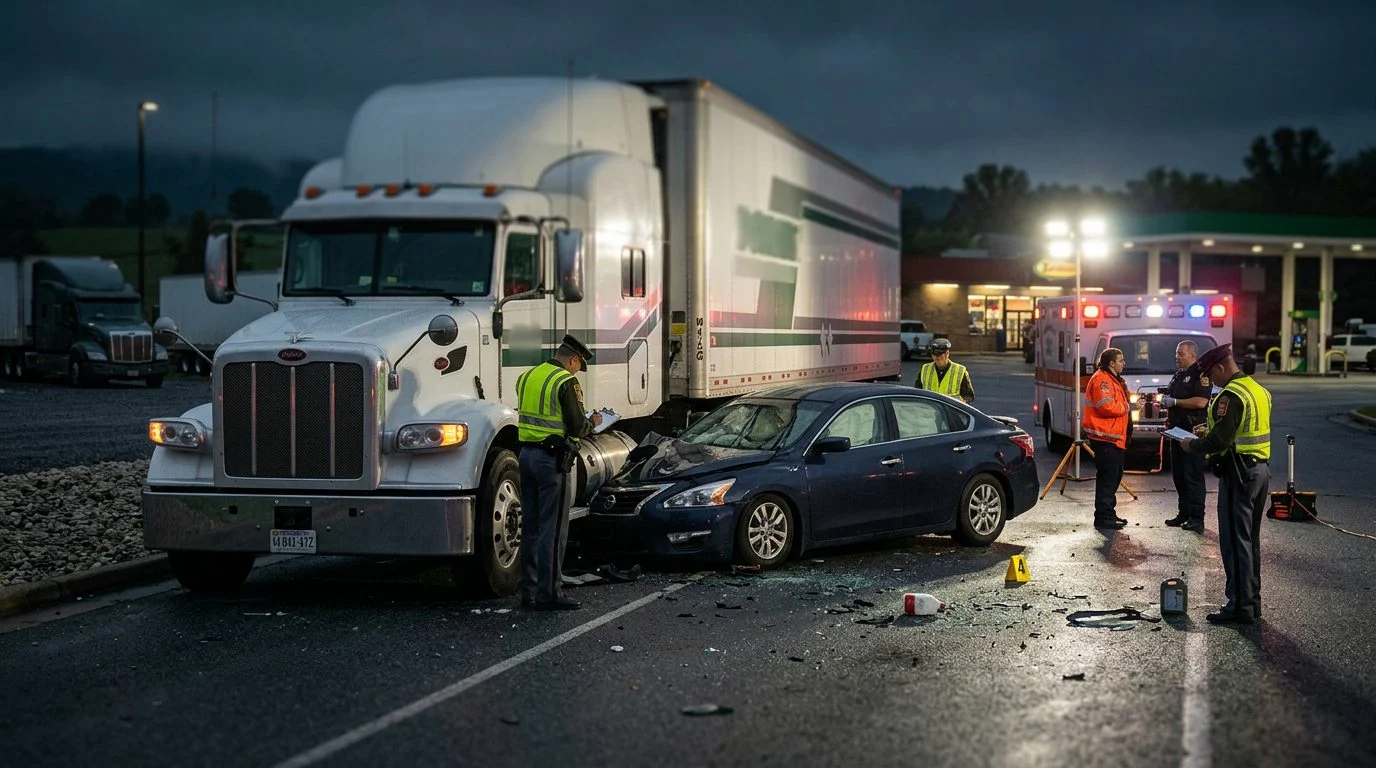
An underride crash happens when a car or SUV passes under the rear or side of a trailer instead of hitting its bumper. Rear underride is the most common picture. Side underride can happen when a vehicle slides under the side of a trailer.
A typical rear-end crash meets a bumper or a crush zone. In an underride crash, the vehicle’s roof and windshield can strike the trailer’s underside. That can push the trailer’s structure into the driver’s head, neck and upper body. Injuries in these crashes can be more severe than in an ordinary rear-end collision.
Fault review often goes beyond the moment of impact. Investigators may look at the trailer’s equipment, the carrier’s maintenance and the driver’s conduct before the crash. This page is written for injured drivers and passengers, and for families of people who died.
If a car or SUV was pushed under a trailer and you or someone you love was hurt, you may have a claim, and the firm can talk through your options with you. Talk it through with Correll Law Firm — we can walk you through how a situation like yours is usually handled and what your options are.

The federal rear impact guard rule and why it matters to the claim
Federal rules require many trailers to have a rear impact guard. The guard is a horizontal member that sits at the rear of the trailer to block a car from sliding underneath. The rule is at 49 CFR 393.86.
Under the rule, the bottom edge of the guard may not sit more than 22 inches above the ground at any point across its width. At heights of 22 inches or more, the rear surface of the guard must sit within 12 inches of the rear end of the vehicle. The horizontal member must also be at least 3.94 inches tall in cross-section.
The rule has exemptions. It does not cover pole trailers, pulpwood trailers, low chassis vehicles, special purpose vehicles, wheels back vehicles, road construction controlled horizontal discharge trailers, or trailers towed in driveaway-towaway operations.
Whether a guard was present, its height and its condition are questions an investigation may examine. Missing or damaged parts after the crash can matter. Keep notes and photos of the trailer, its position and any damage you can see. The guard is one fact among many in the investigation.
Who may share responsibility after an underride crash
Several parties may be connected to an underride crash, depending on the facts. These can include the truck driver, the motor carrier that operated the truck, the trailer owner, and a maintenance or loading contractor. Responsibility is not assumed from who owns the truck. It is traced through who controlled the equipment and what happened before the crash.
Maintenance history can matter. Federal rules require every motor carrier to systematically inspect, repair and maintain the motor vehicles it controls, with parts and accessories in safe and proper operating condition at all times.
Virginia’s partial-fault rule can affect a claim, so the details of how the crash happened matter. Virginia follows contributory negligence: if you are found even partly at fault, you may be barred from recovering, with limited exceptions. Talk to a lawyer about your facts.
Catastrophic injuries common in underride crashes
Underride impacts can cause catastrophic injuries, including traumatic brain injury and spinal cord injury. Recovery from these injuries can take a long time, and some effects may last. Medical records and future care needs often shape how an injury is documented, so keep every bill, discharge summary and therapy note.
The firm handles catastrophic injury claims that arise from truck and commercial vehicle crashes.
When a crash causes a death, Virginia law uses a different path. A Virginia wrongful death action is filed by the decedent’s personal representative within two years of the death (Va. Code §§ 8.01-50(C), 8.01-244(B)), on behalf of the family members the statute protects. Family members do not file; they share in the recovery. The statutes are at Va. Code § 8.01-50 and Va. Code § 8.01-244.
Virginia wrongful death damages cover the family’s sorrow, mental anguish and loss of the decedent’s companionship, guidance and care; lost income and services; medical expenses from the injury; funeral expenses; and, for willful or wanton conduct, punitive damages (Va. Code § 8.01-52).
Records an injured person should keep after an underride crash
Early records help any claim, and the first legal step is reporting the crash. Virginia requires a driver involved in a crash with injury or death to stop and report it to police immediately (Va. Code §§ 46.2-371, 46.2-894). Va. Code § 46.2-371 provides that the driver of any vehicle involved in any accident resulting in injury to or death of any person, or some person acting for him, shall immediately give notice of the accident to a law-enforcement officer. A willful failure to make the report required in this section shall constitute a Class 4 misdemeanor.
That reporting duty is separate from the deadline to file a lawsuit. The two-year period applies to filing a lawsuit, not to reporting a crash.
Useful records include:
- The police report number and the name of the responding agency.
- Photos of the scene, the vehicles and the trailer’s position and markings.
- Names and addresses of witnesses.
- Medical records, bills, and work or income records.
- Written notes about what happened, made while your memory is fresh.
Keep the vehicle and any parts that came off, if you can. Trucking companies and their insurers can move quickly to collect their own evidence. Federal rules require carriers to keep inspection and repair records for one year, and for six months after a vehicle leaves their control, under 49 CFR 396.3.
Deadlines and what to expect in a Virginia underride claim
Virginia generally allows two years from the date of injury to file a personal injury lawsuit (Va. Code § 8.01-243(A)); the clock runs from the date of injury, not the date of discovery, with narrow exceptions. The statute is at Va. Code § 8.01-243.
A typical path looks like this:
- First intake, where the crash facts and injuries are reviewed.
- Preservation of evidence, including trailer and carrier records.
- Investigation of the trailer’s equipment, the carrier’s maintenance and the driver’s conduct.
- Review of injuries, medical care and losses.
- Presentation of a claim to the responsible parties and their insurers.
- A lawsuit, if needed, filed within the deadline.
Timelines vary with the injuries, the investigation and whether the claim resolves before a lawsuit. No single length applies to every case. Some claims carry earlier notice rules.
Not sure what your next step is?
Talk it through with Correll Law Firm — we can walk you through how a situation like yours is usually handled and what your options are.
Why the firm handles underride and truck crash claims
The firm has offices in Winchester and Harrisonburg. It represents people from the Shenandoah Valley, Richmond and Henrico County.
The firm focuses on car accidents, truck accidents, commercial vehicle accidents, catastrophic injuries, traumatic brain injury, spinal cord injury and wrongful death.
The firm cannot promise any particular result. Each claim depends on its own facts and the evidence that is available.

Frequently asked questions about underride truck crash claims
Is an underride crash handled differently from an ordinary truck crash?
Often, yes. The trailer’s guard, its height and the way the vehicle went under it shape both the injuries and the investigation.
Does the federal guard rule decide a claim by itself?
The rule is one part of the investigation. The facts of each crash control the result.
Can family members pursue a claim after a fatal underride crash?
Yes. The decedent’s personal representative files the action, which must be brought within two years after the death of the injured person, as specified in § 8.01-244.
What should I do first after the crash?
Get medical care for any injury, report the crash as Virginia law requires, and start keeping the records listed above.