
Car and truck accidents | Winchester, Harrisonburg and the Shenandoah Valley
Hit by a Bus in Virginia? Here Is What to Do Next
A calm, practical guide for the days after a bus crash, for injured people and the families who support them.
Published November 20, 2026
Being hit by a bus is frightening, and the first hours matter. If a bus has hit you in Virginia, the first steps are to get out of traffic if you can, call 911, and get medical care, even if you feel fine.
After that, report the crash to police, document the scene and the bus, and keep Virginia’s deadlines in view. The sections below walk through each step in order.
Get to Safety and Call for Help
If you can move safely, get out of the traffic lane and call 911 right away. Buses are large, and a crash can pull in other cars, cyclists and pedestrians. Staying in a live lane can expose you to a second impact.
If you think you have a serious neck, back or head injury, stay still unless you are in immediate danger. Moving someone with those injuries can make them worse. If a bystander is nearby, ask them to watch traffic while you wait for help.
Emergency responders also create the first official record of the crash. That record can matter later, because people often remember a fast, frightening event in different ways. Give responders a clear account and ask them to note the bus’s company name and number.
Not sure what your next step is?
Talk it through with Correll Law Firm — we can walk you through how a situation like yours is usually handled and what your options are.

Get Medical Attention, Even If You Feel Fine
Get checked by a medical provider as soon as you can, even if you feel fine at the scene. Adrenaline can hide pain, and some injuries show symptoms hours or days later.
Watch for headache, confusion, dizziness, numbness, weakness, belly pain or trouble breathing. Those signs call for prompt care. A traumatic brain injury (an injury to the brain from a blow or jolt) and a spinal cord injury may not be obvious at the scene.
Virginia law also sets out the driver’s duty to help. The driver must render reasonable assistance, including taking an injured person to a physician, surgeon or hospital when medical treatment is apparent or requested (Va. Code § 46.2-894).
Keep every visit summary, test result, prescription and bill. Tell each provider exactly how the bus hit you, and describe every part of your body that hurts.
Report the Crash to Police
Report the crash to police right away when anyone was hurt. Virginia requires a driver involved in a crash with injury or death to stop and report it to police immediately (Va. Code §§ 46.2-371, 46.2-894). A willful failure to make that report is a Class 4 misdemeanor (Va. Code § 46.2-371).
If you are hurt, ask a bystander or responder to make sure the report is made. When officers arrive, ask for the report number and the officer’s name and badge number. Write them down.
The two-year period is generally the deadline to file a personal injury lawsuit, unless this section or another statute provides otherwise (Va. Code § 8.01-243). It is not a deadline to report a crash.
Document the Scene and the Bus
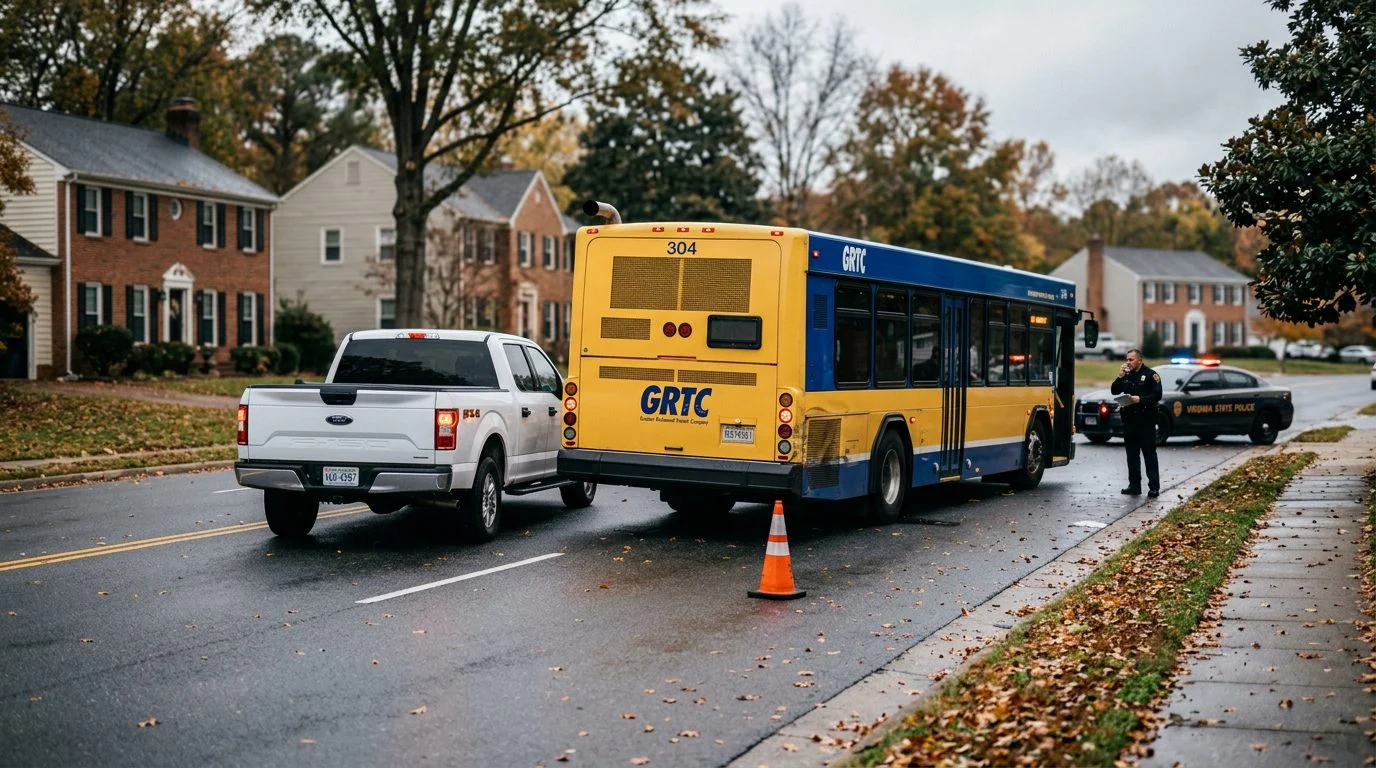
Photograph the scene and the bus while they are still there. Then write down the bus’s identifying details before you leave.
Take wide shots of the bus, its position, the roadway, and any traffic signals or signs. Also photograph skid or debris marks, damage to the bus and damage to your own vehicle, bicycle or clothing. Photograph your visible injuries too, and keep any items that were damaged.
Identifying details matter because a bus may be run by a company, a public agency or a contractor. Record the operating company’s name, the bus or fleet number, route or charter information, and any USDOT number on the vehicle. Federal rules require many commercial vehicles to carry identifying marks (49 C.F.R. § 390.21T).
Collect the names and contact details of witnesses, including passengers on the bus. Write down what you remember while it is fresh: the time of day, the weather, the lights, and what the bus was doing.
Dealing With Insurance and Statements
Several insurers may be involved after a bus crash, and each may reach out to you. The bus operator’s insurer, the driver’s insurer and your own insurer each play a different role.
Adjusters may ask for a recorded statement or ask you to sign papers quickly. You may wish to talk with a lawyer before you give a statement or sign anything. Describe only what you know, and avoid guessing about speed, distance or fault.
Keep a file. Save copies of letters, claim numbers and bills. After each phone call, write the date, the person’s name and what was said.
Who May Be Responsible for a Bus Crash
More than one party may be responsible, depending on the facts. The driver, the bus company, a government agency that runs a public bus, or a maintenance contractor could each be involved.
Public buses, private or commercial buses and school buses can follow different rules, and the parties, insurers and notice steps can differ. Va. Code § 15.2-209 reads: “Every claim cognizable against any county, city, or town for negligence shall be forever barred unless the claimant or his agent, attorney, or representative has filed a written statement of the nature of the claim, which includes the time and place at which the injury is alleged to have occurred, within six months after such cause of action accrued.” Va. Code § 15.2-209 reads: “Failure to provide such statement shall not bar a claim against any county, city, or town, provided that the attorney, chief executive, or mayor of such locality, or any insurer or entity providing coverage or indemnification of the claim, had actual knowledge of the claim, which includes the nature of the claim and the time and place at which the injury is alleged to have occurred, within six months after such cause of action accrued.” Claims against a transportation district carry a one-year notice rule (Va. Code § 8.01-195.6).
Virginia follows contributory negligence: if you are found even partly at fault, you may be barred from recovering, with limited exceptions. Talk to a lawyer about your facts.
Fault is decided on the facts of each crash, and no one can say in advance how it will turn out.
Not sure what your next step is?
Talk it through with Correll Law Firm — we can walk you through how a situation like yours is usually handled and what your options are.

Deadlines to Keep in View
Virginia generally allows two years from the date of injury to file a personal injury lawsuit (Va. Code § 8.01-243(A)); the clock runs from the date of injury, not the date of discovery, with narrow exceptions. Notice rules for claims against public agencies can run out sooner than that.
If a crash causes a death, Virginia’s wrongful death rules apply. A Virginia wrongful death action is filed by the decedent’s personal representative within two years of the death (Va. Code §§ 8.01-50(C), 8.01-244(B)), on behalf of the family members the statute protects. The statutes are at Va. Code § 8.01-50 and Va. Code § 8.01-244.
The firm handles car, truck and commercial vehicle crash cases from its Winchester and Harrisonburg locations. For the wider picture on commercial vehicle crashes, see the Commercial Vehicle Accidents in Virginia guide.
What if the bus driver leaves the scene?
A driver involved in a crash in which a person is killed or injured, or in which an attended vehicle or other attended property is damaged, still has the duty to stop and report it under Va. Code § 46.2-894.
Is a school bus crash handled differently?
It can be. Who operates the bus affects which insurers and notice rules may apply, so write down the operator’s details early.