
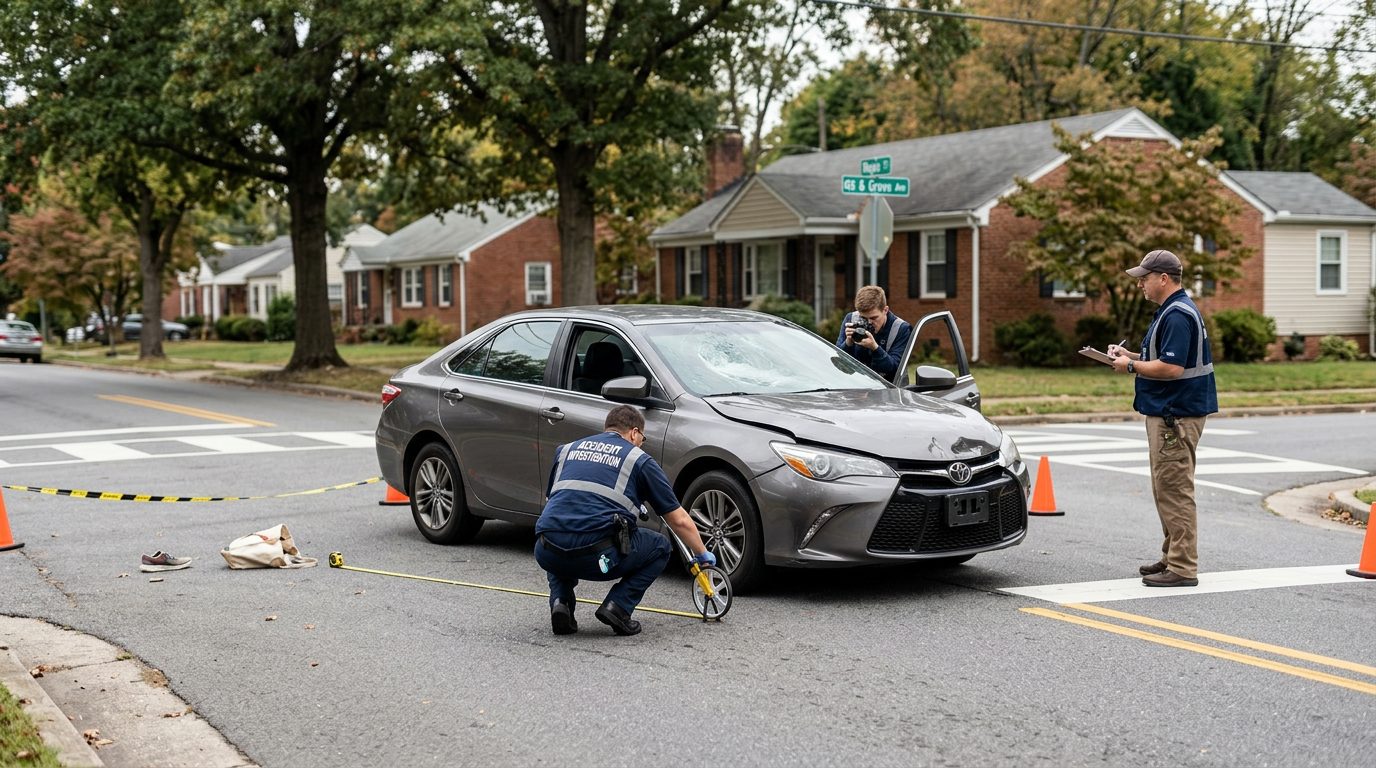
Pedestrian Crashes in Virginia: How Fault Is Judged
Published November 15, 2026
Maybe you were hit while walking, or maybe you were the driver who struck someone on foot. Either way, you may be asking whether you can sue a pedestrian.
Yes. In Virginia, a pedestrian can be sued when their own careless conduct helps cause a crash that injures someone else. The rule also works in reverse, so an injured pedestrian can bring a claim against a driver. This guide explains how fault works, which deadlines matter, and what changes when a truck or bus is involved. For more background, see pedestrian accident claims in Virginia.
Can you sue a pedestrian in Virginia?
Yes. A pedestrian can be a defendant in a negligence claim if their own careless conduct caused the crash and the harm to another person.
A claim asks one main question: did one person’s failure to act with care cause the injury? Walking does not change that question.
The question also runs in the other direction. An injured pedestrian can bring a claim against a driver whose negligence caused the crash.
Crashes rarely have one simple story. Both people may have made choices that mattered. The evidence shows which choices counted.
Not sure what your next step is?
Talk it through with Correll Law Firm — we can walk you through how a situation like yours is usually handled and what your options are.
Common ways a pedestrian can be at fault
A pedestrian’s conduct can matter when it contributes to the crash. Examples a court or jury may weigh include stepping into traffic outside a crosswalk, crossing against a signal, walking into a roadway while impaired, and failing to watch for approaching vehicles. Each one raises the same question: did that conduct help cause the crash?
These are examples, not a checklist. A pedestrian who steps into traffic does not automatically bear the blame. A driver who hits someone in a crosswalk is not automatically at fault either. Each crash turns on its own facts: where the person stepped, what the signal showed, how far away the vehicle was, and whether the driver could have seen the person in time.
Timing often decides the case.
A common mistake is assuming the driver is automatically responsible because the driver had the heavier vehicle. Another is assuming a pedestrian has no claim just because they were in the road.
How fault affects a claim in Virginia
Fault can decide whether an injured person can recover anything in Virginia. Virginia follows contributory negligence: if you are found even partly at fault, you may be barred from recovering, with limited exceptions. Talk to a lawyer about your facts.
Because the rule is strict, the evidence carries heavy weight. Witness statements, the police report, nearby video and vehicle data can all bear on who had the chance to avoid the crash.
Reporting the crash and keeping evidence
The duty to report comes first, and it applies right away. Virginia requires a driver involved in a crash with injury or death to stop and report it to police immediately (Va. Code §§ 46.2-371, 46.2-894).
The same driver duties also call for stopping as close to the scene as possible without blocking traffic, and giving reasonable help to anyone hurt (Va. Code § 46.2-894).
The two-year period discussed below is the deadline to file a lawsuit (Va. Code § 8.01-243). It is not the deadline to report a crash.
Many people who were hurt in a pedestrian crash keep track of a few basic items:
- The police report number
- Photos of the scene, the vehicles and any injuries
- Names and phone numbers of witnesses
- Medical records and bills
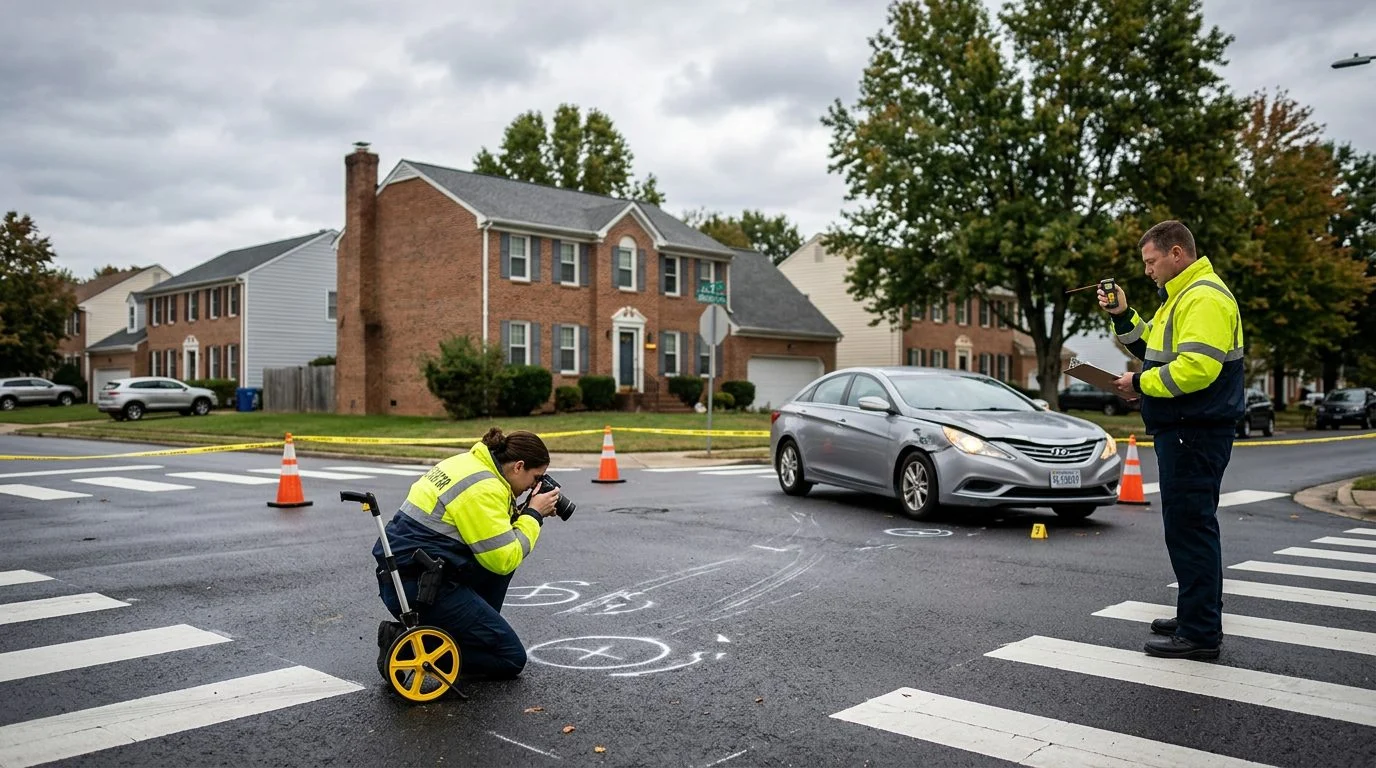
Commercial trucks, buses and school buses
A crash with a commercial vehicle can involve more parties and more records than a car crash. The operator, the employer, and the company that controls the vehicle can each be part of the picture. Registration and carrier information on the vehicle can help identify them.
Federal rules also apply to many commercial drivers. The Hours of Service of Drivers rule governs how long commercial motor vehicle drivers may work and drive. It applies alongside Virginia law.
A pedestrian struck by a school bus raises the same basic questions. A common mistake is treating the bus as a single party when the operator and owner may differ. The firm handles truck accident and commercial vehicle accident claims.
Time limits for a pedestrian injury lawsuit
Virginia generally allows two years from the date of injury to file a personal injury lawsuit (Va. Code § 8.01-243(A)); the clock runs from the date of injury, not the date of discovery, with narrow exceptions.
Some claims carry notice requirements that run out sooner.
Readers should not assume the two-year period fits every claim. Waiting to learn the details can cost time that the notice rules do not allow.
Not sure what your next step is?
Talk it through with Correll Law Firm — we can walk you through how a situation like yours is usually handled and what your options are.
When a pedestrian dies in a crash
When a pedestrian dies, the claim is brought differently than an injury claim. The family’s role is set by statute, and the timing runs from the date of death. A Virginia wrongful death action is filed by the decedent’s personal representative within two years of the death (Va. Code §§ 8.01-50(C), 8.01-244(B)), on behalf of the family members the statute protects.
Virginia wrongful death damages cover the family’s sorrow, mental anguish and loss of the decedent’s companionship, guidance and care; lost income and services; medical expenses from the injury; funeral expenses; and, for willful or wanton conduct, punitive damages (Va. Code § 8.01-52).
Only certain relatives share in any recovery under the statute’s distribution rules, which name the surviving spouse, children of the deceased and children of any deceased child of the deceased first; parents are eligible in that first group only if they regularly received support or services from the decedent within 12 months before the death, but if the decedent left a surviving spouse and parent or parents and no child or grandchild, the award goes to the spouse and the parents; parents, brothers and sisters are next when there is no spouse, child or child of a deceased child, and other relatives share alongside these groups only if they are primarily dependent on the decedent for support or services and are also members of the same household; if none of these survivors exist, the award is distributed in the course of descents under § 64.2-200, and a parent whose parental rights have been terminated by a court or by a permanent entrustment agreement is not eligible (Va. Code § 8.01-53).
Punitive damages in Virginia
Punitive damages are available in Virginia only for a narrow kind of conduct.
Virginia allows punitive damages for actual malice, or for willful or wanton conduct or recklessness showing a conscious disregard for the safety of others, capped at $350,000 (Va. Code § 8.01-38.1).
Ordinary carelessness, even when it causes serious harm, does not fit this standard.